
Livraison le jour même ou le lendemain

Qualité garantie

Débloquez vos offres de bienvenue: Livraison GRATUITE | Jusqu'à -80 % | 30 jours d'essai gratuits à JoyPlus
Téléchargez l'application
Tangled cables behind your desk, standby devices silently draining energy, and the fear of a power surge frying your brand-new computer or TV: these scenarios are likely all too familiar. Organising your workspace or media centre while keeping an eye on your electricity bill is often a real headache.
This guide is here to help you choose the right individually switched power strip for you. We'll break down the essential features to consider—no marketing fluff—to help you find a solution that is practical, safe, and perfectly suited to your needs.
Before diving in headfirst, let's review the criteria that really make a difference. Here are the key points to check to ensure you make the right choice.
While a power strip's primary job is to distribute power, its protective role is just as crucial. A surge protector power strip includes a device that absorbs sudden voltage spikes (caused by lightning or grid fluctuations), thereby shielding the sensitive electronic components of your equipment. For homes with young children, the presence of child safety features (shutters in the socket openings) is essential for peace of mind and preventing household accidents.
The layout of your room will often dictate your choice of power strip.
Individual switches are the core feature of this type of power strip. They allow you to cut power to a specific device without having to unplug everything, which is ideal for tracking down and eliminating standby power consumption. More and more models also include a power strip with USB, allowing you to directly charge your smartphones, tablets, and other gadgets without sacrificing a standard power outlet.
To help you see things more clearly, we've selected a few models that caught our attention, each catering to a specific need.
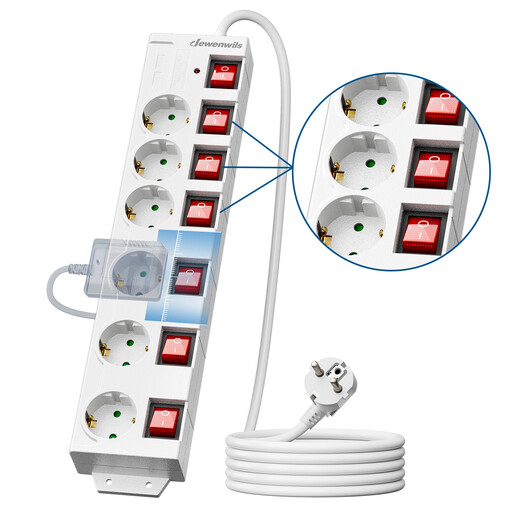
Why this model stands out: The focus here is on flexibility and reach. Its extra-long 5-metre cable makes it the perfect ally for large rooms, offices, or workshops where power outlets are scarce or poorly located.
Key Features:
Who is it for? For those who need to connect equipment far from a wall outlet, whether in a spacious living room, a large office, or a garage.
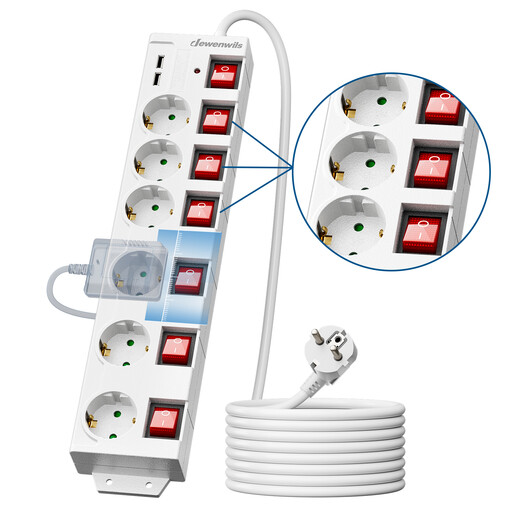
Why this model stands out: This power strip combines the extra-long reach of its 5-metre cable with the convenience of two USB ports. It's the ultimate all-in-one solution for modern work environments.
Key Features:
Who is it for? Ideal for computer setups or TV areas where traditional equipment (monitor, computer) and USB-chargeable gadgets (smartphone, headphones) coexist.
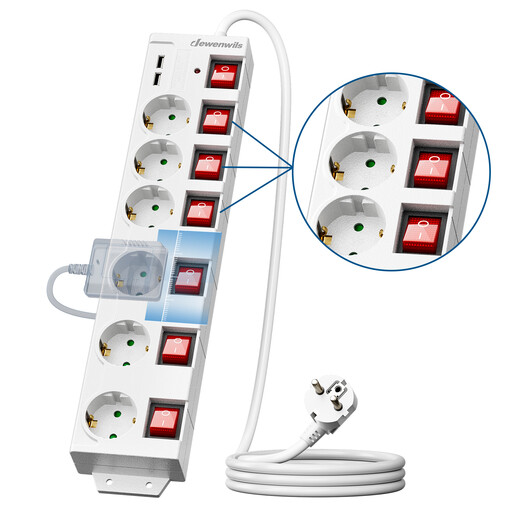
Why this model stands out: A more compact, but equally versatile model. With its 2-metre cable, it's perfect for use on or under a desk, in a kitchen, or near a bedside table, where a longer cable would be more of a hindrance than a help.
Key Features:
Who is it for? For those looking for a complete solution for a defined space (desk, worktop, workbench) without the clutter of unnecessary cable length.
Every setup is unique. If none of these models ticks all your boxes, whether in terms of the number of outlets, cable length, or features, be aware that many other configurations are available.
? Explore our full range of Cable Blocks to discover other options.
Mainly two things: control and energy savings. You can cut power to a single device (charger, printer, games console) when you're not using it, without affecting the others. This is incredibly effective for combating the "phantom load" from devices on standby, which, believe it or not, adds up on your electricity bill at the end of the year.
It's more than recommended—it's practically a must-have if you value your expensive electronic devices (computer, TV, audio system, internet router). A single power surge, even a very brief one, can permanently fry their circuits. A surge protector power strip acts as a shield and can save you from costly repairs, or even from having to buy new equipment altogether.
The rule is simple: measure the distance between the wall outlet and where you plan to place the power strip. Add a safety margin (about 50 cm to 1 m) so the cable isn't pulled taut, which could damage it and create a trip hazard. A 1.5 to 2-metre cable is often sufficient for a desk, while a 3 to 5-metre model will be necessary to cross a room or equip a workshop.