People keeping an eye on their meal’s protein
You want to know how much protein is in the portion you’ll eat, rather than relying on the recipe name mentioning meat, fish or pulses.


To choose an individual frozen meal with protein in mind, compare the grams of protein in the portion you’ll eat, then check the full nutritional information, ingredients and allergens. A range labelled high-protein can make it easier to find suitable options, but the label itself — like the Nutri-Score, if shown — is no substitute for checking the exact product’s packaging.
You want to know how much protein is in the portion you’ll eat, rather than relying on the recipe name mentioning meat, fish or pulses.
You prefer a frozen portion that’s easy to heat up, and check that the cooking instructions suit the appliances you have.
You compare portion size, nutritional values, ingredients and the Nutri-Score, if shown, rather than basing your choice on protein content alone.
For an individual meal, start with the amount you’ll actually eat: a value given per 100 g won’t necessarily tell you how much is in your portion.
| Criteria | What to check | Who it matters to |
|---|---|---|
| Protein in your meal | Compare the grams of protein in the portion you’ll eat. If the label only gives a value per 100 g, take the weight of your portion into account. | If I’m eating the whole tray, I want to know how much protein is in my meal, not just the amount per 100 g. Around 42% of consumers make this a priority. |
| What’s in the meal | Check the nutritional values, ingredients and allergens. Use the Nutri-Score as an additional guide, if shown. | I want to look beyond the protein content, especially when there are ingredients I need to avoid. For around 33% of consumers, this is the top priority. |
| Format and preparation | Check the number of portions and the heating instructions for the exact product. | When I’m short on time, I look for a portion I can prepare with the equipment I have. This is a priority for around 25% of consumers. |
A name that mentions chicken, fish or pulses won’t tell you how many grams of protein are in the portion you’ll eat.
Check the ‘protein’ line in the nutritional information and the weight of your portion.
According to Santé publique France, the Nutri-Score makes nutritional information easier to understand. On its own, it won’t tell you how much protein is in your portion or list the allergens.
Use it alongside the product’s nutritional values and ingredients list.
The DGCCRF advises that a rise in temperature speeds up microbial growth.
Pick up frozen food towards the end of your shop, use an insulated bag if possible and put it in the freezer promptly, following the instructions on the packaging.
Picard has a High-Protein range that can help you find recipes suited to what you’re looking for.
Auchan has a selection of individual frozen ready meals, with a range of recipes to choose from.
Carrefour offers frozen ready meals in a range of formats.
E.Leclerc DRIVE offers frozen food through local services, including drive-through or walk-up collection.
Lidl lists a category for frozen ready meals.
ALDI has a frozen food range.
This selection features frozen breaded poultry portions that you can use to put together an individual meal; they are not complete ready meals. The amount of protein in your meal depends on the portion you actually eat.
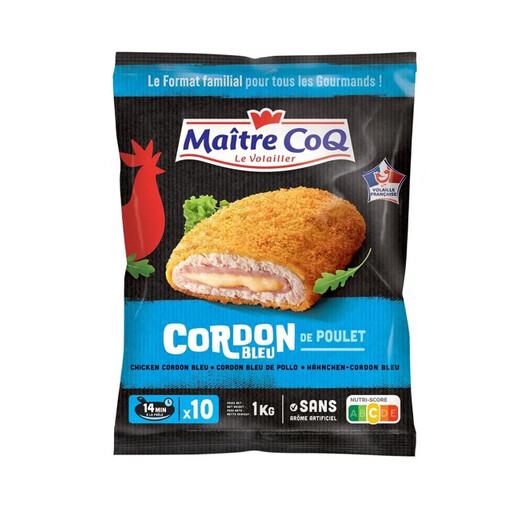 Image unavailable
These frozen portions can be part of an individual meal; one piece may not be enough to make a complete meal.
Pack of 10, total weight 1 kg. Check the weight of the portion you’ll eat, its protein content, allergens and cooking instructions on the packaging.
Compare the grams of protein in the portion you plan to eat. Values per 100 g are useful for comparing products on the same basis, but you should also consider the weight you’ll actually eat.
No. The Nutri-Score is an additional guide and doesn’t replace checking the protein content per portion. Also look at the other nutritional values, ingredients and allergens.
Keep the time between buying it and putting it in the freezer to a minimum, and use an insulated bag for the journey if possible. The DGCCRF advises that a rise in temperature speeds up microbial growth; follow the storage instructions on the packaging.
No. Only use a microwave if the product’s instructions say you can. Different appliances and recipes need different cooking instructions, so check the packaging before heating.