
Livraison le jour même ou le lendemain

Qualité garantie

Débloquez vos offres de bienvenue: Livraison GRATUITE | Jusqu'à -80 % | 30 jours d'essai gratuits à JoyPlus
Téléchargez l'application
An impromptu aperitif, an evening with friends or a whisky served at home can sometimes expose the limitations of your freezer: the ice runs out just when you need it most. A countertop ice maker can solve the problem, provided you look beyond the promise of rapid ice production.
When buying, certain pitfalls come up time and again:
For the home, office or motorhome, a portable ice maker capable of producing around 8 to 9 ice cubes in 6 to 10 minutes may be sufficient if you use them as they are made. For a party or home bar, an advertised output of 10 to 12 kg of ice per day gives you more leeway.
However, you need to distinguish between three pieces of information:
The description « 12 kg per day ice maker » generally refers to an estimated output over 24 hours under specific conditions. It does not mean that the basket will remain full at all times. Ice also starts to melt if the appliance does not have a genuine freezing system.
A 1.2 to 2.2-litre water tank means you will not need to refill it too often for everyday use. Indicators showing a low water level or a full basket are also very useful: they save you from having to keep an eye on the machine constantly.
For a family or a gathering, a large tank provides welcome convenience. When travelling, however, weight, the handle and the amount of space it takes up may matter more than maximum capacity. A compact ice maker must also remain completely stable on a flat, dry surface.
Two ice cube sizes allow you to adapt production to soft drinks, cocktails or spirits. Smaller cubes chill a drink quickly, while larger ones take up more space in the glass. This is therefore a choice based on how you use the ice, not a guarantee that the drink will stay cold for longer.
A self-cleaning ice maker makes maintenance easier, but a few precautions are still essential:
A supplied ice scoop makes serving easier and prevents you from touching the ice directly with your hands. If the appliance uses a flammable refrigerant such as R600a, never pierce or modify the cooling circuit in any way.
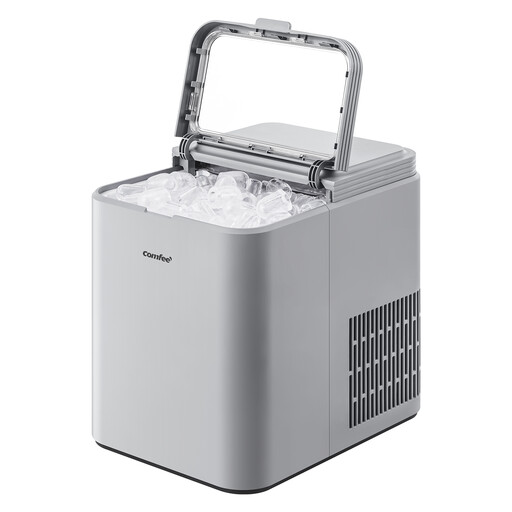
Why this model suits this profile : Its countertop format and simple controls make it a good first ice maker for the home, office or motorhome.
The indicators show when the water is low and when the basket is full. Advertised output reaches up to 12 kg in 24 hours, but storage capacity is limited to 0.4 kg.
Two ice cube sizes, an advertised cycle of 8 cubes in 6 minutes, a 1.3-litre tank, self-cleaning and a supplied scoop.
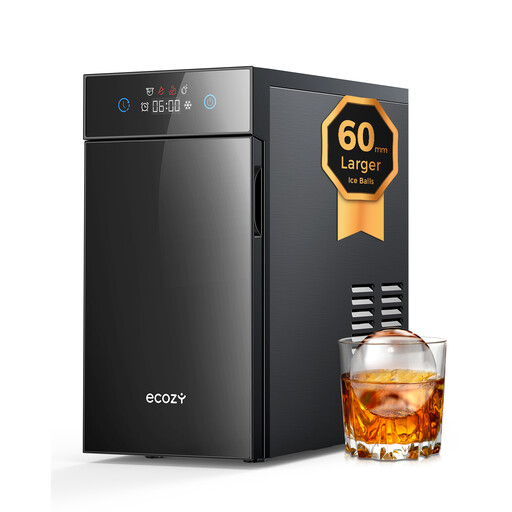
Why this model suits this profile : It is designed for whisky and bourbon enthusiasts looking for 60 mm ice spheres to serve their spirits at home.
It does not promise a high output of standard ice cubes: its advertised cycle produces one sphere in 40 minutes, for a maximum of 32 spheres per day. Its positioning is therefore clearly specialised.
LED touchscreen, 8-hour timer, self-cleaning function, 0.85-litre tank and supplied storage box.

Why this model suits this profile : With its 3.2-litre tank and advertised capacity, it is suitable for frequent entertaining, home bars and uses requiring several batches.
The product details distinguish between the first 13-minute cycle for 24 ice cubes, the tank and the basket. This information helps you assess real-world use, rather than relying solely on the advertised daily capacity.
3.2-litre tank, supplied basket and scoop, self-cleaning function, and a stainless steel and plastic design.
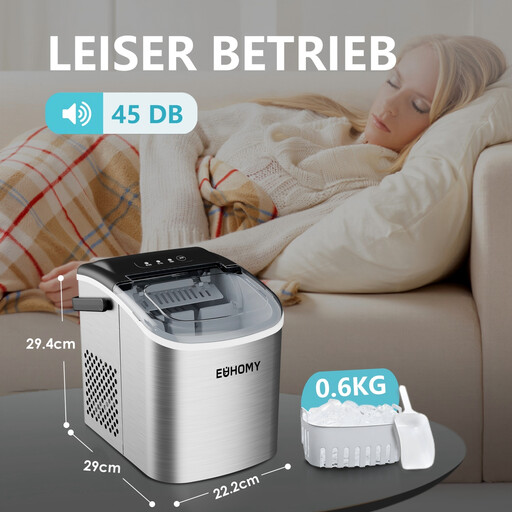
Why this model suits this profile : Its handle, compact design and advertised output make it suitable for the kitchen, office or occasional use while travelling.
The product details specify that it works with drinking water only, must be properly ventilated and should be left upright before being switched on for the first time.
9 ice cubes in 6 minutes, output of up to 12 kg in 24 hours, two sizes, self-cleaning, and supplied basket and scoop.
We have selected a complete, real-time updated list of products that meet these demanding criteria as well as European safety standards.
The cost mainly depends on the electrical power, operating time, ambient temperature and electricity price. To estimate it, multiply the power in kilowatts by the operating time, then by your tariff per kilowatt-hour. The advertised capacity in kilograms is therefore not enough to determine electricity consumption.
After transportation, some manufacturers recommend leaving the appliance upright for several hours to allow the refrigerant and compressor to stabilise. The exact duration is given in the instructions. Then install the machine on a flat surface, leaving enough space around the vents.
Yes. Run the self-cleaning function when available, then empty and rinse the tank in accordance with the manufacturer's instructions. Also clean the basket, scoop and accessible parts. Using drinking water and storing the appliance in a dry place between uses helps maintain its proper operation.