
Livraison le jour même ou le lendemain

Qualité garantie

Débloquez vos offres de bienvenue: Livraison GRATUITE | Jusqu'à -80 % | 30 jours d'essai gratuits à JoyPlus
Téléchargez l'application
Summer is approaching, and with it, patio drinks, barbecues, and the simple pleasure of an ice-cold beverage. But this idyllic picture often hits a familiar snag: running out of ice. Traditional trays are slow and inconvenient, and bags from the supermarket take up precious space in an already overstuffed freezer. The countertop ice maker emerges as the perfect solution. But with so many misleading marketing claims, how do you navigate your options?
As a product recommendation expert at Joybuy, my mission is to help you decode the spec sheets to make a truly informed choice. Let's cut through the jargon and focus on what's essential. Here are the pitfalls to avoid and the criteria that really matter for finding the perfect machine for you.
The market is flooded with models that look perfect on paper. But be wary: certain design flaws or exaggerated marketing claims can quickly turn your investment into a disappointment.
To avoid these traps, focus on these few objective characteristics. They will give you a clear idea of the performance and ease of use of the model you're considering.
This is the number one criterion: production capacity, always expressed in kg/24h. A 12kg per day ice maker is an excellent benchmark for family use or parties with friends. This is equivalent to about 500g of ice per hour, enough to serve a dozen people without interruption. Also, remember to check the size of the water reservoir: with more than 1.2L, you won't have to refill it every five minutes.
The word "compact" is highly subjective. Before you pull out your credit card, take out a tape measure and check the available space on your countertop. A countertop ice maker should fit in without overwhelming the space. Check the exact dimensions (L?x?W?x?H) and remember to leave a few centimetres around it for ventilation. If you plan to move it from the living room to the garden, opt for a portable ice maker with handles and a manageable weight.
Versatility often makes the difference. Some models offer two ice cube sizes: small ones, perfect for chilling a soda in a flash, and larger ones, which melt slowly and are ideal for cocktails and spirits. We can't stress this enough: the self-cleaning function is essential. It radically simplifies maintenance and guarantees impeccable hygiene, all at the touch of a button.
To help you see how these criteria apply in practice, here are some typical user profiles and the models that suit them.
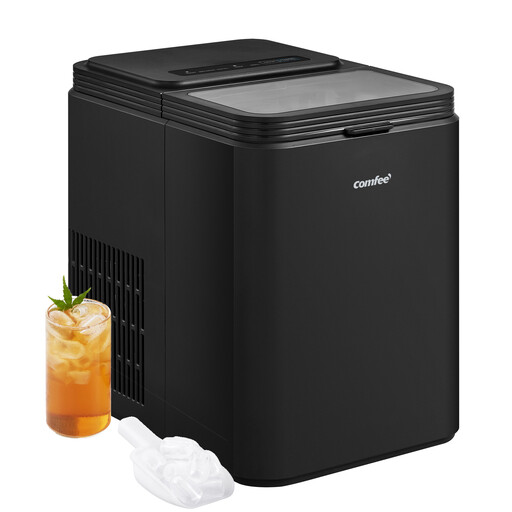
The ideal user: Perfect for impromptu get-togethers and family meals. This machine meets the need for spontaneity by producing ice on demand, with no planning required. Its understated black design and compact dimensions allow it to blend into any modern kitchen decor.
It avoids the "false speed" trap with clear, honest figures: first ice cubes in 6 minutes and a real-world capacity of 12 kg per day. The self-cleaning function checks the essential hygiene box.
Its strength? The combination of fast production and the choice between two ice cube sizes for maximum versatility. The removable ice basket and included scoop make serving a breeze.
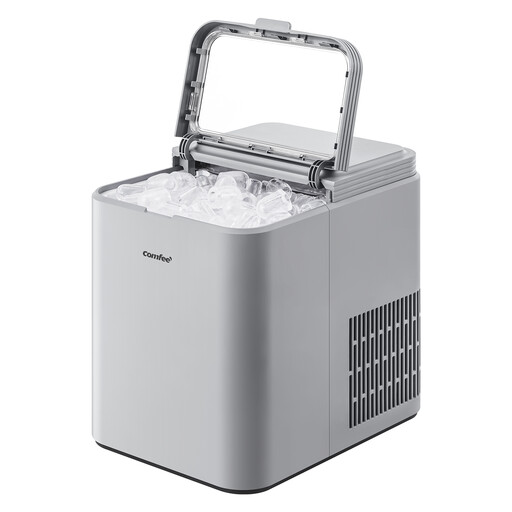
The ideal user: For those who run on cold drinks all day (iced coffee, tea, water). Its grey colour and 29.6 x 21.3 x 29.5 cm dimensions make it a discreet appliance, designed to sit permanently on a countertop or in an office.
It addresses the space constraint by listing precise dimensions, allowing you to plan its placement. For daily use, the self-cleaning function is a major selling point, ensuring perfect, hassle-free hygiene.
Its main advantage for heavy use is its ease of maintenance, thanks to the automatic cleaning cycle. The continuous output of 12 kg/24h ensures a permanent supply of ice, so you never have to think about freezer trays again.
We have curated a full range of products that meet our strict selection criteria and European safety standards.
1. What is the lifespan of a countertop ice maker? It all depends on usage and maintenance. A well-maintained model that is cleaned regularly (thanks to the self-cleaning function!) and used with filtered water to limit limescale can operate flawlessly for many years.
2. Does an ice maker use a lot of electricity? Generally, no. An ice maker operates in short cycles, not continuously like a refrigerator. Its consumption is comparable to that of a small home appliance. It can even be more energy-efficient than constantly opening your freezer, an action that forces the compressor to run at full blast to restore the temperature.
3. Can you leave water in the reservoir permanently? That's a very bad idea for hygiene reasons. It is strongly advised not to let the same water stagnate for more than 24 hours. If you don't use the machine daily, empty the reservoir and let it dry. For daily use, make it a habit to change the water every morning.