
Livraison le jour même ou le lendemain

Qualité garantie

Débloquez vos offres de bienvenue: Livraison GRATUITE | Jusqu'à -80 % | 30 jours d'essai gratuits à JoyPlus
Téléchargez l'application
Serving ice cream or sorbet seems simple… until the day the scoop bends, gets stuck in the tub or produces uneven portions. At home, for a gathering or in a food service setting, the right utensil directly affects serving speed and the presentation of your desserts.
However, some marketing claims should be treated with caution. An ice cream scoop described as “professional” is not necessarily designed for intensive use, while a very wide scoop may be impractical for creating attractive, evenly sized scoops. Here are the key points to consider before placing your order.
An ice scoop generally has a wide, open head. It is used to move ice cubes, pellets or large quantities of product. However, it is not necessarily designed to create evenly shaped scoops.
An ice cream scoop, often equipped with an ergonomic handle or an ejection mechanism, is designed to serve round portions of ice cream, sorbet or gelato. Before buying, check the shape of the head and the movement it is designed for.
Stainless steel generally offers better resistance to moisture and is easy to clean, but not all utensils are made to the same standard. Look at the proportion of stainless steel, the rigidity of the head, the quality of the joins and whether the handle contains plastic.
A stainless steel ice cream scoop with a plastic handle may be comfortable to hold, but it will often need to be washed by hand. Check the manufacturer’s dishwasher recommendations before using it.
Ice cream stored at a very low temperature is inevitably more difficult to portion. A lightweight utensil may be sufficient for occasional use, but it can quickly reach its limits during repeated serving. Conversely, a head that is too large may tire your hand and produce excessively generous portions.
For a family-sized tub, prioritise manoeuvrability. In a bar, restaurant or ice cream parlour, focus instead on durability, handling comfort and ease of maintenance.
For a utensil intended for ice cream and sorbet, look for a smooth surface without awkward corners that are difficult to clean. Stainless steel is valued for its resistance to corrosion and simple maintenance. The term 304 stainless steel, when clearly stated, refers to a grade commonly used for kitchen utensils. However, it does not replace the need to follow washing and drying instructions.
Materials intended for food contact should be accompanied by traceability and usage information suitable for the European market. For a manual utensil, CE marking is not systematically mandatory, as it may be for certain electrical appliances. The product listing, the contact details of the manufacturer or of the responsible person established in the European Union, and the warnings should therefore all be checked.
A narrow head enters a compact tub more easily, while a wide head speeds up the transfer of ice cream or ice cubes. Weight is also important: a model weighing around 70 grams may be pleasant to use at home, whereas a more robust model will be better suited to repeated use.
In particular, check:
An ergonomic ice cream scoop should provide a secure grip, without uncomfortable edges or a mechanism that could jam. A non-slip handle can make all the difference when your hands are wet or during prolonged service.
After use, rinse off sugary residue, clean the utensil with a soft sponge, then dry it thoroughly. Avoid abrasive products and impacts against hard surfaces. For models combining plastic and metal, hand washing is often preferable unless the manufacturer states otherwise.
The models below are designed for different needs. Your choice depends on how often you use it, the type of dessert you serve and how important portion control is to you.
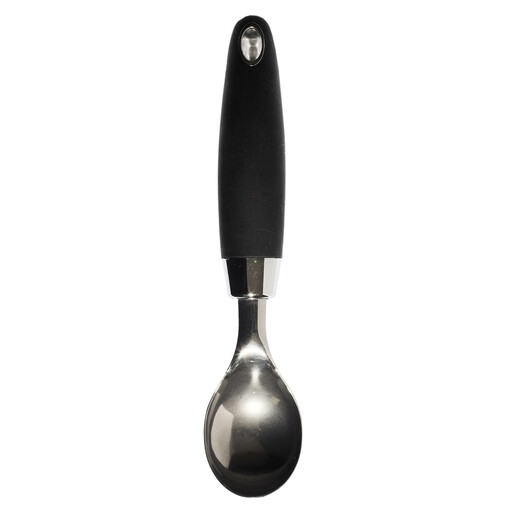
Why this choice suits this profile : At 21.5 cm long and fitted with a non-slip handle, this model is suitable for family use or occasional dessert preparation.
Its composition is clearly detailed : 60 % plastic and 40 % stainless steel. You therefore will not mistake the utensil for one made entirely from stainless steel.
Stainless steel head, non-slip handle and stated weight of 70 g. Hand washing recommended.
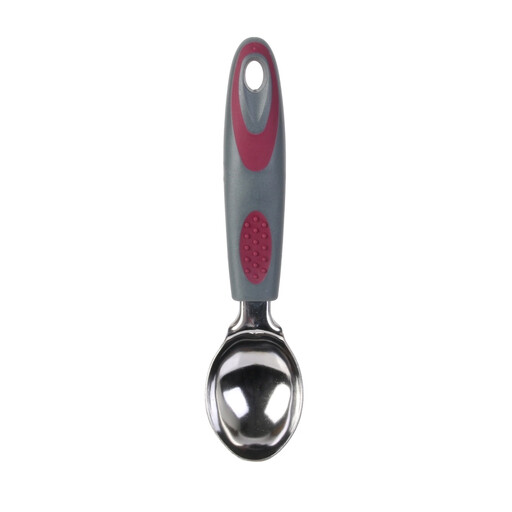
Why this choice suits this profile : Its stainless steel body and grey finish enhanced with burgundy details will fit perfectly into a kitchen where the utensil needs to be as presentable as it is functional.
The head releases after a rotation, helping to prevent portions from sticking to the utensil.
Stainless steel, an ergonomic grip and designed for use with ice cream, sorbet, gelato and certain moulded preparations.
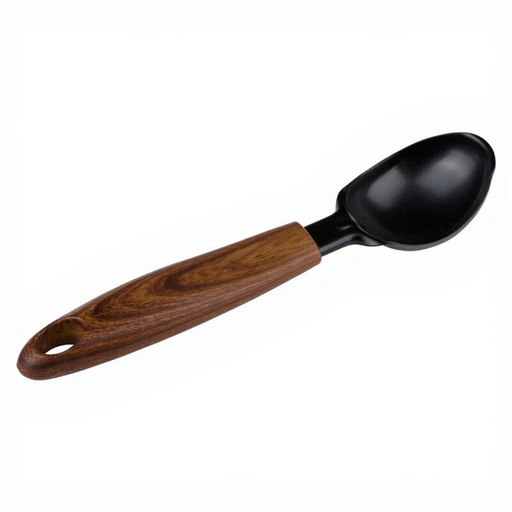
Why this choice suits this profile : Its 24 × 19 cm head is designed to move large volumes, particularly in a bar, commercial kitchen or at a reception.
Its clearly stated size helps you avoid choosing a small ice cream scoop for a transfer task. However, reserve it for situations where perfectly even individual scoops are not the priority.
Stated weight of 65 g, ergonomic handle and construction combining wood and stainless steel. It can also be used for certain loose products.
The service life of an ice cream scoop depends mainly on how often it is used, the hardness of the ice cream and the quality of its care. To preserve both a professional model and a household utensil:
An ice cream scoop with an ejection mechanism should not be used as a shovel to move ice cubes. Similarly, a high-capacity scoop is not necessarily suitable for preparing individual portions.
Allow the ice cream to soften slightly, then moisten the head with lukewarm water if the manufacturer’s instructions allow it. Push the scoop in, rotate it smoothly, then place the portion in the bowl or cone. Avoid very hot water, which could alter the texture of the dessert or damage certain handles.
Not necessarily. A fully metal model may sometimes be dishwasher-safe, but this must be confirmed by the manufacturer. Utensils with a plastic handle, mechanism or decorative finish are often designed to be washed by hand. Always check the instructions and dry the scoop after cleaning.
An ice cream scoop is designed to portion ice cream and give it a rounded shape. An ice scoop is mainly used to move or transfer larger quantities. The right choice therefore depends on your priority: individual presentation, transfer speed or versatility for a bar, reception or professional kitchen.