
Livraison le jour même ou le lendemain

Qualité garantie

Débloquez vos offres de bienvenue: Livraison GRATUITE | Jusqu'à -80 % | 30 jours d'essai gratuits à JoyPlus
Téléchargez l'application
A newborn's skin is extremely delicate and permeable. Caring for their laundry thus becomes a top priority for parents. But with store shelves overflowing with promises, it's easy to feel lost. The goal? To get soft laundry, of course, but above all, to do it safely, without exposing your baby to potentially irritating substances.
However, beware of marketing traps that can mislead you. Knowing how to avoid them is the first step toward making a truly informed choice.
natural baby fabric softener can contain botanical fragrances that, while natural, are poorly tolerated by sensitive skin.To protect your child's skin, forget the marketing slogans and focus on what matters: objective criteria. Here are the points to check before you buy.
A short, understandable ingredient list is often a good sign. Your mission: to hunt down unnecessary or risky components. Pay close attention to the 'free from skin allergens' claim, which guarantees the absence of substances listed as allergenic by European regulations. A true hypoallergenic baby fabric softener must be free of:
The effectiveness of a good softener can be undermined by a harsh detergent. For optimal protection, the ideal approach is to pair a baby detergent and softener that share the same formulation philosophy: hypoallergenic, free from controversial substances, and tested on sensitive skin.
Every family has different needs. Here are our recommended options, chosen for their formulas tailored to delicate skin, based on distinct user profiles.
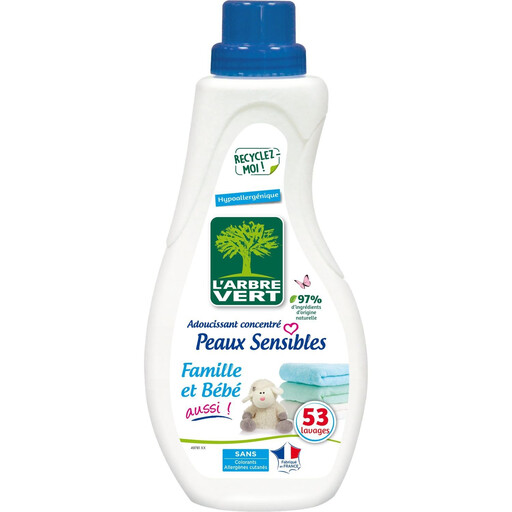
Why we recommend it: Specifically designed for the highly sensitive skin of infants, this softener prioritises maximum safety. Its French manufacturing and 97% natural origin ingredient composition make it a trusted choice for parents who make no compromises on ingredients.
Its formula is free from dyes, MIT, and is explicitly free of listed skin allergens. It goes beyond simply being 'natural' by guaranteeing high tolerance.
Hypoallergenic formula designed to minimise allergy risks, ideal from a baby's very first days.
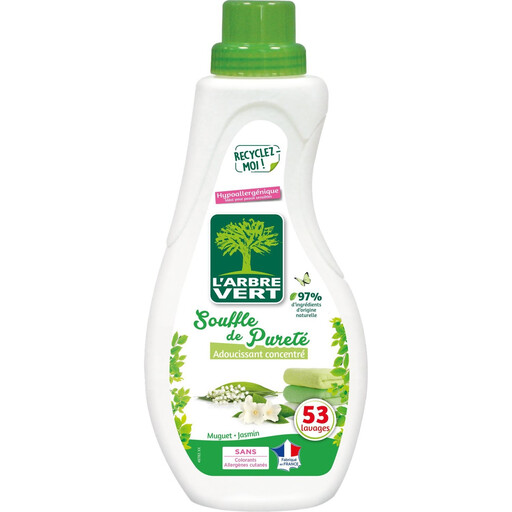
Why we recommend it: Ideal for families with older children or anyone with sensitive skin who doesn't want to give up delicately scented laundry. This `L'Arbre Vert softener`, suitable for the whole family, balances olfactory pleasure with a high-tolerance formula.
The fragrance is specifically designed to be hypoallergenic. The formula is free from dyes and isothiazolinone-type preservatives, thereby eliminating the most common sources of irritation.
The EU Ecolabel certification guarantees a reduced environmental impact, all within a hypoallergenic formula suitable for the whole family.
Find our complete selection of products that meet our strict selection criteria and current safety standards.
You can use a fabric softener from birth, provided it is specifically formulated for babies. This means it must be hypoallergenic, dermatologically tested, and ideally, free from fragrances and dyes. Always ensure the label confirms its suitability for infant skin.
Not necessarily. The term 'natural' is not a guarantee of safety for atopic or very sensitive skin. Some natural ingredients, like plant extracts or essential oils, can be allergenic. Rely on the 'hypoallergenic' criterion and an ingredient list free from known allergens rather than just the 'natural' claim.
It's not mandatory, but it's often good practice. Brands typically design their baby detergent and softener ranges to work in synergy. Using products from the same hypoallergenic line ensures consistency in formulation and reduces the risk of mixing components that could interact or compromise the benefits of each product. The main thing is that both products, individually, are impeccable for a baby's fragile skin.