
Livraison le jour même ou le lendemain

Qualité garantie

Débloquez vos offres de bienvenue: Livraison GRATUITE | Jusqu'à -80 % | 30 jours d'essai gratuits à JoyPlus
Téléchargez l'application
A newborn's skin, being particularly thin and permeable, is a literal sponge. This makes it far more vulnerable to irritation. Choosing the right hypoallergenic baby detergent isn't just a minor detail—it's a crucial step for your baby's well-being. But here's the problem: faced with shelves overloaded with marketing promises, it's easy to feel lost. As a product expert at Joybuy, my mission is to help you see things more clearly. Let's decipher the labels together to avoid the common traps and make the right choice.
Before you even start comparing bottles, it's essential to know how to spot common misconceptions and misleading marketing claims.
To stop choosing at random, focus on objective and verifiable criteria. Here are the three points to scrutinise before any purchase.
Forget the slogans—look for official labels. The EU Ecolabel certified detergent is an excellent benchmark. This label not only guarantees a reduced environmental impact but also imposes strict criteria on the exclusion of many substances of concern to health, making it a relevant choice for an allergen-free detergent.
A short ingredient list is often a good sign. Make sure the detergent is free from the highest-risk components for reactive skin:
The liquid detergent refill format is a win-win. On one hand, it's more ecological, using significantly less plastic than a new bottle. On the other, it's often more economical per litre, allowing for long-term savings—a significant point for a family detergent.
To put theory into practice, here is our selection of products that tick all the boxes, based on the objective criteria we've just discussed.
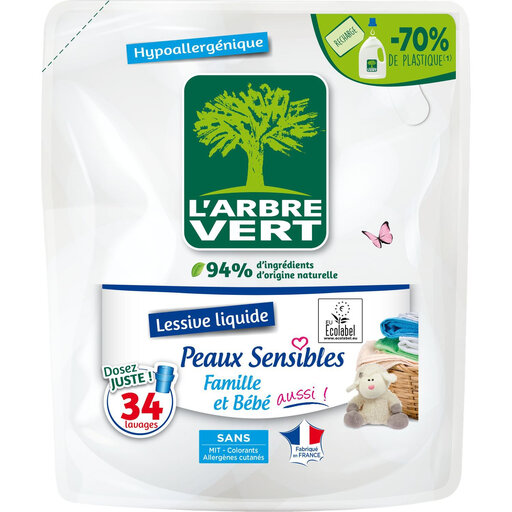
Why we love it: This refill ticks all the boxes for a family concerned about its impact and skin health. It's designed for everyone's laundry, including the baby's, and its format reduces plastic use by 70% compared to a standard bottle.
No empty promises here. Its formula is EU Ecolabel certified and guaranteed free of MIT and listed skin allergens. It's completely transparent.
A single detergent for the whole family, made in France, with a hypoallergenic formula and a practical, eco-friendly refill format.
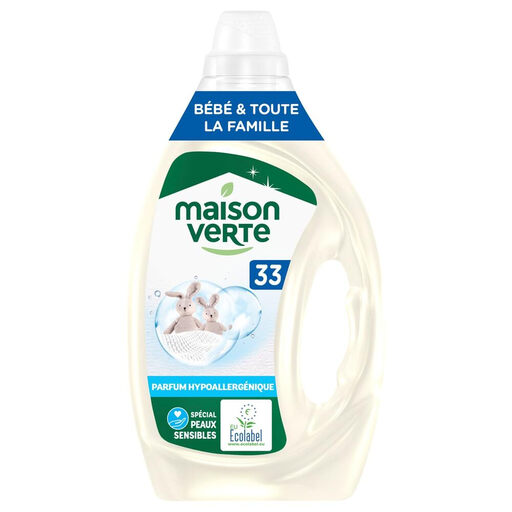
Why we love it: Ideal for those who want to combine effective cleaning with energy savings. Its formula is designed to work from 20°C, which is perfect for lightly soiled baby clothes, while still tackling tougher stains thanks to its 5-enzyme complex.
Its effectiveness doesn't just rely on a "baby" sticker but on a solid technical feature: its 5-enzyme complex. It is also EU Ecolabel certified and MIT/BIT-free.
Excellent washing performance even in cold water (from 20°C), which preserves delicate textiles and reduces your electricity bill.
Explore our full selection of skin- and eco-friendly detergents that meet our strict selection criteria.
To wrap up, here are the answers to the questions you ask most often.
For everyday laundry (pyjamas, clothes), a 30°C or 40°C cycle is generally sufficient, especially with a modern detergent that's effective at low temperatures. For more heavily soiled items like bibs, underwear, or in case of illness, a 60°C wash is recommended to eliminate bacteria, provided the garment's care label allows it.
Our advice: skip it. Fabric softeners deposit softening agents and fragrances on fibres that can be a source of irritation for a newborn's sensitive skin. A good hypoallergenic baby detergent will leave the laundry soft enough. If you have very hard water that makes laundry feel rough, a splash of white vinegar in the softener compartment is a great natural alternative. Just remember to check compatibility with your washing machine.
The two often complement each other but are not synonymous.
The holy grail? A detergent that combines both, like the L'Arbre Vert sensitive skin detergent, which is both hypoallergenic and EU Ecolabel certified.