
Livraison le jour même ou le lendemain

Qualité garantie

Débloquez vos offres de bienvenue: Livraison GRATUITE | Jusqu'à -80 % | 30 jours d'essai gratuits à JoyPlus
Téléchargez l'application
A hydraulic car jack makes it easier to change a wheel, inspect the chassis or carry out routine maintenance. However, a stated capacity in tonnes alone is not enough to guarantee a safe choice. Ground clearance, the lifting point and the stability of the ground are just as important.
Here are the main pitfalls to avoid before buying, along with a selection of models suited to different uses.
A 2-tonne car jack does not necessarily lift the entire vehicle. When just one wheel is raised, only part of the vehicle’s weight rests on the jack. You must nevertheless take account of the vehicle’s total weight, its load and a sufficient safety margin. Check the maximum authorised mass shown on the vehicle registration certificate and never exceed the rated load specified by the manufacturer.
A jack that is too tall may not fit under a lowered car or a vehicle with a flat tyre. In this situation, an extra-low jack, with a minimum height of between 85 and 105 mm, is much more practical. Conversely, an SUV, van or motorhome will often require a greater lifting height.
A hydraulic trolley jack or hydraulic bottle jack is designed to lift the vehicle, not to support it on its own during repairs. Once the vehicle has been raised, fit axle stands suitable for the support points specified by the manufacturer. Work on a hard, level and clear surface, apply the parking brake and chock the opposite wheels.
For a city car or saloon, a capacity of 1.8 to 2.5 tonnes may be suitable for many domestic uses, provided you check the vehicle’s specifications. SUVs, leisure vehicles and vans may require a jack rated at 3 tonnes or more. Motorhomes, heavy goods vehicles and industrial equipment fall into a different category, with vertical models rated at 6 or 10 tonnes, for example.
A jack for an SUV should therefore not be chosen solely according to its capacity in tonnes. Maximum height, saddle width and the stability of the base also deserve your full attention.
Measure the distance between the ground and the lifting point when the vehicle is loaded in its usual configuration. Compare this measurement with the jack’s minimum height. Then check that the maximum height is sufficient to lift the wheel clear or free the part that needs replacing.
Specifications such as “85–380 mm”, “105–350 mm” or “150–530 mm” indicate the lifting range, not a height that can be used in every situation. The contact point must remain correctly positioned throughout the operation.
A steel frame is generally suitable for regular use in a garage, while an aluminium-alloy model focuses primarily on being lightweight. Swivel castors make a garage jack easier to move, but they cannot compensate for an unstable surface.
For the models concerned, look for clearly documented CE marking and compliance with the EN 1494 standard. This information should appear on the product page or in the documentation provided. It does not remove the need to follow the instructions, maximum load and safety guidelines. A safety valve, non-slip saddle and sufficiently wide base are also important features to examine.
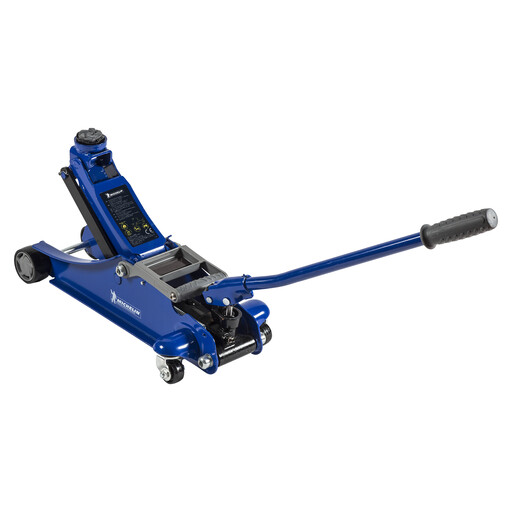
Why this choice suits this profile : Its 1,800 kg capacity and 105 to 350 mm lifting range suit many passenger cars, whether you are changing a wheel or carrying out routine maintenance.
The minimum height is clearly specified, making it easier to compare with your car’s lifting point. The universal rubber saddle helps protect this contact area.
Swivel castors, a 360° rotating handle, magnetic nut storage and a comfortable grip.
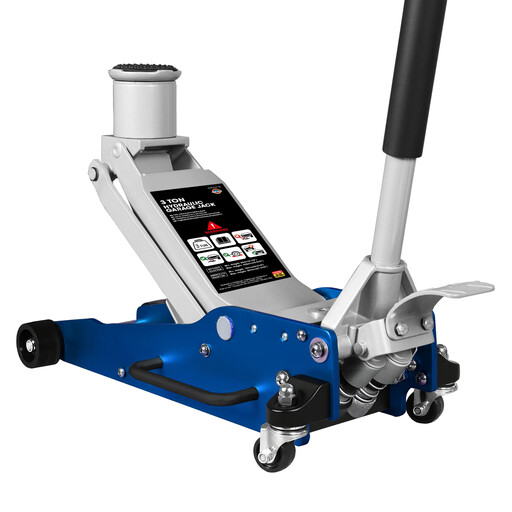
Why this choice suits this profile : This model is aimed at users looking for a 3-tonne capacity, low access height and easier handling thanks to its aluminium-alloy construction.
With an access height of 85 mm, it reduces the risk of incompatibility with a low car. The product page also mentions CE and EN 1494 standards: check the documentation provided before first use.
85 to 465 mm lifting range, extension up to 541 mm, double pump and a 3-tonne rated capacity.
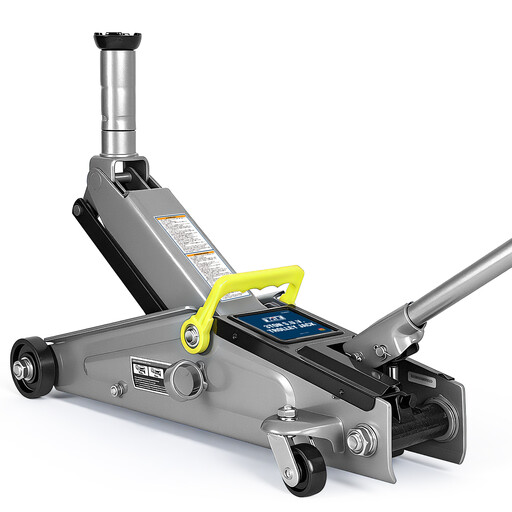
Why this choice suits this profile : Its 150 to 530 mm lifting range suits vehicles with higher lifting points, including certain cars, SUVs and MPVs.
The product page mentions an overload safety valve. However, this does not allow you to exceed the specified 3-tonne capacity.
Steel construction, horizontal lifting, 3-tonne capacity and CE marking mentioned in the product description.
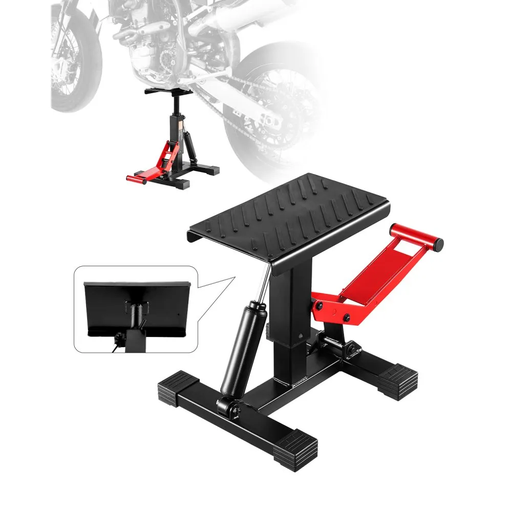
Why this choice suits this profile : This hydraulic motorcycle lift is designed for motorcycle and quad owners. It has a stated capacity of 544 kg and a lifting height of between 250 and 465 mm.
Its intended use is clearly two-wheeled vehicles and all-terrain vehicles. This avoids misusing a car jack whose saddle would not be suitable.
544 kg capacity and 250 to 465 mm lifting range, to be compared with the weight and geometry of your motorcycle or quad.
We have put together a comprehensive, real-time updated selection of products that meet these demanding selection criteria and European safety requirements.
The jack’s service life depends on how often it is used for lifting, the load it supports, storage conditions and maintenance. A leak, uneven lowering or a deformed base should result in the equipment being taken out of use immediately.
Compare the vehicle’s weight, the height of the lifting point and the space available in the boot. A model rated at 1.8 to 2.5 tonnes may suit many passenger cars. Extra-low models are particularly suitable for vehicles with limited ground clearance.
Yes, provided that its capacity, maximum height and saddle shape are compatible with the vehicle. For a heavy SUV, pick-up or van, also consider models rated at 3, 6 tonnes or more. For a motorhome, check the manufacturer’s data and the load distribution before starting to lift.
For normal use, a manual hydraulic jack requires neither electricity nor any particular consumables. Potential costs mainly involve maintenance, replacing the hydraulic fluid or replacing worn parts. The actual cost therefore depends primarily on build quality, frequency of use and compliance with the permitted load.