
Livraison le jour même ou le lendemain

Qualité garantie

Débloquez vos offres de bienvenue: Livraison GRATUITE | Jusqu'à -80 % | 30 jours d'essai gratuits à JoyPlus
Téléchargez l'application
Changing a wheel, inspecting the underside of a vehicle or carrying out a minor mechanical repair requires suitable lifting equipment. However, choosing a hydraulic car jack is not simply a matter of relying on the capacity shown on the packaging. The vehicle’s weight, ground clearance, lifting points and overall stability all need to be compatible.
A poorly chosen model may not fit under a low car, may not provide enough height for an SUV or may be awkward to store in the boot. Here are the key criteria to consider before buying, followed by a selection of models suited to different uses.
A 3-tonne car jack is not designed to lift the entire vehicle in one go. It will generally lift one side, or even just one lifting point. The actual load it supports therefore depends on the distribution of the vehicle’s weight and the position of the jack.
To maintain a reasonable safety margin, check your car’s total weight on its registration document or in its documentation, then choose a device whose capacity is clearly suitable. Heavy SUVs and light commercial vehicles may require a higher capacity than a compact saloon.
A jack that is too tall will not fit under a sports car, a lowered saloon or a vehicle with a flat tyre. Minimum height is therefore just as important as lifting capacity.
An ultra-low-profile hydraulic car jack with a minimum height of around 85 to 90 mm may be suitable for some cars with low ground clearance. However, measure the distance between the ground and the lifting point before ordering. The shape of the underside and access to the chassis rail can also make the operation more difficult.
A jack is used to lift a vehicle, not to keep it raised for an extended period. For any work that requires you to go underneath the bodywork, use 3-tonne car axle stands or suitable supporting equipment, positioned on the points specified by the manufacturer.
The ground must be stable, level and strong enough. Apply the handbrake and chock the wheels remaining on the ground where the configuration allows. Never go underneath a vehicle supported solely by a jack.
Before buying a hydraulic trolley jack, note down three pieces of information:
A model advertised as offering 85 to 465 mm does not provide the same range of use as a device offering 150 to 530 mm. The first will be more comfortable under a low chassis, while the second can rise higher for certain SUVs and MPVs.
Steel generally provides a robust structure, but it makes the equipment heavier. A model combining aluminium and steel will often be easier to move and store. The diameter of the saddle, the width of the base and the quality of the castors also affect stability while lifting.
An aluminium double-pump jack can speed up the initial lift thanks to its two pumps. However, you still need to check the capacity, height range and compatibility of the support points.
The EN 1494 standard applies to mobile or movable lifting equipment and provides a technical benchmark to look for in the product specifications. The CE marking indicates that the manufacturer declares compliance with the applicable requirements, but it does not replace reading the instructions or observing the operating limits.
Also check for a safety valve, a stable handle, a suitable saddle and instructions that are in French or sufficiently clear. For axle stands, choose a reliable locking mechanism and a sufficiently wide base.
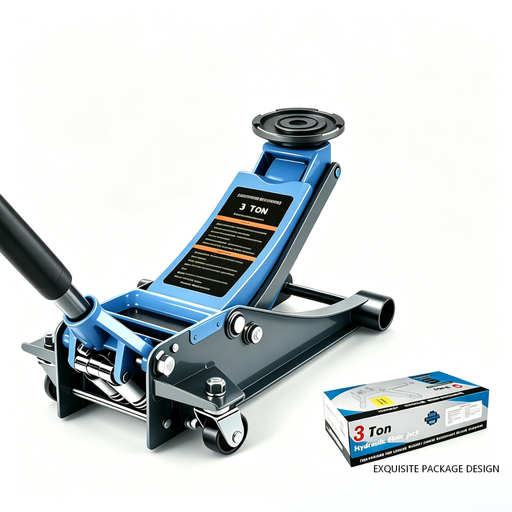
Why this model may be suitable: Its stated 3-tonne capacity and range of approximately 80 to 465 mm cover a wide range of jobs on saloons, SUVs and passenger vehicles. Its removable handle makes storage easier.
Its low minimum height reduces the risk of choosing a device that cannot slide under a low car. Nevertheless, measure the available clearance on your vehicle.
Steel and aluminium construction, wide rubberised saddle, 360° swivelling saddle and double pump.
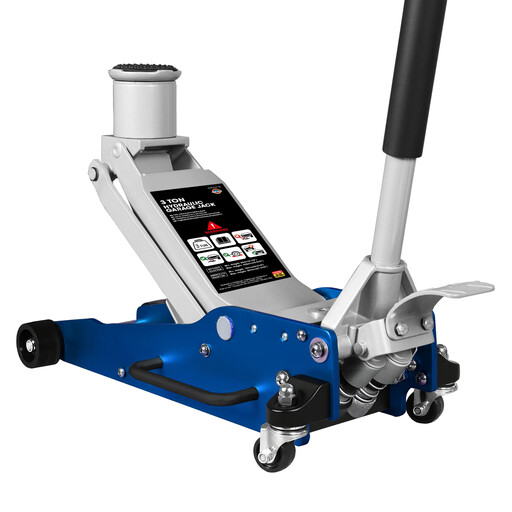
Why this model may be suitable: It is aimed at those who regularly move their equipment between the garage and parking area, particularly for sports cars, SUVs, MPVs or vans.
The specifications state a minimum height of 85 mm and include an extension system, so you do not have to choose between low access and a substantial lifting height.
Stated 3-tonne capacity, double pump, aluminium-alloy and steel body, EN 1494 certification and CE marking listed in the specifications.
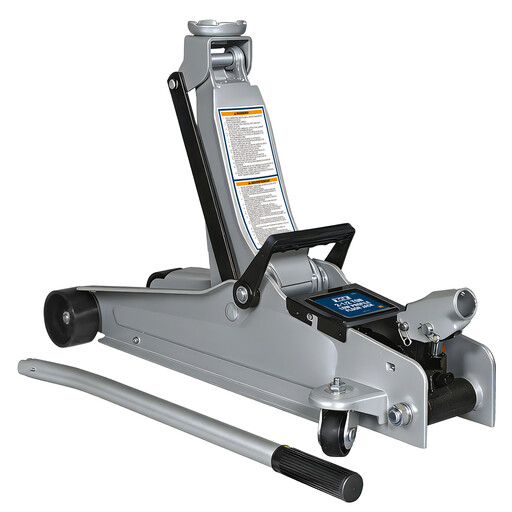
Why this model may be suitable: With a stated minimum height of 85 mm, this jack designed for sports cars can suit low chassis, provided you measure the support point beforehand.
Its very low access height solves the problem of jacks that cannot fit under a lowered car. However, check that its maximum height is sufficient for your needs.
Stated range of 85 to 380 mm, steel construction, 2.5-tonne capacity and EN 1494 and CE references included in the specifications.
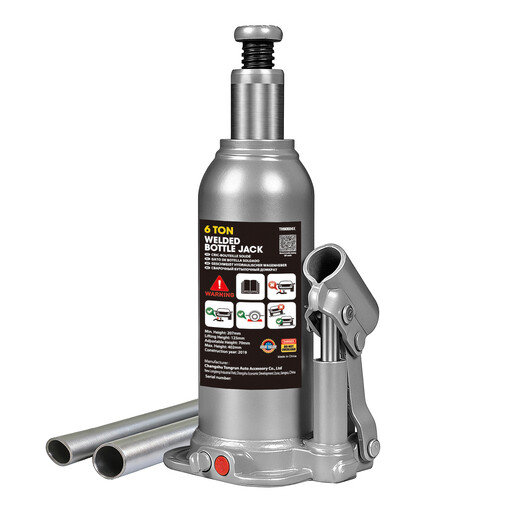
Why this model may be suitable: This hydraulic bottle jack is designed for heavier vehicles, such as certain SUVs, pick-ups and light commercial vehicles, provided that the 207 mm minimum height is compatible.
Its stated 6-tonne capacity meets demanding lifting requirements. However, its high minimum height must be checked before buying.
Forged steel base, chrome-plated piston, overload safety valve and precise screw adjustment, according to the product specifications.
The hydraulic trolley jack is primarily suited to a garage or workshop with a smooth, even floor. It is easy to manoeuvre and will often lift the vehicle more quickly.
The scissor car jack is more compact and practical for changing a wheel in an emergency. It stores easily in the boot, but requires more effort and is not a substitute for workshop equipment. Also check the technical specifications: the capacity stated in the model name may differ from the figure given in the description.
A bottle jack takes up little space and is suitable for taller vehicles. However, its vertical support point and high minimum height make it less versatile under a low saloon.
Discover an up-to-date selection of lifting equipment and compare its capacities, heights and uses before making your choice.
A 2- to 3-tonne model will generally suit a saloon or light SUV, provided that its capacity and height range match the vehicle’s specifications. Never exceed the rated load stated by the manufacturer.
It depends on how often it is used, storage conditions and maintenance. Store the jack in a dry place, inspect the castors and hydraulic system regularly, and stop using it if you notice a leak, deformation or uneven lowering.
No. To work underneath the vehicle, use suitable axle stands positioned on the support points specified by the manufacturer. The jack should only be used to lift the car and position the supports.