
Livraison le jour même ou le lendemain

Qualité garantie

Débloquez vos offres de bienvenue: Livraison GRATUITE | Jusqu'à -80 % | 30 jours d'essai gratuits à JoyPlus
Téléchargez l'application
A hydraulic jack makes it easier to change a wheel, replace tyres and carry out certain routine maintenance tasks. But the stated lifting capacity in tonnes is not enough to make the right choice. Minimum height, stability, lifting point and operating conditions all determine whether it is genuinely compatible with your vehicle.
Before placing your order, here are the most common mistakes to avoid and the criteria to check.
A 3-tonne hydraulic jack should not be chosen simply because its capacity appears generous. Start by checking the vehicle’s maximum authorised mass, shown on the vehicle registration document. You then need to consider the part of the vehicle that will actually be lifted. The jack must have sufficient capacity for the intended operation and be used in accordance with the manufacturer’s instructions.
A 1.8-tonne model may be suitable for many passenger cars. However, a heavy SUV, van or panel van may require a more powerful workshop jack. Never exceed the stated rated load.
A jack that is too tall may simply not fit under a vehicle with low ground clearance. This is particularly true of sports cars, certain electric models and vehicles with lowered suspension. An extra-low-profile jack with a minimum height of 85 mm will be easier to position than a model that starts at 135 or 150 mm.
Conversely, a jack that does not raise high enough may not lift an SUV wheel sufficiently clear of the ground, or a vehicle fitted with large tyres. Always compare the minimum and maximum heights with your car’s ground clearance and lifting point.
The wording “CE EN 1494-approved jack” deserves careful consideration. The CE marking indicates compliance with the applicable requirements, while EN 1494 covers the safety requirements applicable to certain types of mobile lifting equipment. Check the instructions, the manufacturer’s information and the markings shown on the product. A simple mention in a product title does not replace the relevant documentation.
For a city car or compact car, a 1.8-tonne hydraulic trolley jack may be perfectly suitable for occasional use. For a family saloon, SUV or MPV, 2.5- to 3-tonne models offer more leeway, provided you respect the vehicle’s weight and the support points specified by the manufacturer.
The lifting range must suit your car:
A wide lifting range does not mean that the jack will suit every car. The shape of the saddle and the position of the lifting point remain decisive.
Choose a stable base, a suitable saddle and, where the design allows, a jack fitted with swivel castors. 360° swivel wheels make positioning easier in a garage, but they do not make it safe to use on uneven or soft ground.
A rubber saddle can reduce the risk of direct contact with the sill. Also check for a comfortable handle, a detachable handle or storage space for wheel nuts and small parts. These details make a real difference when you need to change wheels regularly.
Steel generally provides a robust structure, while a steel-and-aluminium construction can make the jack lighter to carry. The right choice depends mainly on how often you will use it and how much space you have available.
Look in particular for an overload safety valve, a controlled lowering system and clear instructions. These features do not remove the need to use axle stands: you must never work underneath a car supported only by a jack.
The specifications below are based on the information provided for each product. Before buying, check the dimensions, permissible load and included accessories on the product page.
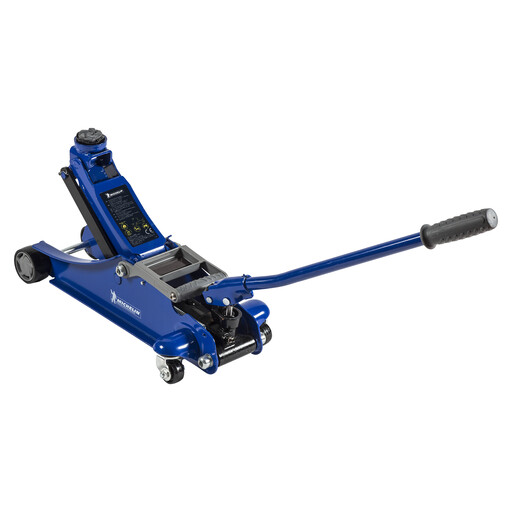
Why this choice suits this user profile : With a capacity of 1 800 kg and a height range of 105 to 350 mm, it is suitable for many passenger cars and occasional domestic use.
The minimum and maximum heights are clearly stated. The universal rubber saddle helps protect the lifting point, provided it is compatible with your vehicle.
Swivel wheels, a 360° rotating handle and magnetic storage for wheel nuts and small parts.
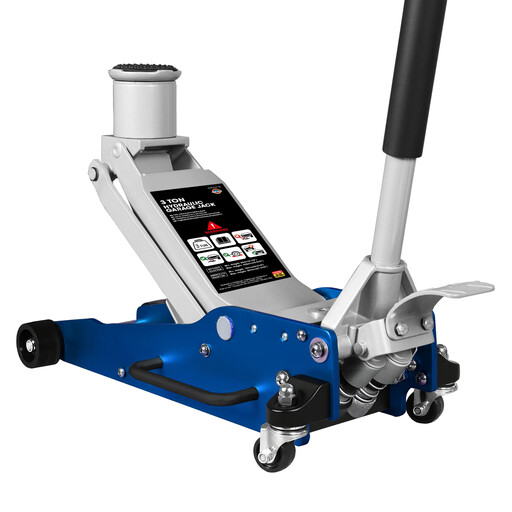
Why this choice suits this user profile : Its aluminium and steel construction, dual pumping system and extra-low profile make it suitable for users looking for both portability and versatility.
With a minimum height of 85 mm, it reduces the risk of incompatibility with a low car. However, its stated 3-tonne capacity must still be compared with the vehicle’s actual weight.
Lifting range of 85 to 465 mm, extension up to 541 mm and CE EN 1494 certification stated on the product page.
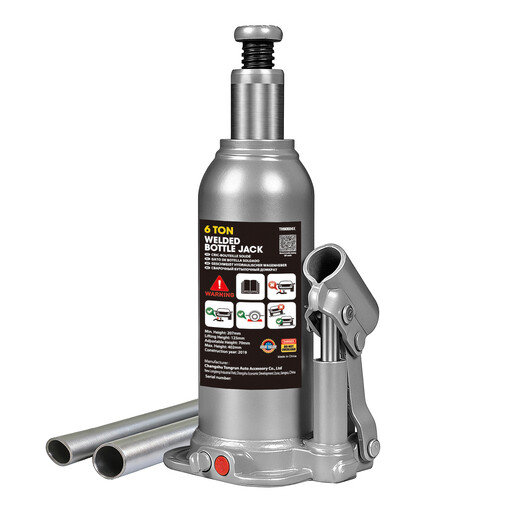
Why this choice suits this user profile : This 6-tonne hydraulic bottle jack is designed for SUV, pick-up and small lorry owners who need high capacity in a workshop or maintenance area.
The load capacity and lifting range of 207 to 402 mm are clearly stated. However, the vertical format must be compatible with the space available beneath the chassis.
Forged steel base, chrome-plated piston, safety valve and height adjustment screw.
We have put together a complete, real-time updated selection of products that meet these demanding selection criteria and European safety requirements.
To lift a car correctly, park it on hard, level and stable ground, apply the handbrake and select a gear or the mode specified by the manufacturer. Position the saddle only beneath the lifting point indicated in the manual.
Once the vehicle has been raised, fit suitable axle stands before carrying out any work. Never get underneath a car supported only by the jack. To extend its service life, store it away from moisture, clean the rod and regularly check for leaks, the condition of the wheels and that the lowering mechanism is working properly.
Start by comparing the vehicle’s maximum authorised mass, its ground clearance and the height required to lift the wheel clear of the ground. A 3-tonne SUV and 4x4 jack may be suitable for some models, while a heavier vehicle may require a 6-tonne vertical model. The stated capacity does not remove the need to check the support point.
A hydraulic trolley jack is easy to move thanks to its wheels and is suitable for regular work on a level surface. A hydraulic bottle jack is more compact and can offer a high capacity, but it is less convenient to move and position. For a motorbike or quad bike, choose equipment designed specifically for these vehicles, such as a hydraulic jack for motorbikes and quad bikes.
Its service life depends on the load it supports, how often it is used, storage conditions and maintenance. Follow the instructions, avoid overloading it and stop using it immediately if you notice a leak, uneven lowering or deformation. In a workshop, periodic inspection and consistently using axle stands significantly improve safety.