
Livraison le jour même ou le lendemain

Qualité garantie

Débloquez vos offres de bienvenue: Livraison GRATUITE | Jusqu'à -80 % | 30 jours d'essai gratuits à JoyPlus
Téléchargez l'application
A hydraulic motorcycle lift makes maintenance much easier, provided it is suited to the weight, dimensions and configuration of your two-wheeler. Whether you are changing the oil, cleaning the chain, replacing a wheel or working on the brakes, the wrong equipment can quickly become cumbersome, unstable or difficult to manoeuvre.
Before buying a motorcycle lift table or a motorcycle jack, it is worth looking beyond the marketing claims and checking a few essential features.
A stated maximum load of 700 kg does not mean every vehicle can be lifted without care. You also need to consider the platform surface area, the position of the centre of gravity and the width of the chassis. A heavy motorcycle, a custom bike or an ATV can have a very different weight distribution.
The stated capacity must remain higher than the total weight of the vehicle, including accessories. Never exceed the value specified in the instruction manual.
A motorcycle jack that is too tall may not fit under the frame or lifting points. Conversely, a maximum height that is too low limits access to the wheels, transmission or underside of the engine.
Always compare the lifting range, expressed in millimetres, with your vehicle's ground clearance and the working height you need.
Castors are handy for moving a motorcycle lift around the garage, but they must sit on a sufficiently stable base and be paired with a suitable locking system. Never move the lift while the motorcycle is raised, unless the manual explicitly allows it.
A non-slip platform, straps and fixing points remain essential, especially when a job is going to take a while.
For everyday use, look at each of the following separately:
A 700 kg motorcycle lift may suit heavy vehicles, but its size and its own weight also need to match the space you have for storage.
The hydraulic system usually lets you raise the load gradually using a pump or foot pedal. It reduces the effort needed to lift the vehicle. However, check the quality of the control, the stability during lifting and the presence of a mechanical safety lock.
A scissor motorcycle jack works differently. More compact, it can be useful for occasional jobs, but it requires precise positioning and careful attention to balance.
A platform covered with a non-slip material helps prevent slipping and scratching underneath the motorcycle. That said, it does not replace a proper restraint system. For work on the wheels, suspension or transmission, plan to use straps and, if necessary, an additional support.
A paddock stand or a lifting support may be more suitable for a targeted job on the front or rear wheel. For wider access underneath the vehicle, a motorcycle lift table offers a more generous working surface.
The models below meet different needs. Before each use, check the dimensions, load capacity and safety instructions specific to the product you choose.
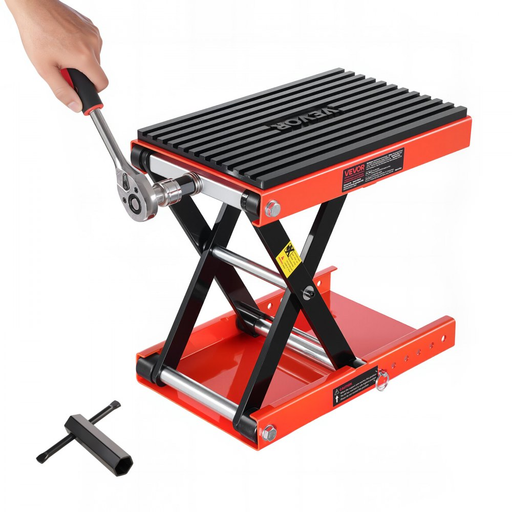
Why this choice suits this profile: Its scissor jack design is ideal for riders looking for a simple maintenance solution for a compatible motorcycle or ATV.
Its 105–380 mm lifting range and stated 544 kg capacity give you concrete figures to check before buying, rather than relying on a vague promise of versatility.
Stated capacity of 544 kg, 105–380 mm lifting range and ratchet wrench included, according to the product listing.
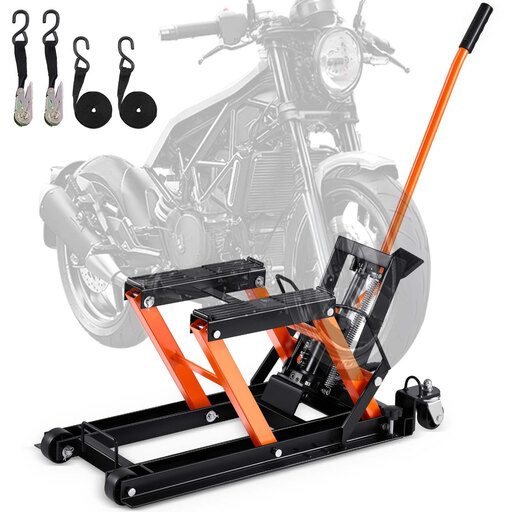
Why this choice suits this profile: This model is aimed at users who want a high capacity and hydraulic operation for regular garage work.
The listing specifies a 700 kg capacity and a 120–385 mm range. The castors and platform fitted with rubber strips address common issues with moving and slipping.
Hydraulic pump, long handle control and four castors, including two that swivel 360°, according to the description provided.
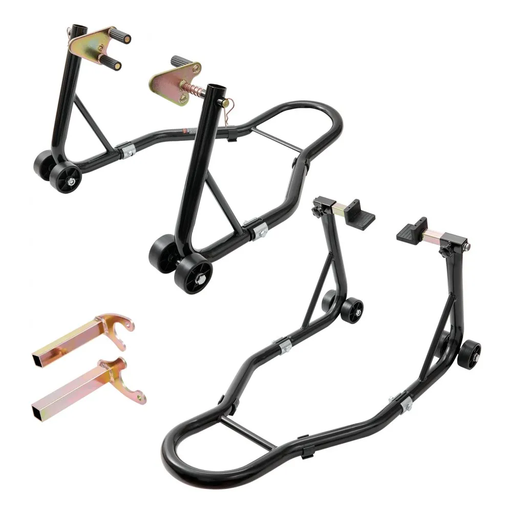
Why this choice suits this profile: This kit is ideal for targeted jobs that require lifting the front or rear wheel, particularly for maintaining the chain or wheels.
The U-fork and L-fork adapters allow you to fit different lifting points. However, do check their compatibility with your motorcycle's swingarm and fork.
Front and rear lifting, stated capacity of 386 kg and two types of adapters included, according to the product title.
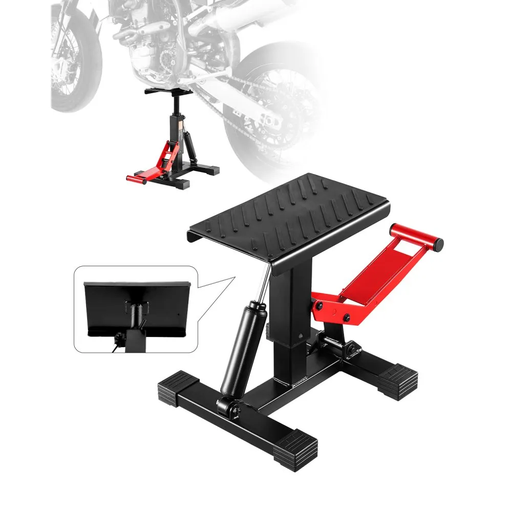
Why this choice suits this profile: Its 250–465 mm lifting range may suit those looking for a higher working position for a compatible motorcycle or ATV.
The maximum height and 544 kg capacity are clearly stated. These figures let you compare the lift against your vehicle's ground clearance and actual weight.
Hydraulic operation, stated capacity of 544 kg and 250–465 mm lifting range.
Set up the motorcycle lift on a hard, level and clear surface. Before you start lifting the vehicle, check the following points:
Never work under a motorcycle supported only by hydraulic pressure. An additional mechanical safety lock is strongly recommended when the job requires you to be underneath the vehicle.
We have put together a full selection, updated in real time, of products that meet these demanding criteria and European safety standards.
The capacity varies by model. The products featured here state 386 kg, 544 kg or 700 kg. This figure should be compared to the total weight of your motorcycle or ATV, taking into account the load distribution and any accessories. A high capacity does not mean you can ignore the manual or the fixing instructions.
Use a non-slip platform, place the vehicle in the centre and add suitable straps. Lift gradually, checking the balance at each stage. For work on the front or rear wheel, choose a support designed for your model's lifting points.
A motorcycle lift table generally offers a wider surface and a working position better suited to frequent jobs. A motorcycle jack is more compact and may suit a garage where space is tight. The choice depends on the load to be lifted, the height you need, how often you use it and the type of maintenance you plan to carry out.