
Livraison le jour même ou le lendemain

Qualité garantie

Débloquez vos offres de bienvenue: Livraison GRATUITE | Jusqu'à -80 % | 30 jours d'essai gratuits à JoyPlus
Téléchargez l'application
Lifting a motorcycle, quad, or car isn't just about checking the load capacity. An undersized hydraulic motorcycle jack can lack stability, make wheel access difficult, or become awkward to store after just a few uses. Whether you're working in a garage, a workshop, or carrying out regular maintenance on your own machine, several factors are worth examining before you start comparing prices.
A stated capacity of 500 or 700 kg doesn't mean every vehicle can be lifted in any position. You need to consider the total weight, the mass distribution, and the contact surface area with the platform. The load specified by the manufacturer must remain compatible with your intended use, and you should never exceed the rated limit.
A hydraulic motorcycle lift that's too tall in its lowest position may not fit under a bike with low ground clearance. Conversely, a limited lifting range could prevent you from removing a wheel or working on the suspension. Always compare the minimum height, maximum height, and the actual space available under the chassis.
The pump is there to lift the load, but it doesn't replace a stable setup. The floor must be level, the wheels or supports correctly positioned, and the motorcycle properly immobilised. For prolonged work, use appropriate safety stands. Never work under a vehicle supported only by hydraulic pressure.
For a touring motorcycle, a model like a motorcycle and quad jack with a capacity exceeding the vehicle's weight provides a welcome safety margin. Heavy motorcycles, quads, and certain models fitted with accessories may require a 700 kg lift. Also check the platform's width and length to ensure good distribution of the support points.
The centre of gravity shifts when the front or rear wheel is removed. A non-slip platform, adapters, or a front and rear motorcycle wheel stand help keep the machine in a stable position. However, they don't replace the need to strap or secure the vehicle when the situation demands it.
A range of roughly 100 to 400 mm suits many common jobs, but every motorcycle has a different ground clearance. The height you need won't be the same for an oil change, wheel work, or replacing a transmission component.
A motorcycle lift table generally offers a wider surface and more comfortable access, while a compact jack is easier to store. Castors make moving the equipment simpler, but they must be locked or stabilised during lifting.
Painted steel, aluminium, or a combination of materials: the construction should be assessed based on the weight supported, frequency of use, and your garage environment. Choose a non-slip platform, suitable castors, and a handle long enough to operate the pump without adopting an uncomfortable position.
For a hydraulic car jack, the EN 1494 standard and CE marking are regulatory elements to check when stated for the product in question. They don't mean all uses are authorised, nor that the jack is automatically suitable for a motorcycle. Always consult the manual, load limits, and the manufacturer's instructions.
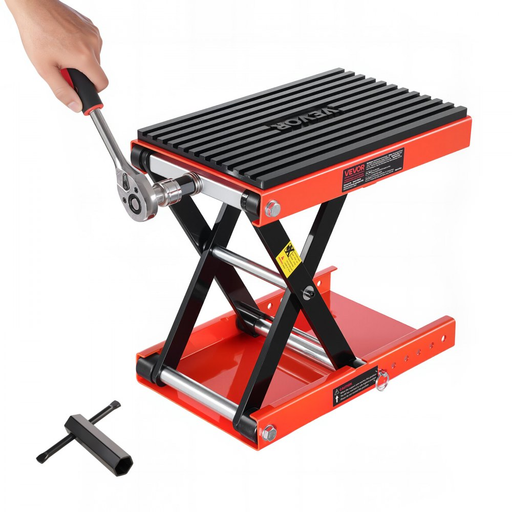
Why this choice suits this profile: Its scissor design is ideal for home mechanics who want to carry out routine jobs on a motorcycle or quad without taking up too much garage space.
Its lifting range of 105 to 380 mm lets you accurately check compatibility with your ground clearance before buying, rather than relying on a general promise.
Stated capacity of 544 kg and a ratchet wrench supplied to operate the mechanism.
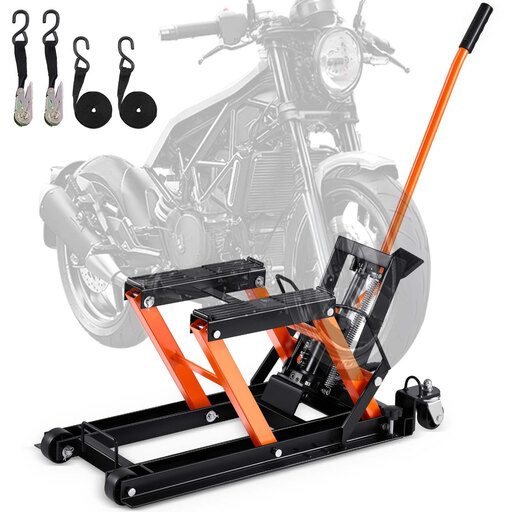
Why this choice suits this profile: Its stated capacity is aimed at users who regularly handle heavy motorcycles or quads, provided the limits and recommended positioning are respected.
Its platform is covered with rubber strips designed to reduce slipping and marks on the underside of the motorcycle.
Lifting range of 120 to 385 mm, foot-pedal-operated hydraulic pump, and four castors, including two that swivel 360°.
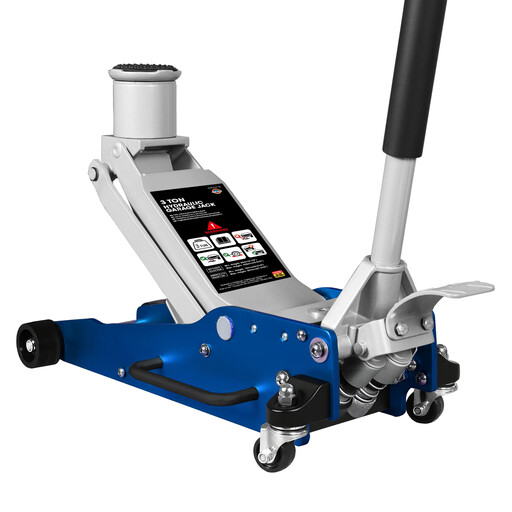
Why this choice suits this profile: This jack is aimed at garages and versatile users who want to cover automotive needs, as well as certain jobs requiring a low entry height.
Its stated entry height of 85 mm and extension mechanism let you concretely check access under the vehicle before buying.
Stated load of 3 tonnes, dual pump, aluminium alloy body, and EN 1494 and CE markings according to the product sheet.
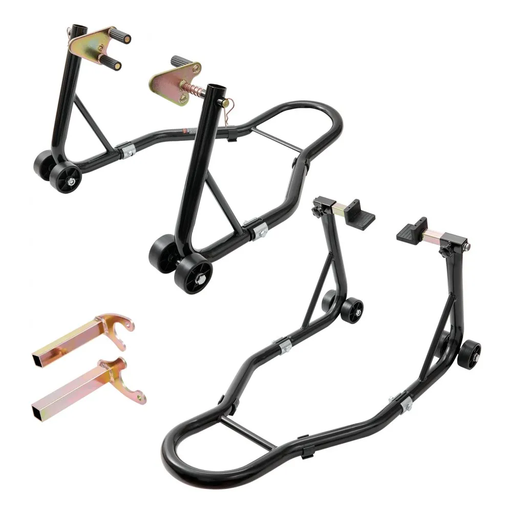
Why this choice suits this profile: This motorcycle paddock stand is suitable for wheel work, storage, and regular maintenance of a compatible motorcycle.
The U-shaped and L-shaped adapters allow you to tailor the stand to your motorcycle's configuration. Check their compatibility before ordering.
Lifts both front and rear wheels, with a stated capacity of 386 kg.
We've put together a comprehensive list, updated in real time, of products that meet these demanding selection criteria and European safety regulations.
Before each lift, check the condition of the castors, visible welds, platform, and hydraulic circuit. Place the jack on a hard, level surface, align the support points with the chassis, and avoid sudden movements. A tie-down strap can supplement the setup when the motorcycle is in the raised position.
After use, lower the equipment in accordance with the manual, wipe off any splashes, and store it away from moisture. A leak, uneven lowering, or a deformed platform should lead to immediate discontinuation of use. Its service life depends on the load supported, the frequency of use, and the quality of maintenance, rather than a fixed number of months or years.
Start by checking the vehicle's weight in its actual configuration, then compare it to the jack's rated capacity. A model stated at 700 kg may suit some heavy-duty uses, but stability also depends on the platform, support points, and load distribution.
Not automatically. A motorcycle lift is designed for a specific geometry and specific support points. For a car, use a hydraulic car jack whose capacity, entry height, and design match the vehicle. The TCE model shown above states a capacity of 3 tonnes along with EN 1494 and CE references on its product sheet, but the manual remains the reference to follow.
A motorcycle paddock stand generally supports one wheel or axle and is suitable for targeted jobs. A lift table offers a wider platform and a greater working height, at the cost of more space and often a higher budget. The choice depends on the space available, the type of repair, and how often you use it.