
Same-day & Next-day Delivery

Quality Guaranteed

Unlock Your Welcome Offers: FREE Delivery | Up to 80% OFF | Free 30-day JoyPlus trial
Download the APP
Changing a wheel, working on a motorbike or carrying out routine maintenance becomes much easier with suitable lifting equipment. But choosing a hydraulic jack for motorbikes and cars is not simply about comparing capacities in kilograms. The minimum height, stability and compatibility with your vehicle are just as important.
A capacity of 544 kg may be suitable for a motorbike or certain quad bikes, but it is not enough to lift a car. Conversely, a 1.8-tonne hydraulic trolley jack is designed for cars and light vehicles, but it may not be suitable for every van or heavy goods vehicle.
Remember to check:
The stated capacity must never be exceeded. Nor does it remove the need to use axle stands whenever you need to work underneath the vehicle.
A jack can offer a generous maximum height yet prove unusable if its minimum height is too great to fit beneath the chassis. A low-profile car, a faired motorbike and a quad bike all present different requirements.
To avoid unpleasant surprises, measure the distance between the ground and the lifting point before placing your order. Then compare this measurement with the jack’s minimum height. This check is particularly important for a hydraulic jack intended for a car or a model used on a lowered motorbike.
Swivel wheels make it easier to position a jack in a garage, but manoeuvrability alone does not guarantee stability. The ground must be hard, level and sufficiently even. A slope, gravel or a wet surface can compromise lifting.
Also check:
For a motorbike or quad bike, a 544 kg hydraulic motorbike lift may be suitable for routine maintenance, provided that the vehicle’s weight and support points are compatible. For a car, a capacity of 1.8 tonnes is suitable for many lighter models, but the vehicle’s exact weight should be checked in its documentation.
A jack for motorbikes and quad bikes generally features a platform or structure designed for two-wheeled vehicle chassis and all-terrain vehicles. A trolley jack is more commonly designed to reach a car’s side or central lifting points.
The lifting range represents the product’s actual operating range. An adjustable model from 105 to 380 mm is used differently from a jack that lifts from 250 to 465 mm.
The maximum height must be sufficient to remove the wheel or access the relevant area. That said, a greater height does not necessarily mean a better choice: the minimum height remains essential for fitting underneath the vehicle.
A jack is designed to lift a vehicle, not to support it in the air for an extended period. When changing a tyre, working on the brakes or carrying out maintenance, proceed as follows:
The product instructions take precedence over any general guidance, particularly when it comes to the position of the support points.
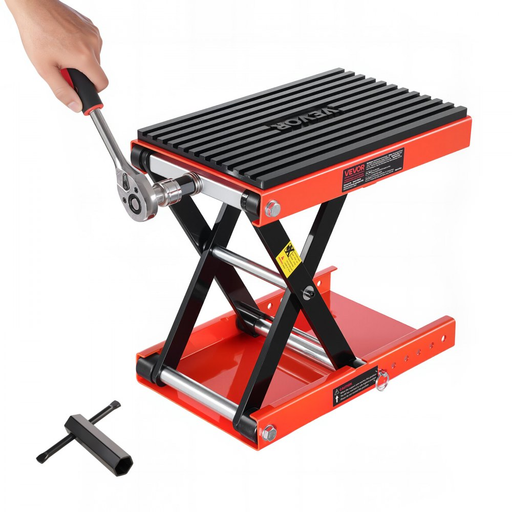
Why this choice suits this profile : With a capacity of 544 kg and a lifting range of 105 to 380 mm, this model is aimed at private users who maintain a motorbike or quad bike at home. The included ratchet wrench makes adjustments easier during occasional maintenance work.
The lifting dimensions are clearly stated, allowing you to compare them with your vehicle’s ground clearance before buying.
544 kg capacity ; adjustment from 105 to 380 mm ; ratchet wrench included.
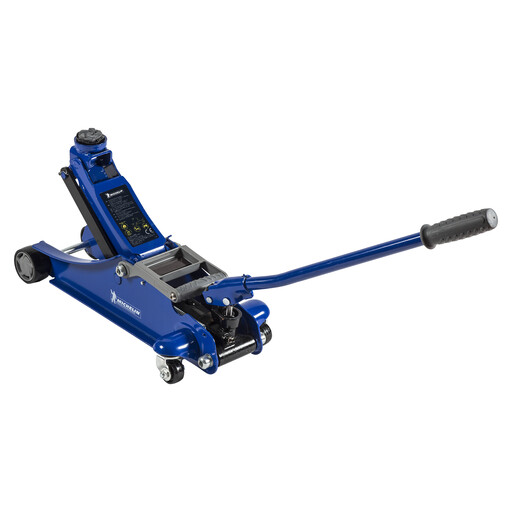
Why this choice suits this profile : Designed for car maintenance, this jack supports up to 1 800 kg and offers a lifting range of 105 to 350 mm. Its 360° rotating handle and swivel wheels are well suited to a regularly used home garage.
The 105 mm minimum height is clearly stated. The universal rubber base is designed to protect the vehicle’s lifting point.
1 800 kg capacity ; swivel wheels ; magnetic storage space for nuts and small parts ; 360° rotating handle.
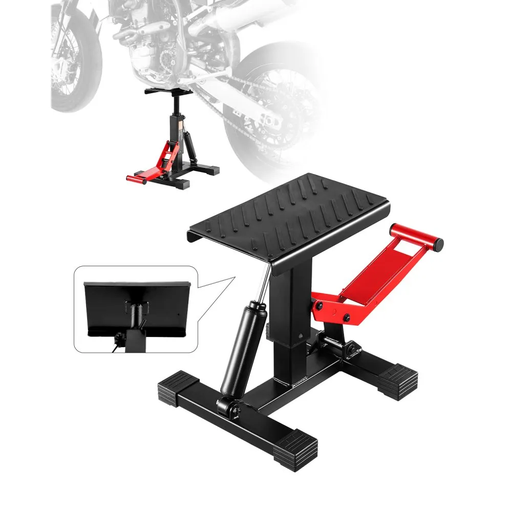
Why this choice suits this profile : Its lifting range of 250 to 465 mm suits riders who need a higher working position for certain jobs on motorbikes or quad bikes.
The maximum height of 465 mm is paired with a clearly stated capacity of 544 kg, allowing you to compare these specifications with your motorbike’s dimensions and weight.
544 kg capacity ; lifting range of 250 to 465 mm ; design dedicated to motorbikes and all-terrain vehicles.
A motorbike lift offers a more comfortable working position, but it requires more space and a suitable installation. For occasional use, a compact hydraulic motorbike lift will often be easier to store.
We have put together a complete, real-time selection of products that meet these strict selection criteria, as well as European safety regulations.
No. A jack is used to lift the vehicle, but must never be its only support while you are working underneath the car. Use suitable axle stands, positioned in the designated areas, and follow both the vehicle manufacturer’s instructions and those provided by the jack manufacturer.
It all depends on the total weight of the motorbike or quad bike and how the load is distributed across the platform. A 544 kg model may be suitable for certain vehicles, but this figure is not a universal recommendation. Always check the vehicle’s actual weight and the position of its support points.
Store it in a dry place, clean its surfaces after every use and regularly check the wheels, handle, platform and lowering mechanism. Never use equipment that shows signs of leakage, deformation or unusual operation. Follow the manufacturer’s recommendations regarding hydraulic oil and maintenance procedures.