Joybuy Insights

Which Hydraulic Jack Should You Choose? Top Picks for Your Garage

Lifting your car, whether to change a wheel or for a more involved mechanical session, is not an operation to be taken lightly. Safety and efficiency are the watchwords. Faced with the multitude of models on the market, it can be difficult to find your way: floor jack or bottle jack? What lifting capacity is needed for an SUV compared to a sports car?

At Joybuy, our mission is to help you see things more clearly. This guide has been designed to give you everything you need to choose the hydraulic jack perfectly suited to your needs, based on clear criteria: lifting capacity, vehicle type, and safety standards.

Buyer's Guide: The Criteria for Choosing the Right Hydraulic Jack

Before diving into our selection, let's review the three essential criteria that will guide your choice.

1. Floor Jack or Bottle Jack: A Matter of Use

The choice between these two types of jacks depends mainly on your work environment and the vehicles you own.

  • The floor jack: Mounted on wheels, it is very stable and easy to manoeuvre for precise positioning under the chassis. Its wide support base makes it the tool of choice for a garage jack and for use on flat surfaces. Many models are available in a low-profile jack version, which is essential for sports or lowered cars.
  • The bottle jack: More compact and vertical, it offers significant lifting power in a small footprint. It is particularly suited for vehicles with high ground clearance, such as SUVs, vans, or 4x4s. Its narrower base requires a perfectly stable and flat support surface.

2. Lifting Capacity: A Matter of Safety

Expressed in tons, lifting capacity is THE number one safety criterion. Be aware, it does not correspond to the total weight of the vehicle! A jack never lifts the entire car, but only a corner or an axle.

The golden rule to avoid any risk? Choose a jack with a capacity of at least 75% of your vehicle's total weight.

  • For city cars and compact sedans: A 1.5 to 2-tonne jack is often sufficient.
  • For sedans, estate cars, and compact SUVs: A 3-tonne jack offers a comfortable safety margin and great versatility.
  • For large SUVs, vans, and commercial vehicles: A 6-tonne jack or more is necessary to ensure a safe lift.

3. Technical Specifications: Height, Materials, and Certifications

Beyond these two points, certain technical details make all the difference:

  • Lifting height: Check the minimum height (to ensure it fits under your car) and the maximum height (to know if it can lift your jack for an SUV high enough). A low-profile jack is essential for sports vehicles.
  • Materials: Steel jacks are robust and durable, but heavy. An aluminium jack will be much lighter and easier to transport, ideal for mobile use or on the track.
  • Safety: Check that the jack complies with European standards. The EN 1494 certification, dedicated to mobile lifting equipment, is a real guarantee of safety. The CE mark, meanwhile, attests that the product conforms to the requirements of the European Union.

Recommended Hydraulic Jacks for Buyers

We have selected models for you that cover all uses, from lifting heavy-duty vehicles to maintaining the lowest sports cars.
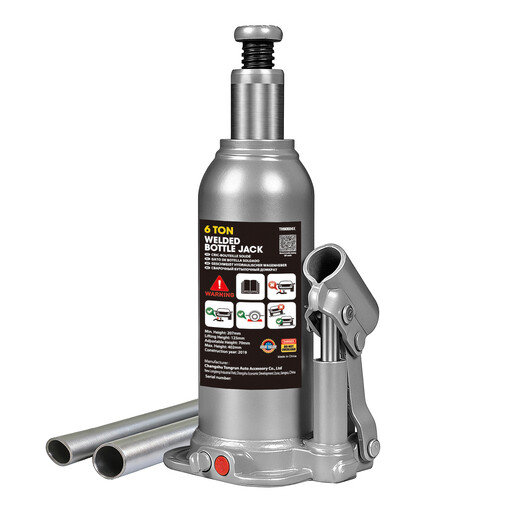
For Heavy Vehicles: TCE 6-Tonne Vertical Hydraulic Bottle Jack

TCE 6-Tonne Vertical Hydraulic Bottle Jack

Why we chose it: Its heavy-duty capacity of 6 tonnes (6,000 kg) and its forged steel construction make it a powerful ally for the most demanding tasks.

The pros:

  • High capacity: Designed to effortlessly lift large SUVs, pick-up trucks, and light commercial vehicles.
  • Robust construction: Forged steel base and automated welding for rock-solid durability.
  • Integrated safety: Overload safety valve and chrome-plated piston rod to resist rust.
  • Lifting range: A lifting range of 207 to 402 mm, complemented by an extension screw for millimetre-perfect adjustment.

Who is it for? Owners of large SUVs and commercial vehicles, as well as professionals looking for a powerful and durable bottle jack for substantial loads.
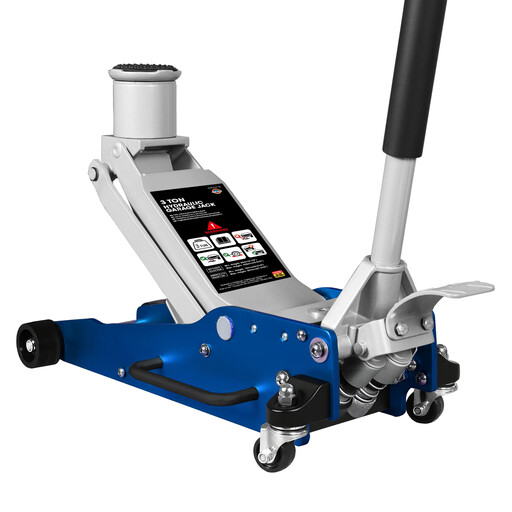
The All-Rounder: TCE 3-Tonne Aluminium Alloy Hydraulic Floor Jack

TCE 3-Tonne Aluminium Alloy Hydraulic Floor Jack

Why we chose it: It's the Swiss Army knife of our selection. A low profile, 3-tonne capacity, and a removable riser pad: it adapts to an impressive range of vehicles, from the lowest sports cars to the tallest SUVs.

The pros:

  • Dual compatibility: A minimum height of just 85 mm to slide under sports cars, and a maximum height of 541 mm (with the riser) for SUVs.
  • Rapid lift: Its dual-piston system lifts the vehicle in a flash, much faster than a standard jack.
  • Lightweight and sturdy: Its aluminium chassis combines lightness for transport with the robustness to support 3 tonnes.
  • Certified safe: Complies with EN 1494 + CE standards for complete peace of mind.

Who is it for? The enthusiast or the knowledgeable home mechanic who works on multiple vehicles (a sedan and an SUV, for example) and wants a single, high-performance, and versatile garage jack.
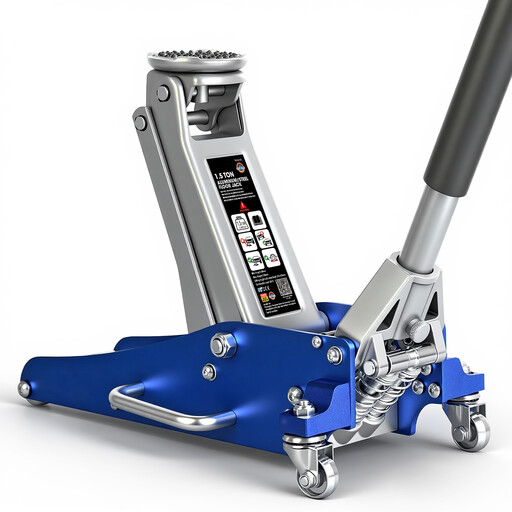
The Portable One: TCE 1.5-Tonne Ultra-Lightweight Aluminium Hydraulic Floor Jack

TCE 1.5-Tonne Ultra-Lightweight Aluminium Hydraulic Floor Jack

Why we chose it: Its featherweight design. At only 14.3 kg, this all-aluminium jack can be transported effortlessly, without compromising on performance.

The pros:

  • Ultra-lightweight: Perfect for the boot in case of an emergency or to take with you to track days.
  • Low profile: Its low entry height of 90 mm gives it access to most sports and lowered vehicles.
  • Lifting performance: The dual-piston system ensures a rapid lift up to 358 mm.
  • Certified safety:EN 1494 + CE certified safety.

Who is it for? Sports car enthusiasts, track day regulars, and anyone looking for a lightweight and compact hydraulic jack for the garage or for mobile repairs.

Looking for Another Type of Tool?

Need to complete your workshop? Beyond lifting, good mechanics rely on precision tools. For finishing or adjusting metal parts, quality equipment is essential.

Discover our range of metal files and tools

Frequently Asked Questions

1. What jack capacity do I need for my car?

To calculate the minimum capacity, take your vehicle's total weight (found on your registration document) and multiply it by 0.75. Example: for a 2,000 kg SUV, a 1,500 kg (1.5-tonne) jack is the absolute minimum. We strongly recommend a 3-tonne jack for a comfortable safety margin. When in doubt, always go for a higher capacity!

2. Floor jack or bottle jack: which one should I choose?

The floor jack is the king of the garage: stable, easy to position on a flat surface, it's the preferred choice for standard and sports cars. The bottle jack, which is more compact and often more powerful for its size, is perfect for vehicles with high ground clearance (SUVs, 4x4s, vans) or for stowing in the boot for emergencies.

3. Does a hydraulic jack require maintenance?

Absolutely. Regular maintenance is the key to its longevity and your safety. Remember to:

  • Check the hydraulic oil level periodically.
  • Bleed the hydraulic system from time to time to remove air bubbles that impair its efficiency.
  • Keep it clean and lubricate its moving parts (wheels, joints, etc.).
  • Store it in the lowered position (ram retracted) to protect the piston from corrosion and dust.