
Livraison le jour même ou le lendemain

Qualité garantie

Débloquez vos offres de bienvenue: Livraison GRATUITE | Jusqu'à -80 % | 30 jours d'essai gratuits à JoyPlus
Téléchargez l'application
Changing a wheel, checking the brakes or carrying out a minor repair under a car requires the right equipment. However, choosing a hydraulic car jack is not simply a matter of relying on the maximum capacity stated. The minimum height, stability and compatibility with the lifting points all play a decisive role in everyday use.
A 3-tonne hydraulic jack should not be chosen simply because your vehicle weighs less than 3 tonnes. You need to consider the actual load being lifted, how the weight is distributed and the manufacturer’s recommendations. The stated capacity is a limit that must never be exceeded, not a safety margin to be used routinely.
A low car, sports model or vehicle fitted with side skirts may be incompatible with a jack that is too tall. Conversely, an ultra-low-profile jack may not lift high enough to reach the body of an SUV or van. Before comparing models, measure the distance between the ground and the lifting point.
The word ‘professional’ alone does not guarantee that a jack will suit your needs. A heavy-duty construction can be a real advantage in a garage, but become awkward to transport. A hydraulic bottle jack, on the other hand, is compact, but cannot be positioned under the vehicle in the same way as a hydraulic trolley jack. Dimensions, wheels and weight should be assessed alongside lifting capacity.
For a city car or saloon, a 1.8-tonne model may be suitable for routine tasks, provided the vehicle’s specifications allow it. For an SUV, van or a 4x4 jack, a capacity of 3 tonnes or more may be more appropriate. Heavy vehicles and some lorries require a heavy-duty jack designed for their category.
Always compare these three specifications:
A hydraulic trolley jack generally has fixed and swivelling castors, making it easier to position under the vehicle. However, it requires a hard, level and unobstructed surface. More compact, a hydraulic bottle jack is easy to store in a car, but must be positioned with particular precision.
Choose a saddle suited to the lifting point, ideally with a non-slip surface or rubber protection. A long handle reduces pumping effort, while a removable model makes storage easier.
Steel provides a robust structure, while aluminium helps reduce the weight of some models. However, the material alone is not enough to judge a jack’s quality: the design of the base, the diameter of the saddle and the reliability of the mechanism are just as important.
Some products state compliance with EN 1494 and display a CE marking in their technical specifications. Check these details in the supplied documentation, on the labelling and in the seller’s information. Under no circumstances do they replace the need to follow the instructions for use.
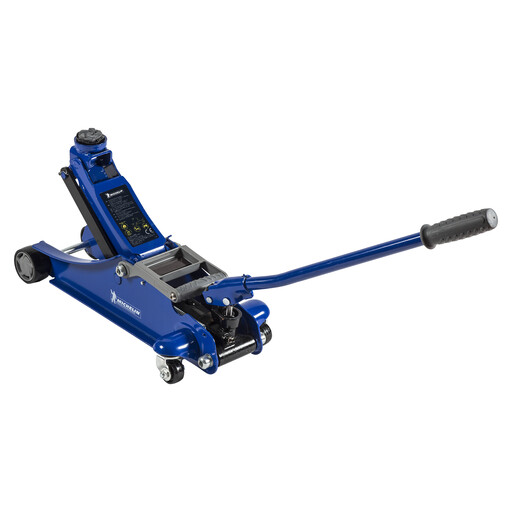
Why this choice suits this user profile : This garage jack is aimed at motorists looking for a wheeled model for changing a wheel or carrying out routine maintenance on a car or light vehicle.
Its stated height range of 105 to 350 mm reduces the risk of buying a model that is too tall for a standard car. The rubber-based saddle protects the lifting point.
1,800 kg capacity, swivelling castors, 360° rotating handle and a magnetic tray for nuts and small parts.
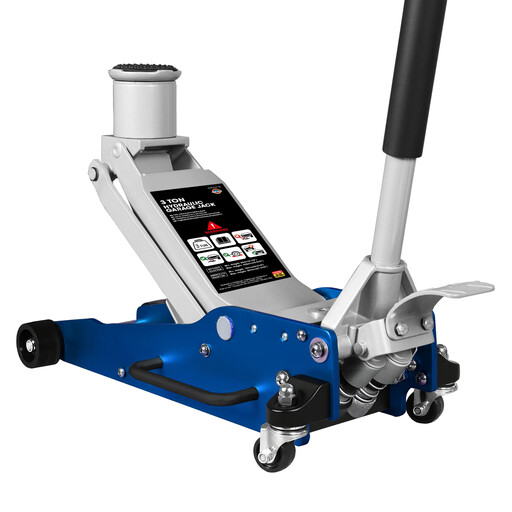
Why this choice suits this user profile : Its aluminium chassis and 3-tonne capacity are ideal for users looking for a wide adjustment range in a private garage.
With a stated minimum height of 85 mm, it can suit many lowered vehicles. The extension system also allows it to reach a greater height, depending on the configuration.
Range of 85 to 465 mm, extension up to 541 mm, dual pump and EN 1494 and CE indications in the product specifications.
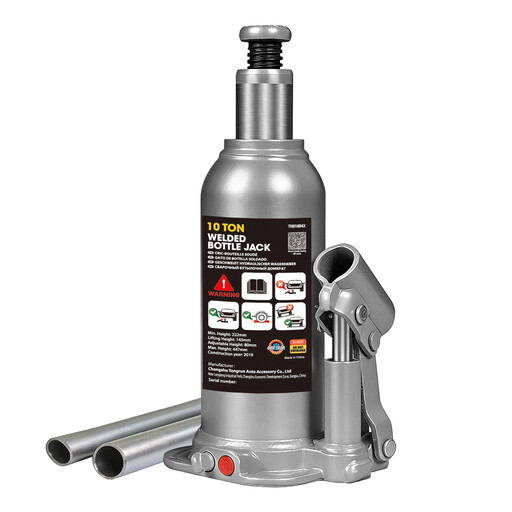
Why this choice suits this user profile : This hydraulic bottle jack is designed for workshops and users working on lorries, buses, construction vehicles or heavy equipment.
Its stated 10,000 kg capacity is suitable for heavy-duty applications, while the specifications mention a forged steel base and a safety valve.
Lifting range of 222 to 448 mm, height adjustment screw, chrome-plated rod and treated non-slip saddle, according to the description.
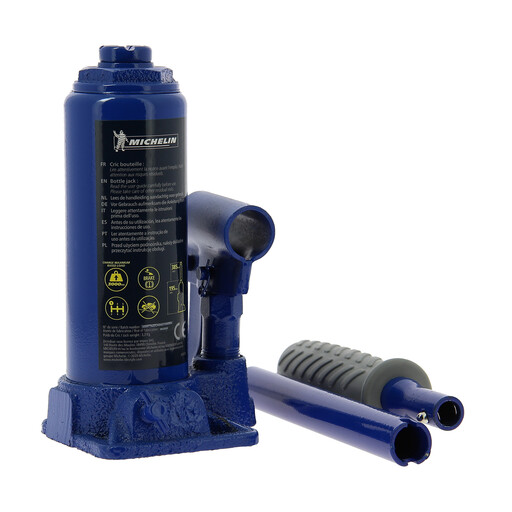
Why this choice suits this user profile : Its compact design is easy to store in a van, large vehicle or utility vehicle used every day.
The 195 to 385 mm range and threaded extension screw allow the height to be adjusted, subject to compatibility with the lifting point.
Stated capacity of 3,000 kg, comfortable lever and compact footprint.
We have brought together a comprehensive, real-time updated selection of products that meet these demanding criteria, while complying with European safety regulations.
Before every lift, check the condition of the jack, close the release valve properly and place the equipment on hard, level and stable ground. The lifting point must match the one specified in the vehicle handbook. Apply the handbrake and, if necessary, place chocks under the opposite wheels.
A jack is designed to lift the vehicle, not to support it during repairs. To work underneath the car, install axle stands suitable for the load, then check the stability of the entire setup before starting any work. Never exceed the rated capacity and do not leave anyone inside the vehicle while it is being lifted.
Start by checking the vehicle’s weight, chassis height and the position of the lifting point. A 3-tonne model may be suitable for some SUVs, but a heavier vehicle may require a 6-tonne jack or more. Maximum height is also important for clearing a large-diameter wheel.
A hydraulic trolley jack moves under the vehicle on its wheels. It is generally suitable for a garage or workshop. More compact and easier to store, a hydraulic bottle jack must, however, be positioned precisely. For an occasional wheel change at the roadside, also check the equipment’s weight and overall size.
This depends on how often it is used for lifting, storage conditions, maintenance and compliance with the maximum load. Store the jack away from moisture, regularly inspect the wheels and saddle, and check for leaks. A drop in pressure or uneven lowering should be a reason to stop using the jack and have it inspected.