
Livraison le jour même ou le lendemain

Qualité garantie

Débloquez vos offres de bienvenue: Livraison GRATUITE | Jusqu'à -80 % | 30 jours d'essai gratuits à JoyPlus
Téléchargez l'application
A hydraulic car jack makes changing a wheel, inspecting the underside or carrying out maintenance in a private garage much easier. But a high lifting capacity alone doesn't guarantee compatibility with your vehicle. A low-slung saloon, a family SUV and a light commercial vehicle all have different ground clearances and different stability requirements.
Before you place an order, three mistakes crop up time and again:
The load you need to lift isn't necessarily the same as the vehicle's total weight. The jack usually supports only part of that weight, but it must have a sufficient margin. For a city car or a saloon, a 1 to 2.5-tonne model may be suitable for some uses. For an SUV, people carrier, 4x4 or light commercial vehicle, a 3-tonne capacity gives you more leeway, subject to the manufacturer's recommendations.
Never choose a jack simply because its capacity looks high. Check the vehicle's weight, the location of the lifting point and the instructions in the owner's manual.
The minimum height is crucial for a low car. An ultra-low-profile hydraulic jack with a starting height of around 85 to 90 mm can work for some sports cars or lowered vehicles. Conversely, a model that starts at 135 or 150 mm is better suited to vehicles with more clearance underneath.
The maximum height is especially important for SUVs and vehicles with high suspension. Also check whether the stated range includes an adaptor or extension. A range of 85 to 465 mm, for example, isn't directly comparable to a range of 150 to 530 mm: these two configurations serve different needs.
A robust steel jack is generally fine for regular use in a workshop or garage, though it's often heavier. A lightweight aluminium jack is easier to carry and store, but its capacity and stability should be examined before you prioritise portability.
Swivel castors make it easier to position a hydraulic trolley jack on a level floor. On the safety front, look for references to CE marking and the EN 1494 standard. These should be accompanied by documentation that matches the model being sold. Always use the jack on a flat, stable surface, and place suitable axle stands before working underneath the vehicle: a jack alone is not a permanent support.
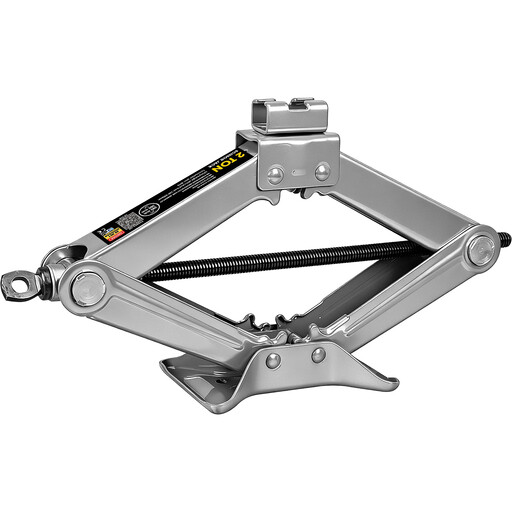
Why this choice suits this profile: This scissor jack folds away and stores easily in the boot. It's suitable for occasional roadside repairs on a saloon or small SUV. However, the description states a capacity of 1,000 kg: you must check this point against your vehicle's technical data before buying.
With a stated starting height of 88 mm, it reduces the risk of choosing a jack that's too tall for a low car. Its capacity must still be verified before each use.
Forged alloy steel construction, widened anti-slip base and foldable design.
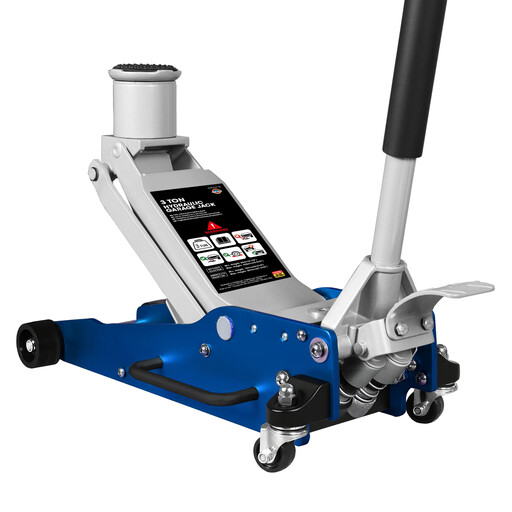
Why this choice suits this profile: This aluminium jack is aimed at motorists who want a 3-tonne capacity without having to move a particularly heavy model around their garage.
Its stated starting height of 85 mm suits low vehicles. The adjustment system lets you increase the lifting range without tools.
Stated range of 85 to 465 mm, or 161 to 541 mm with the extension, plus dual pump.
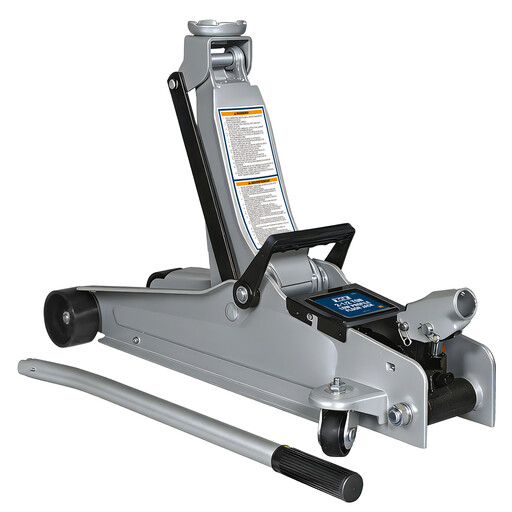
Why this choice suits this profile: This model is aimed at owners of sports cars and low saloons, as well as users who want a steel garage jack for regular maintenance work.
Its stated minimum height of 85 mm prevents you from choosing a model that's incompatible with a low ground clearance.
Stated capacity of 2.5 tonnes, height range of 85 to 380 mm and reinforced steel construction. The product page mentions CE and EN 1494 markings.
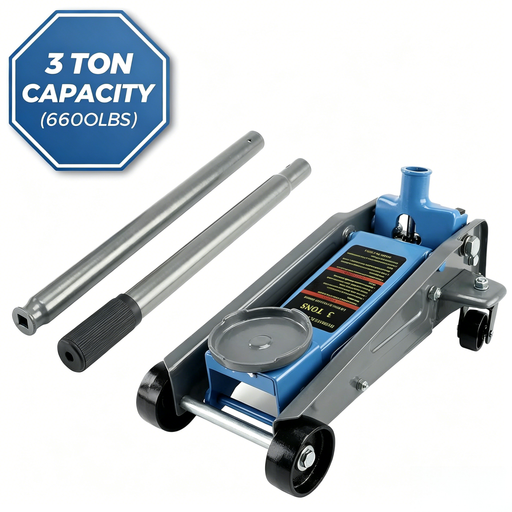
Why this choice suits this profile: Its lifting range is suitable for private garages and workshops that work on cars and SUVs with a standard ground clearance.
The 135 to 460 mm range is clearly stated, so you can easily compare it to the height of your lifting point before ordering.
Stated capacity of 3 tonnes, steel construction and 360° swivel castors.
We've put together a comprehensive, real-time updated selection of products that meet these demanding criteria as well as European safety regulations.
A 3-tonne model gives you a comfortable margin for many SUVs and heavy vehicles. However, compatibility depends on the kerb weight, the lifting point and the ground clearance. Check the manufacturer's data before buying.
Yes, provided you choose a low-profile car jack whose minimum height will fit underneath. Ultra-low-profile models of around 85 to 90 mm should be compared with your vehicle's actual ground clearance.
That depends on how often you use it, where you store it and how well you maintain it. Store the jack in a dry place, don't exceed its rated load, check the condition of the castors and watch for any signs of leaks in the hydraulic system. Regular inspection helps you spot wear or a drop in performance early on.