
Livraison le jour même ou le lendemain

Qualité garantie

Débloquez vos offres de bienvenue: Livraison GRATUITE | Jusqu'à -80 % | 30 jours d'essai gratuits à JoyPlus
Téléchargez l'application
A hydraulic car jack can make changing a wheel, inspecting the underside, or carrying out routine maintenance much easier. But a capacity stated in tonnes alone isn't enough to make the right choice. Minimum height, lifting points, stability and overall size all play a key role in compatibility with your vehicle.
Before you place an order, take the time to steer clear of three common pitfalls.
A 3-tonne hydraulic jack isn't automatically suitable for every situation. The stated load refers to its maximum capacity, yet the jack typically only lifts part of the vehicle. However, you must still account for the total kerb weight, passengers, luggage and accessories.
Never exceed the capacity stated by the manufacturer. When working underneath a car, always use proper axle stands. A vehicle should never be supported solely by a jack.
A garage jack with a minimum height that's too high may not fit under a low saloon, a sports car, or a vehicle with a flat tyre. Conversely, an ultra-low-profile jack might not reach the lifting point of an SUV or a light commercial vehicle properly.
Measure the ground clearance at the lifting point, then compare it with the product's minimum height. Also check the maximum height needed to lift the wheel off the ground or to position an axle stand.
These marketing claims don't replace technical specifications. Instead, look at the lifting range, materials, base, wheels, saddle type and whether there's an overload device. Some models are just as bulky or heavy to move as they are powerful.
For occasional use, a compact hydraulic trolley jack can be perfectly adequate. For regular use, manoeuvrability, pump stroke and ease of storage become important factors.
For a standard car, a 1.8-tonne car jack can be suitable if its height and lifting point match the vehicle. SUVs, vans and 4x4s often require a higher capacity and a greater maximum height. A hydraulic bottle jack generally offers a compact footprint and high capacity, but its base is less practical to move than a trolley jack.
The lifting range must match your vehicle and the intended use:
A high-capacity hydraulic jack doesn't compensate for an incompatible minimum height. Measuring your car remains the essential starting point.
A rubberised or wide saddle can reduce the risk of marking the sill, provided it's positioned on the point specified by the manufacturer. Swivel castors make it easier to move a hydraulic trolley jack on a hard, level surface. A wide base is particularly welcome with a hydraulic bottle jack.
The EN 1494 standard and CE marking, when shown on the product page, are documentation points to check. They don't replace the need to follow the instructions, the maximum load and the usage guidelines. When changing a wheel, park on a level surface, apply the handbrake and chock the opposite wheels.
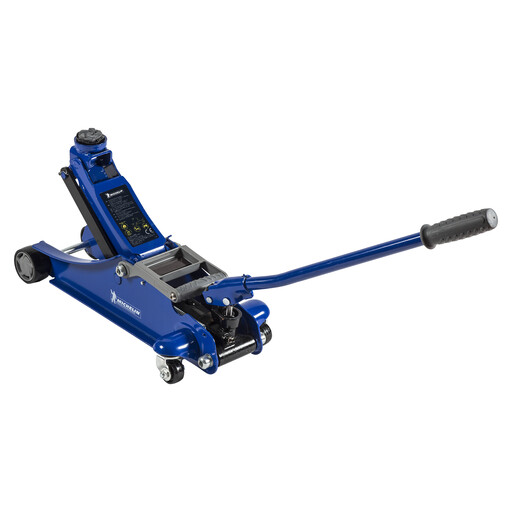
Why this choice suits this profile: Its 1,800 kg capacity and lifting range of 105 to 350 mm are suitable for many standard cars. The swivel castors make it easy to move around a home garage.
The minimum height is clearly stated, which avoids choosing a model incompatible with a low car. The universal rubberised saddle is designed to protect the lifting point.
360° swivel handle, magnetic tray for nuts and a 1,800 kg capacity.
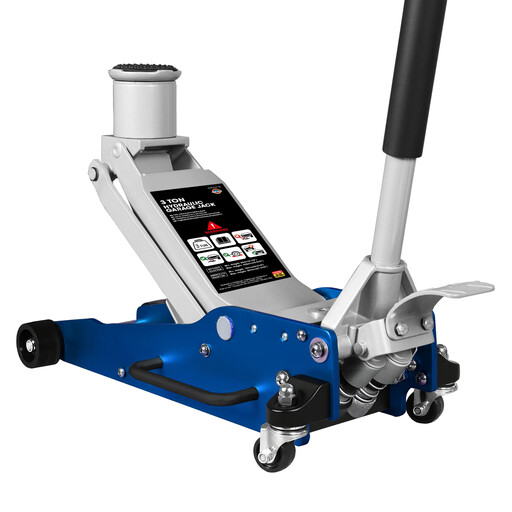
Why this choice suits this profile: This model combines a 3-tonne capacity, a minimum height of 85 mm and a maximum height of 465 mm. It's aimed at users looking for a versatile solution for low cars, SUVs, MPVs and vans.
The detailed height range prevents you from stopping at just the "3-tonne" label. The product page also specifies compliance with the EN 1494 standard and the CE marking.
Aluminium alloy body, dual pump and height extension claimed up to 541 mm.
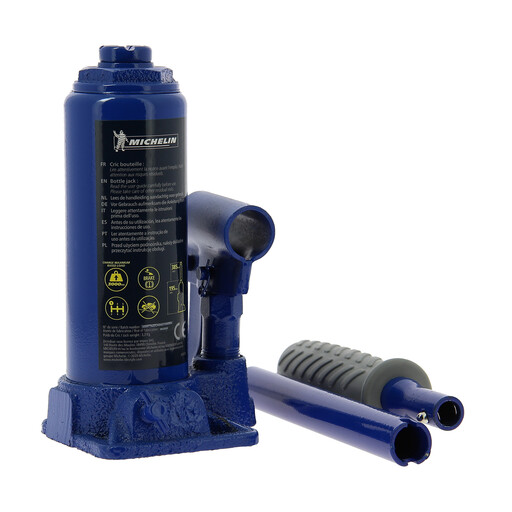
Why this choice suits this profile: Its compact size and 3,000 kg capacity make it suitable for storage in a workshop or on board a suitable vehicle, particularly an SUV, van or 4x4.
The minimum height of 195 mm and the extension screw are clearly stated. This means you can check compatibility with a tall vehicle before buying.
Compact footprint, lifting range of 195 to 385 mm and adjustable threaded extension.
We've put together a comprehensive, real-time updated selection of products that meet these demanding criteria as well as European safety regulations.
Start by checking the vehicle's weight, the height of the lifting point and the maximum height required. A 3-tonne hydraulic bottle jack can be suitable for some SUVs, while a trolley jack offers better mobility in a garage. The capacity must always exceed the requirements specified by the manufacturer.
No. The jack is used to lift the vehicle, not to support it alone while you work. After lifting, place axle stands at the designated points, check the stability of the whole setup and never slide under a vehicle supported only by the jack.
It depends on frequency of use, storage conditions and maintenance. Store the jack in a dry place, avoid overloading, check for leaks and follow the instructions regarding oil level or bleeding. A drop in performance, a leak or uneven lowering means you should stop using it immediately and have the product checked.