
Livraison le jour même ou le lendemain

Qualité garantie

Débloquez vos offres de bienvenue: Livraison GRATUITE | Jusqu'à -80 % | 30 jours d'essai gratuits à JoyPlus
Téléchargez l'application
Changing a wheel, swapping your tyres or working underneath a car requires a hydraulic car jack that is compatible with your vehicle’s weight and ground clearance. Yet certain buying pitfalls keep cropping up among motorists.
A model advertised as 3 tonnes doesn’t mean it’s designed to lift a 3-tonne car. The jack typically only bears part of the vehicle’s total weight, but it must have enough margin and be positioned on the lifting point specified by the manufacturer.
For a family car, a 3-tonne car jack can suit many home-use jobs. For a heavy van, lorry or bus, a bottle jack of 6 or 10 tonnes will be more appropriate. The stated capacity never replaces the need to check your vehicle’s weight in its documentation.
A hydraulic trolley jack that’s too tall may be impossible to slide under a sports car, a lowered saloon or a vehicle with a flat tyre. The minimum height must be compared with the ground clearance measured at the lifting point.
An ultra-low-profile hydraulic jack with a minimum height around 85 mm doesn’t meet the same needs as a model starting at 135 or 150 mm. Conversely, insufficient maximum height may not suit an SUV, MPV or van.
The CE mark indicates a declaration of conformity with applicable European requirements. However, it alone does not guarantee build quality, stability on all surfaces or that the jack is right for your car. A reference to the EN 1494 standard provides an additional technical element for mobile or movable lifting equipment, but it doesn’t replace reading the instructions or following the usage guidelines.
Before ordering, be sure to check the capacity, minimum and maximum heights, the lifting point, base stability and the accessories actually supplied.
The product specification should state the maximum load as well as the minimum and maximum heights. To change a wheel, choose a model that can slide under the vehicle and lift high enough to free the wheel.
A quick-lift jack fitted with a dual pump can reduce the number of strokes needed when empty. However, speed should never overshadow the essentials: stability and precise lowering remain the priority.
Steel is generally suitable for regular use, while aluminium helps keep the jack lighter. Some models combine both materials to strike a better balance between portability and strength.
Swivel castors make positioning on a garage or workshop floor easier. A wide or rubber-coated saddle can help protect the lifting point, provided it matches the shape intended by the manufacturer. Even a heavy-duty hydraulic jack must never be moved with a load suspended.
Always use the jack on a hard, level and stable surface, apply the handbrake and chock the opposite wheels. For any work underneath the vehicle, place axle stands that are suitable. A jack, even one marketed as professional, is for lifting the vehicle – not for supporting it alone while you carry out repairs.
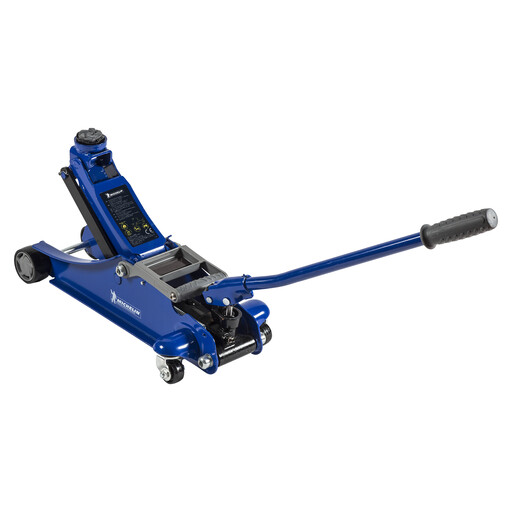
Why this choice suits this profile: Its 1,800 kg capacity and lifting range of 105 to 350 mm are suitable for many passenger cars used occasionally at home.
Its minimum height is clearly stated and its rubber-coated saddle helps limit direct contact with the lifting point.
Swivel castors, 360-degree rotating handle, magnetic tray for small nuts and a comfortable lifting handle.
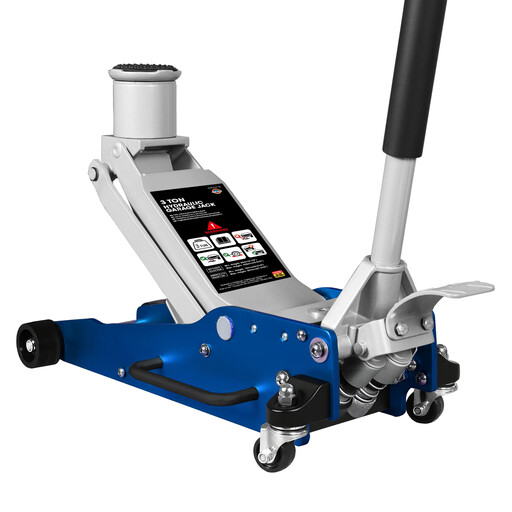
Why this choice suits this profile: It combines a minimum height of 85 mm with a maximum height of 465 mm, and can reach 541 mm depending on the configuration.
Both height ranges are specified, which prevents choosing an ultra-low-profile model without checking the required extension.
3-tonne capacity, aluminium alloy body, dual pump and stated compliance with EN 1494 standard with CE marking.
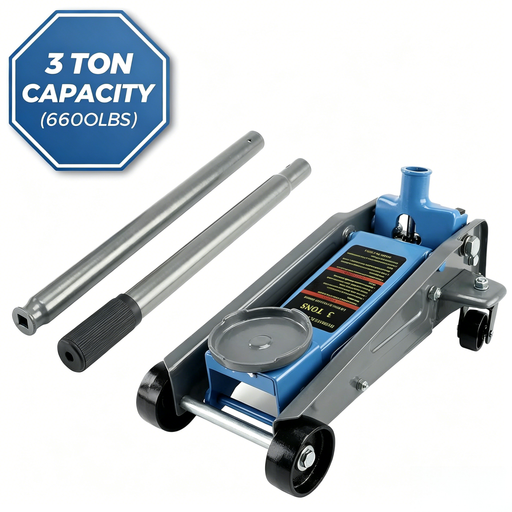
Why this choice suits this profile: Its steel construction, stated 3-tonne load capacity and swivel castors make it a suitable ally for frequent use in the garage or workshop.
The lifting range and capacity are detailed, while the wheels make positioning easy without putting strain on the vehicle.
Steel construction, two large wheels and two 360-degree swivel castors for maintenance jobs and wheel changes.
Before every lift, inspect the wheels, saddle and ram, and look for any oil leaks. Close the valve properly before pumping, then lower the vehicle gradually. Do not modify the jack and never add an extension not intended by the manufacturer.
To keep your garage jack in good condition, store it in a dry place, clean its moving parts and avoid leaving it under load. If the descent becomes uneven or the ram leaks, stop using it immediately until it has been inspected or replaced.
A 1.8-tonne model may suit some light vehicles, provided its weight and lifting points are compatible. A 2.5 or 3-tonne jack offers more margin for many saloons, some SUVs and MPVs. However, you should always compare these values with your vehicle’s specifications.
No. The jack is only for lifting the vehicle. To work underneath, use at least two axle stands, positioned on suitable support points. Never get under a car held up by a single hydraulic jack.
Its lifespan depends on frequency of use, load, storage conditions and maintenance. Using it within the recommended limits, on a stable surface and with regular checks, will reduce wear. A leak, deformation or loss of pressure should mean you stop using the device immediately.