
Livraison le jour même ou le lendemain

Qualité garantie

Débloquez vos offres de bienvenue: Livraison GRATUITE | Jusqu'à -80 % | 30 jours d'essai gratuits à JoyPlus
Téléchargez l'application
A hydraulic car jack makes changing a wheel, inspecting the chassis or carrying out maintenance much easier. But the capacity stated in tonnes isn't enough to guarantee you choose a safe model. The minimum height, the lifting point and stability on the ground matter just as much.
Before you place your order, take the time to avoid three common mistakes.
A 3-tonne hydraulic jack isn't necessarily suitable for every vehicle that weighs a similar amount. You need to consider the gross vehicle weight, and then the load actually applied at the lifting point. For a standard car, it's best to keep a safety margin. Check the vehicle's mass on the V5C registration document or in the manufacturer's handbook.
A garage jack that's too tall may not fit under a lowered car, a sports saloon or a vehicle with a flat tyre. Conversely, a model with a limited maximum height may not reach the sill of an SUV or a light commercial vehicle.
An ultra-low-profile jack with a minimum height of around 85 to 105 mm will be better suited to low vehicles. For an SUV, van or 4x4, check the maximum height and whether an extension is available.
A jack is designed to lift a vehicle, not to hold it up for a long period. For any work underneath the car, use properly rated axle stands on a flat, hard and stable surface. Never exceed the stated capacity and position the jack only under the lifting points specified by the manufacturer.
A hydraulic trolley jack is practical in a garage thanks to its wheels, which allow you to move it horizontally. A hydraulic bottle jack is more compact and easy to store, but it needs a sufficiently accessible support point. For occasional roadside breakdowns, a folding mechanical jack can also do the job, provided you check its capacity and height.
Always compare these two values with your vehicle's specifications. A model with a range of 105 to 350 mm, like the MICHELIN 1.8 T, suits many common cars. An ultra-low-profile jack at 85 mm will be better for a low car, while a bottle jack with a range of 195 to 385 mm will better meet the needs of an SUV or light commercial vehicle.
Choose a base that's wide enough, a non-slip saddle pad and, for a trolley jack, castors suited to your garage floor. A rubber cushion limits direct contact with the lifting point. Swivel castors make positioning easier, but they won't work miracles on uneven ground.
The EN 1494 standard and CE marking, when stated for the product, are among the things to check on the specification sheet. They don't replace the need to follow the instructions, the rated capacity and the manufacturer's guidelines.
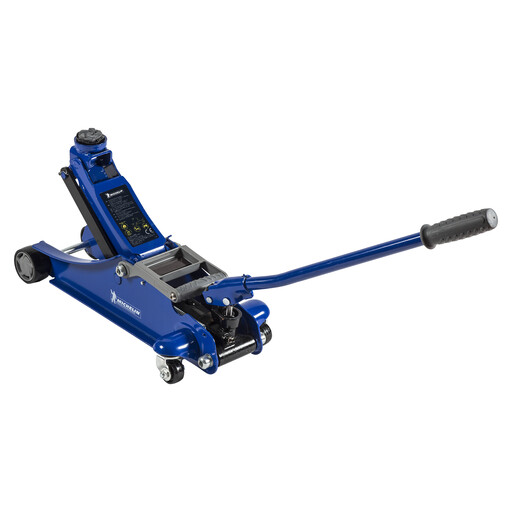
Why this choice: this hydraulic trolley jack is suitable for everyday jobs on many cars and moves easily around a home garage.
Its height range of 105 to 350 mm lets you check compatibility more accurately before buying, rather than relying solely on its 1,800 kg capacity.
Swivel castors, 360° rotating handle, comfortable grip and universal rubber saddle pad.
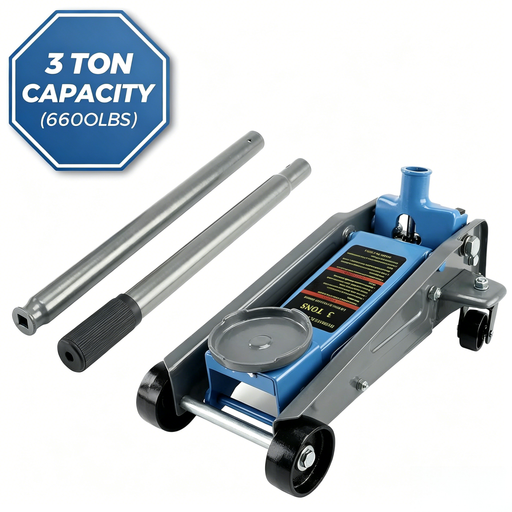
Why this choice: its lifting range of 135 to 460 mm is ideal for motorists who switch between a car and an SUV or a taller vehicle.
Its maximum height of 460 mm reduces the risk of buying a jack that's too short for a raised vehicle, provided you respect the rated load.
Stated capacity of 3 tonnes, two fixed wheels, two 360° swivel castors and a steel structure.
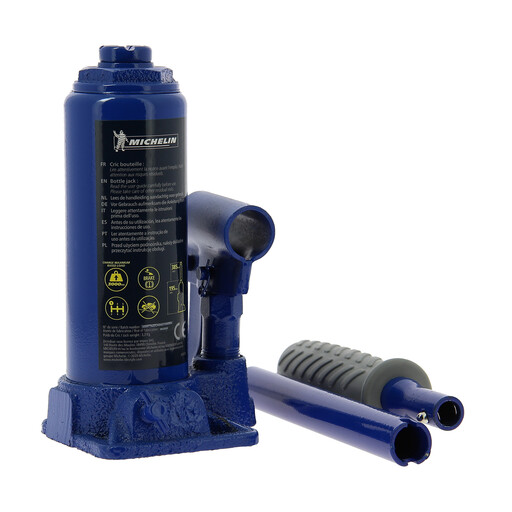
Why this choice: its compact design suits owners of SUVs, vans and 4x4s that have a sufficiently high support point.
Its minimum height of 195 mm is a reminder that a bottle jack isn't designed for very low cars.
Stated capacity of 3,000 kg, height range of 195 to 385 mm, threaded extension screw and compact footprint.
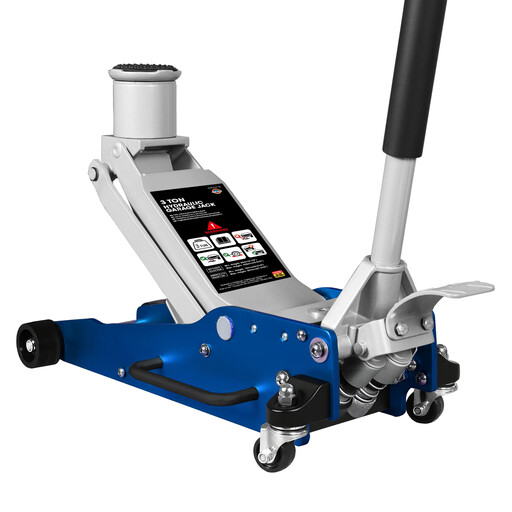
Why this choice: its low entry height and extended lifting range will appeal to workshops working on sports cars, SUVs, MPVs or vans.
Its minimum height of 85 mm suits low vehicles, while the extension device allows it to reach up to 541 mm.
Stated capacity of 3 tonnes, dual pump, aluminium and steel construction, EN 1494 certification and CE marking stated on the spec sheet.
No. Park the vehicle on a flat, hard and stable surface, apply the handbrake and place wheel chocks as needed. Loose ground can compromise the jack's stability and cause its base to shift.
It all depends on how often you use it, how you store it and how well you maintain it. Wipe the jack down after each use, protect its metal parts from moisture and regularly check for oil leaks. An uneven descent, a leak or a deformed structure means you should stop using it immediately.
An air jack can reduce effort and speed up repetitive jobs, but it requires a compressor, a compressed air supply and suitable space. For home use or simply changing a wheel, a properly sized hydraulic jack is generally simpler to use.