
Livraison le jour même ou le lendemain

Qualité garantie

Débloquez vos offres de bienvenue: Livraison GRATUITE | Jusqu'à -80 % | 30 jours d'essai gratuits à JoyPlus
Téléchargez l'application
A hydraulic car jack can make light work of changing a tyre, performing an oil change or carrying out garage repairs. But simply looking at the tonnage rating isn't enough to make the right choice. You also need to consider the minimum height, lifting points, stability and intended use before you buy.
A 3-tonne car jack isn't automatically suitable for every vehicle. The stated load refers to the jack's maximum capacity, whereas the vehicle's total weight is listed on its V5C registration document or in its handbook. You also need to account for weight distribution at the lifting point you're using.
For everyday use, choose a capacity that exceeds the weight actually being supported, and always follow the vehicle manufacturer's instructions as well as those of the jack manufacturer.
A hydraulic trolley jack that's too tall may not fit under a low-slung saloon or a car with modified suspension. Conversely, a model with insufficient maximum height won't lift the wheel clear on an SUV or a light commercial vehicle.
An extra-low-profile jack, with an entry height between 85 and 105 mm, is better suited to low vehicles. A hydraulic bottle jack typically starts higher, but offers substantial capacity in a compact format.
A jack is designed to lift a vehicle, not to hold it securely for extended periods. When working underneath the car, always use properly rated axle stands on a flat, firm and stable surface. Never get under a vehicle supported only by a hydraulic jack, scissor jack or pneumatic jack.
Before choosing a jack for changing a tyre, note down three essential details:
A 3-tonne model with a lifting range of 135 to 460 mm can suit various vehicles, provided you check the dimensions stated by the manufacturer. For a low vehicle, go for an extra-low-profile jack. For a van or heavy vehicle, a 6 or 10-tonne hydraulic bottle jack may be more appropriate, as long as its entry height is compatible with the chassis.
A wide base, a non-slip saddle and properly sized wheels all contribute to more stable positioning. A steel construction is generally suitable for regular workshop or garage use. Aluminium reduces weight and makes the jack easier to move around, but the specification sheet must state the jack's capacity and its intended conditions of use.
The EN 1494 and CE markings, when shown on a product's documentation and labelling, are among the details you should check. They do not remove the need to observe the maximum load, the lifting points and the manufacturer's instructions.
Thanks to its wheels, a hydraulic trolley jack is easy to manoeuvre around a garage. The trade-off is that it takes up more space than a scissor jack. A scissor jack stows neatly in the boot and can get you out of trouble when changing a tyre, but it requires more effort and lifts more slowly.
A pneumatic jack is aimed at users who have a suitable air supply. It can speed up lifting, but its operation depends on the compressor, the connection and the contact surface. Whether you're using it for roadside assistance or in a workshop, this limitation needs to be considered.
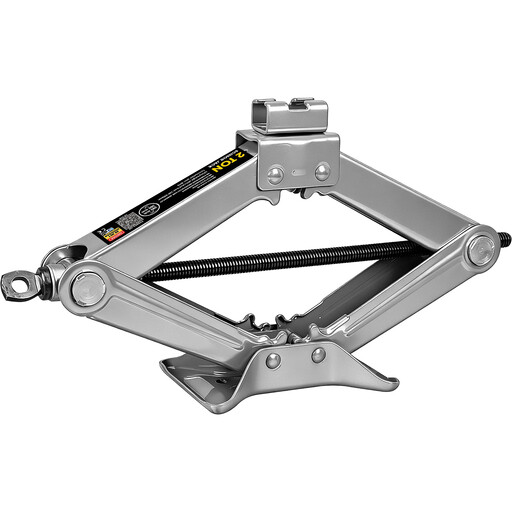
Why this model suits them: Its collapsible design makes it easy to store in the boot for occasional tyre changes. Its stated minimum height of 88 mm also works with some low vehicles.
The lifting range and capacity are clearly stated, so you can compare them with your vehicle's specifications before buying.
Forged steel construction, widened non-slip base and foldable design – handy to keep in the boot.
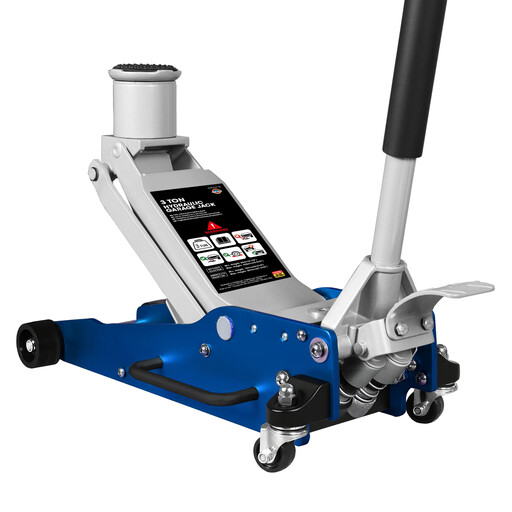
Why this model suits them: Users looking for a manoeuvrable piece of garage equipment will appreciate its low entry height and dual-pump lifting system.
Its stated entry height of 85 mm reduces the risk of incompatibility with a low car, provided you measure the lifting point beforehand.
3-tonne capacity and lifting range of 85 to 465 mm, with extension up to 541 mm according to the product specification.
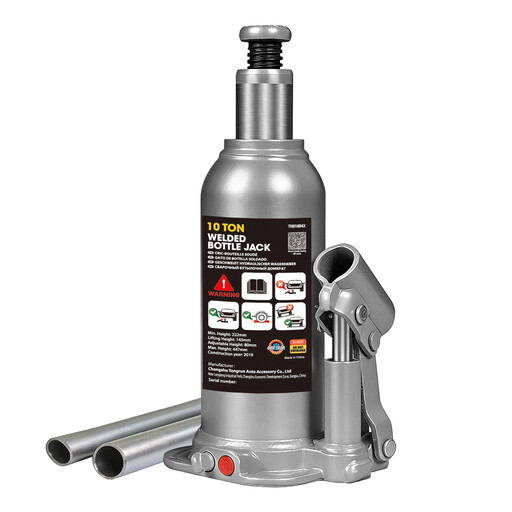
Why this model suits them: Its stated 10-tonne capacity makes it suitable for heavy goods vehicles, buses, construction plant and equipment requiring substantial vertical lifting.
Its lifting range of 222 to 448 mm and forged steel base allow you to check compatibility before use, rather than relying solely on the stated capacity.
Chrome-plated piston, height adjustment screw and overload safety valve, according to the product description.
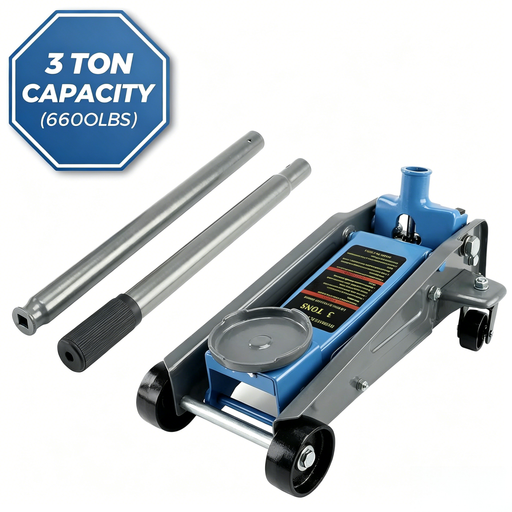
Why this model suits them: Its lifting range of 135 to 460 mm and swivel castors make it ideal as a garage jack for cars, SUVs and everyday vehicles.
The lifting dimensions are specified and the four wheels make positioning easy, without having to lift the jack.
3-tonne capacity, two fixed wheels and two 360° swivel castors for easy movement around the workshop.
Compare the vehicle's weight with the jack's capacity, then allow a safety margin. A 1.5 to 1.8-tonne model may suit some cars, while a 3-tonne car jack is often preferred for SUVs, MPVs or heavier vehicles. The capacity doesn't remove the need to check the lifting points and the available height.
No. A hydraulic car jack is designed for temporary lifting. To secure the vehicle or work on it, use properly rated axle stands and check the stability of the whole setup. The car must remain on a flat, firm and solid surface.
Clean the moving parts after each use, check for oil leaks and inspect the condition of the wheels, saddle and handle. Store the jack away from moisture and never exceed its rated load. If it lowers unevenly or develops a leak, stop using it immediately and consult the manufacturer's documentation.