
Livraison le jour même ou le lendemain

Qualité garantie

Débloquez vos offres de bienvenue: Livraison GRATUITE | Jusqu'à -80 % | 30 jours d'essai gratuits à JoyPlus
Téléchargez l'application
Changing a wheel, carrying out an oil change or inspecting a suspension system requires equipment that is stable, reliable and suitable for your vehicle. However, choosing a hydraulic car jack is not simply a matter of selecting the capacity shown on the box. The minimum height, lifting point and safety features are just as important in practice.
A 2-tonne car does not necessarily transfer its entire weight to the jack when it is only partially lifted. However, you must comply with the rated capacity specified by the manufacturer and take the distribution of the vehicle’s weight into account. A 3-tonne hydraulic car jack is suitable for many cars, some SUVs and MPVs. A 6-tonne model is better suited to pickups, light commercial vehicles and heavier vehicles.
So don’t choose a jack simply because its capacity seems high. Also check its dimensions, lifting height and whether the saddle is compatible with your vehicle’s lifting points.
A jack that is too tall may not fit under a low car, particularly a sports model or one fitted with side skirts. Conversely, a jack with insufficient maximum height will not lift an SUV’s wheel clear of the ground properly.
If you’re looking for a jack for a low car, choose a minimum height below the ground clearance measured at the lifting point. An extra-low aluminium jack may also be easier to transport and store. However, its light weight should not distract you from checking the maximum permitted load.
A jack is designed to lift a vehicle, not to keep it suspended for extended periods. Whenever you need to work under the car, fit suitable axle stands on a flat, hard and unobstructed surface. Apply the handbrake, engage a gear or select « P » on an automatic gearbox, then follow the manufacturer’s recommendations.
With its wheels and mobile base, a hydraulic trolley jack is particularly practical in a garage. It is generally suitable for changing a wheel and carrying out routine maintenance. More compact and upright, a hydraulic bottle jack can be useful where space is limited. A 6-tonne hydraulic bottle jack may therefore be suitable for an SUV, pickup or light commercial vehicle, provided its base is positioned securely on the ground.
Always compare:
The term « adjustable lifting height » may refer to an adjustment screw, an extension or an integrated lifting range. Check the product specifications to understand exactly how the mechanism works.
Steel provides a sturdy structure, but is generally heavier. Aluminium helps reduce weight, which can be useful for mobile use or with a leisure vehicle. Swivel castors make it easier to position a garage jack, but they must remain on a stable surface while lifting.
For a workshop or regular use, choose a model with a sufficiently long handle, a protected saddle and a design that allows precise positioning. For occasional use, a more compact model can mainly help save storage space.
A safety valve or overload valve helps reduce the risk of exceeding the intended capacity. The product specifications should also provide clear information about the manufacturer, conditions of use and warnings.
CE certification indicates a declaration of conformity with the European requirements applicable to the product. EN 1494 applies to mobile or movable lifting equipment intended for vehicles. These markings do not replace basic safety precautions: the load, the type of ground and the jack’s positioning remain essential.
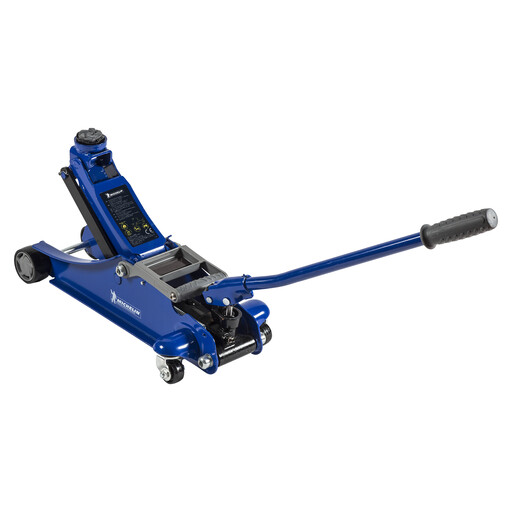
Why it suits this type of user: With a capacity of 1,800 kg and a height range of 105 to 350 mm, this hydraulic trolley jack is suitable for many passenger cars and occasional wheel changes.
Its 105 mm minimum height reduces the risk of choosing a jack that is too tall for a passenger car, provided you check the ground clearance first.
Swivel castors, a 360° rotating handle, a saddle with a rubber base and magnetic storage for small wheel nuts.
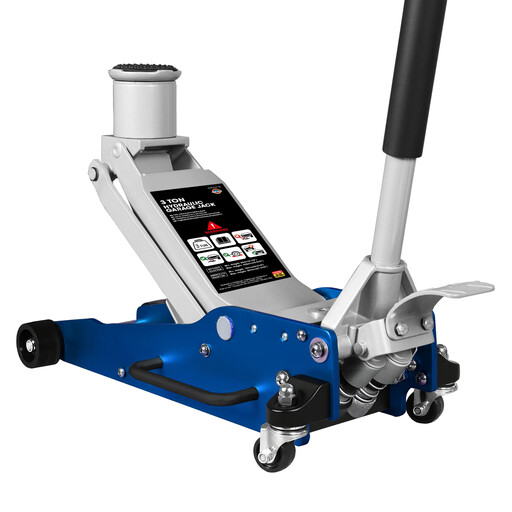
Why it suits this type of user: Its aluminium alloy construction and 85 mm minimum height make it suitable for drivers of low or sports cars looking for equipment that is easier to transport.
The stated range of 85 to 465 mm is clearly specified. An extension device increases it to 161–541 mm.
3-tonne capacity, dual pump, two lifting modes, and EN 1494 and CE markings listed in the product specifications.
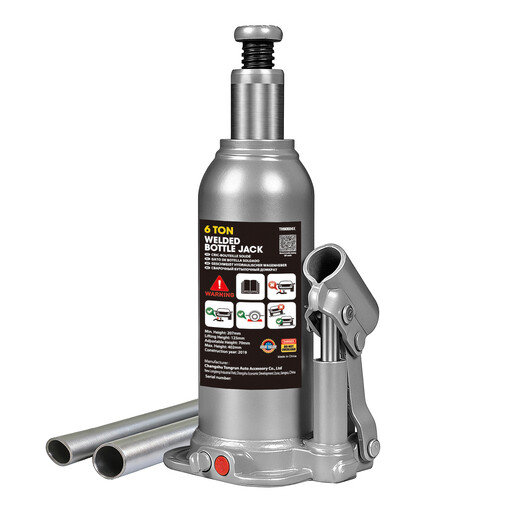
Why it suits this type of user: This 6-tonne hydraulic bottle jack is designed for SUVs, pickups and light commercial vehicles that require greater capacity than a standard car jack.
Its stated capacity of 6,000 kg and range of 207 to 402 mm allow you to check the required load and height precisely before buying.
Forged steel base, chrome-plated piston, non-slip saddle, adjustment screw and safety valve to protect against overloads.
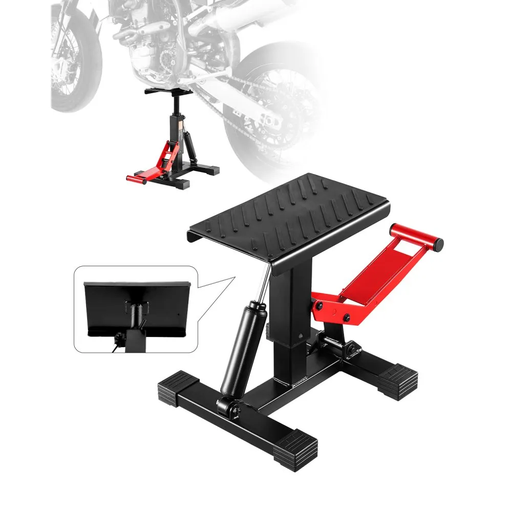
Why it suits this type of user: This hydraulic motorcycle jack is designed for motorbikes and light off-road vehicles, not for lifting a car.
Its 544 kg capacity helps prevent category errors: it should not be confused with a jack designed for a car, SUV or commercial vehicle.
Stated lifting range of 250 to 465 mm and a design dedicated to motorbikes and off-road vehicles.
Before each use, check the condition of the wheels, saddle and handle, then make sure there are no leaks. Close the release valve properly, position the saddle under the point specified by the manufacturer and pump gradually. Never place any part of your body under a vehicle supported solely by its jack.
After use, lower the mechanism completely, wipe down exposed surfaces and store the equipment away from moisture. An oil leak, uneven lowering or a distorted frame should result in immediate discontinuation of use. The jack’s service life depends on how often it is used for lifting, the load applied, storage conditions and compliance with the instructions.
We have put together a complete, real-time selection of products that meet these demanding criteria, as well as European safety requirements.
For a passenger car, a 1.8- to 3-tonne model may be suitable, depending on the vehicle’s weight and the manufacturer’s recommendations. Always check the vehicle’s weight and never exceed the capacity specified on the jack.
Measure the distance between the ground and the lifting point before buying. A low car requires a reduced minimum height, while an SUV often needs a greater maximum height. The lifting range must cover both measurements.
No. The jack is only intended to lift the vehicle. To work underneath it, use axle stands with a suitable capacity, placed on a flat surface and positioned according to the recommended support points.