
Livraison le jour même ou le lendemain

Qualité garantie

Débloquez vos offres de bienvenue: Livraison GRATUITE | Jusqu'à -80 % | 30 jours d'essai gratuits à JoyPlus
Téléchargez l'application
Whether you're taking notes in a lecture, signing an important contract, or letting your creativity flow, choosing the right pen is essential. The problem? The shelves are saturated with marketing promises that often hide future disappointment. A pen that smudges, a tip that snags the paper, ink that dries out before you've even finished the first chapter... These everyday frustrations are easy to avoid, as long as you know what to look for.
As the Head of Product Selections at Joybuy, my mission is to guide you through this jungle. Let's skip the technical jargon and get straight to the point: here's how to sidestep the common pitfalls and find the pen that's truly right for you.
The 3 Pitfalls to Avoid When Buying Pens
To avoid these traps, simply focus on a few simple but decisive features.
The type of tip is what defines the entire gliding sensation on paper.
The tip size, typically 0.5?mm (fine) or 0.7?mm (medium), makes all the difference. A fine tip is perfect for small handwriting and details, while a medium tip produces a bolder, more visible line.
Beyond just colour, the ink's composition is crucial.
When you spend hours writing, whether as a student or in the office, comfort is not an option. A rubber grip, a well-balanced weight, and a convenient mechanism (retractable or capped) make a real difference in preventing hand fatigue. It's the detail that changes everything for your office supplies or school supplies.
Every user has different needs. Here is a selection of products tailored to specific requirements, keeping in mind the quality criteria we've just discussed.

Why we chose it: Perfect for taking lecture notes or creating revision cards. Being able to cleanly erase a mistake, without cross-outs or correction fluid, is a huge time-saver and dramatically improves legibility. This pen set will see you through the entire semester, and the fine 0.5 mm tip is ideal for small handwriting and annotating in the margins.
This erasable pen tackles the problem at its source: no more need for correction tape. The thermosensitive ink vanishes without a trace, preventing the smudges of a classic pen or the mess of correction tape.
Thermosensitive gel ink for flawless corrections and a 0.5 mm needle tip for surgical precision in your note-taking.
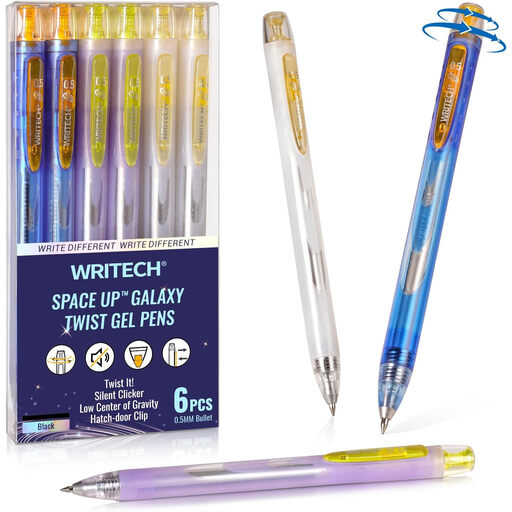
Why we chose it: In a professional setting, elegance is in the details. This pen's twist mechanism is completely silent—no more distracting *click-clack* sounds that break everyone's focus in a meeting. Its low centre of gravity ensures perfect balance for a quick signature or controlled note-taking, all within a sleek, professional design.
This is a world away from the cheap, plastic promotional pen. Designed for performance and elegance, its silent mechanism is a true feature built for the office environment. It's this kind of detail that makes all the difference.
Patented ultra-silent twist mechanism and a low centre of gravity for a smooth, controlled, and perfectly discreet writing experience.
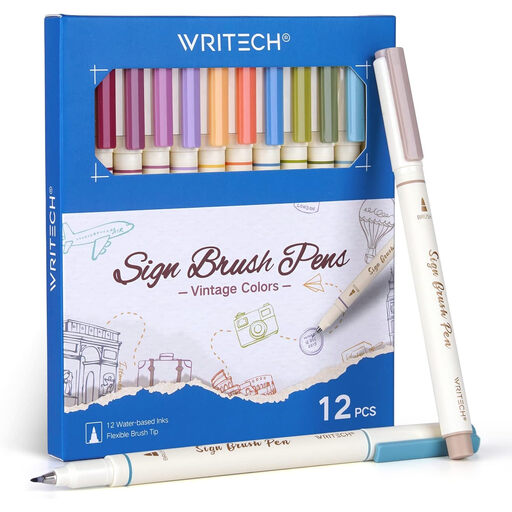
Why we chose it: For *lettering*, calligraphy, or illustrating in a *bullet journal*, versatility is key. The flexible and responsive brush pen tip on these pens allows you to create thick and thin strokes with surprising ease. The "vintage" colour palette is a real bonus for creating pages with a polished and harmonious aesthetic.
Forget generic marker sets with garish, mismatched colours. Here, the palette is carefully curated for a coherent and subtle artistic result. This is a specialist's tool that meets a real creative need.
A flexible, pressure-sensitive brush tip that's perfect even for beginners, plus a selection of 12 vintage colours to give your creations a unique touch.
We have curated a full range of products that meet our quality criteria and current standards.
It's all in the ink! The ballpoint pen uses a thick, oil-based ink, making it ultra-reliable and long-lasting. You need to apply slight pressure to write. The gel pen, on the other hand, contains a more liquid, water-based ink that glides across the paper for a smooth, effortless writing experience. Its colours are more vibrant, but you sometimes need to give it a second to dry.
The golden rule: always cap or retract the tip after use. Also, try to store them horizontally or tip-down, so the ink stays in contact with the ball. Finally, avoid leaving them in direct sunlight or in a freezing cold car during winter.
Not at all! The durability of a fine tip depends far more on the quality of its construction than its size. A well-designed tip (often made of tungsten carbide) paired with a good ink flow regulator will give you a clean, precise line without scratching the paper or risking a bend at the first word. The overall quality of the pen makes all the difference.