If you regularly freeze prepared portions, choose an appliance with a 4-star compartment and check its freezing capacity. Under EU regulations, this compartment must maintain food at −18 °C and meet specific freezing-capacity requirements. An upright freezer makes it easier to organise portions, while a chest freezer suits bulk storage; a compact freezer or fridge-freezer is better for occasional extra space. In every case, compare the freezer capacity, the space available, the room temperature and the model’s kWh/year rating.
Who is each type best suited to?
Households preparing meals each week
If you cook several meals in advance, how you organise tubs and bags matters just as much as capacity. If you’re freezing freshly prepared food, check that the model has a 4-star compartment and look at its freezing capacity too.
Households stocking up in bulk
If you store large quantities as well as prepared meals, consider the freezer capacity and how easy it will be to find what you need. If you’re installing it in a utility room or other outbuilding, also check the permitted ambient temperature range.
Households short on space
If your kitchen limits the size of appliance you can fit, compare the freezer compartment capacity rather than just the total capacity. A compact model or fridge-freezer can store a few portions, as long as it’s suitable for the space where you plan to install it.
What should you check before choosing?
Upright freezer
Choose one if: you want to sort portions separately and access different drawers regularly.
Bear in mind: check the available height and the capacity actually set aside for freezing.
Chest freezer
Choose one if: you store large quantities or bulky food, and have enough room to open the lid.
Bear in mind: you’ll need a system for finding smaller portions in the large compartment.
Fridge-freezer
Choose one if: you want everyday refrigeration and a supply of frozen meals in one appliance.
Bear in mind: the total capacity includes the fridge, so check the freezer compartment capacity separately.
Undercounter freezer
Choose one if: you need to fit a few extra portions into a small space.
Bear in mind: check the dimensions and ventilation requirements for the exact location you have in mind.
| What to consider |
What to check |
Who is it for? |
| Freezing prepared food |
Look for a 4-star compartment and check the freezing capacity in kg/24 h if you’ll be adding fresh food. |
I prepare several portions on the same day and want to know how much the appliance can freeze. Around 33% of consumers rank this capacity as their top priority. |
| Capacity and organisation |
Compare the net freezer capacity and the drawer or basket layout with the containers you use. |
Between homemade meals and shop-bought frozen food, I need to find each portion without disrupting my stock. For around 27% of consumers, organisation and capacity come first. |
| Installation location |
Compare the room temperature with the ambient temperature range specified for the model. |
The temperature in my garage or pantry changes with the seasons, so I need to know whether the appliance can operate there. This compatibility is the top priority for around 20% of consumers. |
| Energy use and maintenance |
Check the kWh/year rating and the defrosting system, taking the capacity and type of appliance into account. |
I keep my appliance running all year and want to factor in both electricity use and defrosting. Around 20% of consumers prioritise these practical considerations. |
Mistakes to avoid
-
Assuming a small freezer compartment is 4-star rated
A small compartment designed to store food that’s already frozen may not be suitable for freezing fresh meals. EU regulations define a 4-star compartment by its ability to maintain food at −18 °C and meet specific freezing-capacity requirements.
To freeze your prepared meals, look for the 4-star rating and the freezing capacity in kg/24 h in the appliance specifications.
-
Choosing a chest freezer without a system for smaller portions
A chest freezer can hold large quantities, but stacked tubs can make it difficult to find meals at the bottom.
Use baskets and date labels, and keep portions you’ll use first somewhere easy to reach.
-
Assuming a freezer will work in any outbuilding
The permitted ambient temperature range depends on the model. A feature advertised for certain appliances designed to work in cold rooms won’t necessarily apply to other models.
Compare the room temperature in winter and summer with the limits published for the appliance you’re considering.
-
Relying on the energy-efficiency rating alone
The rating letter alone doesn’t tell you how much energy appliances of different sizes and types use. ADEME points out that fridges and freezers run continuously.
Compare the kWh/year ratings of models with similar storage capacity, while keeping their freezer capacity in mind.
Brands to know when comparing types
Beko
Beko France offers drawer-style upright freezers, chest freezers and compact models. It’s a range worth exploring depending on whether you prioritise organisation or bulk storage.
- The drawers in upright models make it easy to separate different types of food.
- Beko France says that some models with Freezer Guard can operate down to −15 °C. Check this specification for the exact model before installing it in a cold room.
Electrolux
The Electrolux France range includes dedicated freezers and fridge-freezers, making it worth comparing the available capacity when planning a fitted kitchen.
- Specifications for some models include net capacity, climate class and freezing capacity.
- For a fridge-freezer, check the freezer compartment capacity separately: the total capacity doesn’t tell you how much room there is for frozen meals.
Bosch
Bosch Electroménager France offers freestanding and integrated upright freezers to consider if easy access to portions and internal organisation are priorities.
- Some models have removable drawers or shelves and a No Frost function.
- Features vary by model, so check the layout and defrosting system in the specifications for the one you choose.
Whirlpool
The Whirlpool France range includes chest and upright freezers, allowing you to compare a large storage compartment with vertical storage.
- Whirlpool presents chest freezers as a good option for bulk storage and also offers drawer-style upright models.
- The capacity and number of drawers listed for one model don’t represent the whole range.
Liebherr
Liebherr France offers compact freezers and upright models, which you can compare based on the space available and the capacity you need.
- Model specifications include dimensions and capacity; some models also have NoFrost.
- Don’t assume an appliance has the same capacity or defrosting system as another Liebherr model.
Appliances for different freezing needs
These Joybuy appliances show three ways to make room for prepared meals: a compact upright freezer, chest freezers and fridge-freezers. Start by choosing the type and capacity that suit your portions, then check the features that matter for your installation.
 Image unavailable
COMFEE' RCU60WH2(E), 60 L upright freezer
Worth considering if you want to organise a few portions in a compact freezer.
Its product title lists three drawers, a reversible door and an E energy rating. Before choosing where to put it, check the model’s ambient temperature range. Also check its kWh/year rating if energy use is a factor in your decision.
View on Joybuy
 Image unavailable
CHiQ JR99DWE, 99 L chest freezer
Worth considering if you prefer a chest freezer for bulk storage, while keeping some smaller portions separate.
The product title lists a 4-star compartment, a removable basket and an E energy rating. Before buying, check the kWh/year rating, defrosting requirements and ambient temperature range, especially if you plan to install it in an outbuilding.
View on Joybuy
 Image unavailable
CHiQ JR227LSE, 227 L fridge-freezer
Worth considering if you want to refrigerate everyday food and keep a separate supply of frozen meals in one appliance.
The product title lists 153 L of fridge capacity and 74 L of freezer capacity, as well as a 4-star compartment, a width of 54 cm and Low Frost. If you freeze several freshly prepared meals at once, check the capacity in kg/24 h.
View on Joybuy
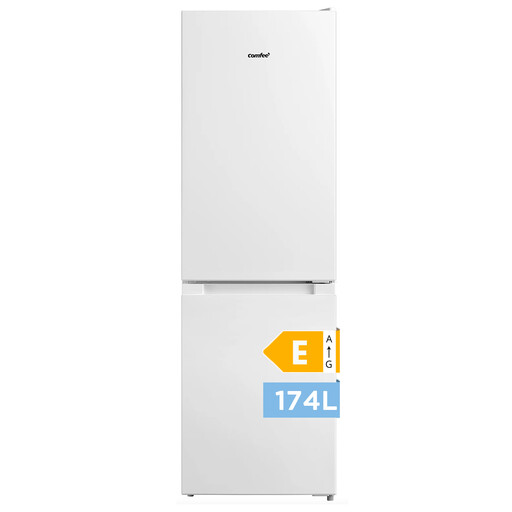 Image unavailable
COMFEE' RCB169WH2(E), 174 L fridge-freezer
Compare it with other fridge-freezers if you want to store a few prepared portions without installing a separate freezer.
The product title lists a 70/30 split, a 4-star freezer compartment, Low Frost and a height of 150 cm. Check the net capacity of the freezer compartment and its freezing capacity if you plan to store a batch of freshly prepared meals.
View on Joybuy
 Image unavailable
AUCMA, 291 L convertible fridge-freezer chest
Worth considering if you mainly need a large storage compartment that can be used as a freezer for prepared meals.
The product title lists a removable basket, five-level digital control and an E energy rating. Check the freezing capacity in kg/24 h for fresh batches and the ambient temperature range before installing it in a garage or cellar.
View on Joybuy
Frequently asked questions
How can I tell whether I can freeze prepared meals in a fridge-freezer?
Check that it has a 4-star compartment and look at its freezing capacity in kg/24 h. EU regulations require a 4-star compartment to maintain food at −18 °C and meet specific freezing-capacity requirements. The total capacity of a fridge-freezer includes the fridge, so it won’t answer this question.
What temperature should I aim for when storing frozen meals?
Keep the freezer compartment at −18 °C. Anses explains that freezing at this temperature stops bacteria from multiplying, but most micro-organisms survive. It won’t make a meal safe if it was stored for too long before being frozen.
Can a freezer run in a garage or cellar?
Yes, if the temperature in the room stays within the ambient temperature range permitted for that specific model. Some Beko France appliances are advertised as working down to −15 °C, but this feature doesn’t apply to every freezer. Check the limits listed for your model before installing it.
What else should I compare besides capacity?
If you’ll be adding fresh meals, compare the freezing capacity, the appliance’s ambient temperature range, its kWh/year rating and its defrosting system. ADEME points out that fridges and freezers run continuously. To assess energy use, consider the kWh/year rating alongside the capacity and type of appliance, rather than looking at the energy-efficiency rating alone.


