
Livraison le jour même ou le lendemain

Qualité garantie

Débloquez vos offres de bienvenue: Livraison GRATUITE | Jusqu'à -80 % | 30 jours d'essai gratuits à JoyPlus
Téléchargez l'application
Choosing a new duvet? It seems simple enough. But the market is saturated with marketing promises that often lead to restless nights. A duvet labelled "all-season" can quickly feel like a furnace in the summer or a mere sheet in the winter. As product experts, our mission is to teach you how to read between the lines on the labels to find THE perfect duvet for your sleep style and budget.
Before you pull out your credit card, here are the 3 pitfalls to avoid:
To make the right choice, forget the marketing jargon and focus on these three technical points. They are what define the comfort, lifespan, and hygiene of your future duvet.
The choice of fill directly impacts the duvet's breathability, weight, and maintenance.
Fill weight (in g/m?) indicates the weight of the filling. But be careful, this number must always be analysed in relation to the type of fill (natural or synthetic) and your bedroom's temperature.
Often overlooked, the shell is crucial: it's what contains the fill. Its material and the quality of its weave directly impact the feel and durability. Cotton (percale, sateen) remains a safe bet for its softness and breathability.
Finally, demand proof! Labels are your best allies for guaranteeing a healthy, high-quality product:
Rather than long lists, here are a few options that cater to distinct user profiles, taking into account our quality and safety criteria.
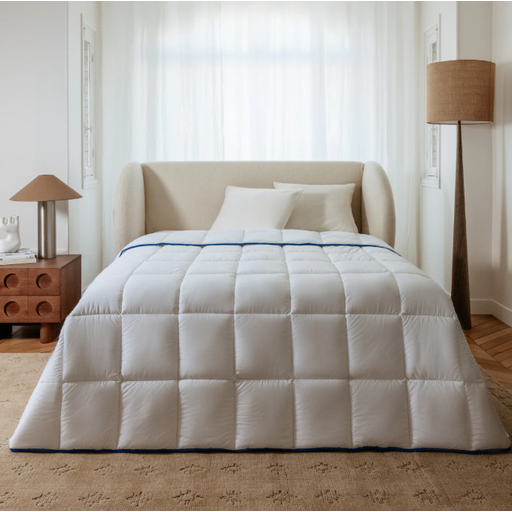
Why we recommend it: It's the perfect solution for those who always feel too hot or want a duvet dedicated to the warmer months. Its synthetic fill and cotton percale shell make it a lightweight and breathable duvet, and a breeze to maintain.
No false promises here. This is a pure summer duvet (250 g/m?), designed for lightness. It avoids the main flaw of low-end "4-season" duvets: making you sweat as soon as the temperature rises.
A trio of certifications (OEKO-TEX, Certipur, Sanitized) that proves in black and white its hypoallergenic qualities and the complete absence of harmful substances.
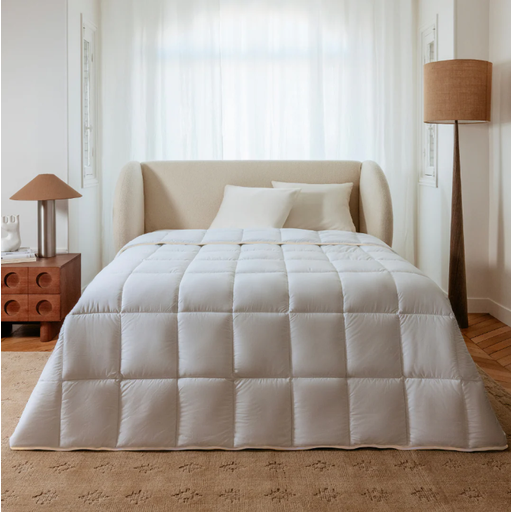
Why we recommend it: For those who swear by the comfort and thermoregulation of a natural duvet. The 90% feather and 10% down blend is an excellent compromise between loft and insulation, ideal for use most of the year.
Here, performance doesn't come from excessive fill weight, but from the quality of the natural fill that regulates temperature. Its baffle-box stitching ensures perfect heat distribution and prevents cold spots from forming.
Exceptional breathability, thanks to the combination of a natural fill and an organic cotton sateen shell. The 220x240 duvet size is the perfect standard for double beds (140 or 160 cm).
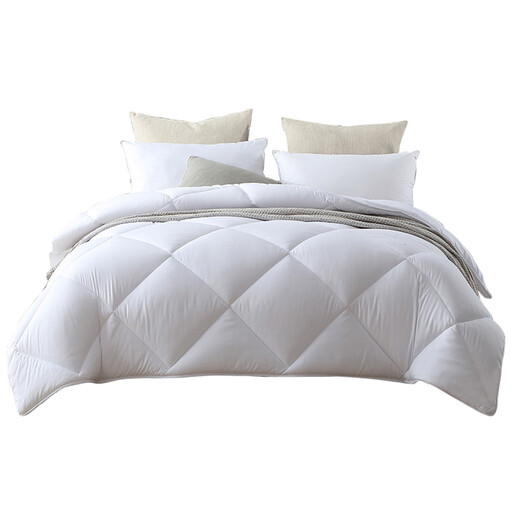
Why we recommend it: Designed for those who make the war on allergens a priority. Its selling points? "Non-allergenic" and "machine washable"—a pragmatic duo for a perfectly healthy sleep environment.
It goes beyond a simple "hypoallergenic" claim. As a machine-washable duvet, it provides a concrete solution for maintaining perfect hygiene and waging war on dust mites, wash after wash.
Its ease of maintenance. For allergy sufferers, being able to wash a duvet regularly isn't a luxury; it's the best strategy for permanently eliminating allergens.
Discover our full selection of duvets, all approved according to our quality and safety criteria.
It all depends on the fill and the care. Expect 5 to 7 years for a good-quality synthetic duvet. A natural duvet, if cared for and aired out properly, can last for 10 or even 15 years. The best practice: shake it out every morning to restore the fill's loft.
First step: read the label! For a machine-washable duvet, you'll need a large-capacity washing machine (12 kg or more) to avoid compressing it. Run a delicate cycle at 30 or 40°C. The crucial step is drying: for a natural duvet, put it in the tumble dryer on low heat with dryer balls (or tennis balls) to help the down regain its full volume. When in doubt? Entrust it to a professional dry cleaner—it's the worry-free option.
For a Queen Size bed (160x200 cm), the standard size is a 220x240 cm duvet. It provides a nice drape on each side and enough room so no one is pulling the covers during the night. If you like to be really wrapped up or if your mattress is very thick, you can even opt for the 240x260 cm size.