
Livraison le jour même ou le lendemain

Qualité garantie

Débloquez vos offres de bienvenue: Livraison GRATUITE | Jusqu'à -80 % | 30 jours d'essai gratuits à JoyPlus
Téléchargez l'application
Replacing your cookware is an investment designed to last. Yet, faced with a jungle of marketing claims, it's easy to end up with a set of pots and pans that warps, loses its coating after a few months, or worse, delivers disappointing performance on an induction hob. To avoid buyer's remorse, here's how to navigate the most common pitfalls.
Here are 3 common mistakes that can cost you dearly?:
To ensure you don't regret your purchase, focus on a few objective technical points. These are the true measure of the quality and durability of your future cookware set.
The choice of material determines everything: its use, cooking performance, and maintenance.
An induction hob works using a magnetic field. For optimal efficiency, the base of the utensil must be perfectly flat and made of a thick ferromagnetic material. A "sandwich" base (a layer of aluminium or copper between two layers of stainless steel) is often the highest-performing solution, as it combines the thermal conductivity of aluminium with the magnetic properties essential for induction. Before buying, check for the spiral-shaped pictogram and, if possible, inquire about the thickness of the base.
For healthy cooking, transparency is non-negotiable. The labels to look for on non-stick cookware are as follows?:
No endless lists here. We've preferred to match products with specific user profiles to help you find the set that truly fits your daily life.
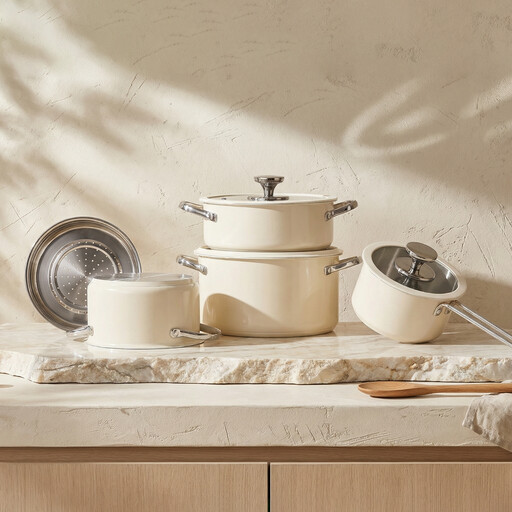
Why it's a great choice : This 4-piece set (saucepan, stockpot with steamer, cooking pot, and high-sided pot) covers the essential daily needs of a family, from simple reheating to preparing soups and stews.
It avoids the trap of oversized sets by focusing on 4 versatile and practically sized pieces, without superfluous accessories. The composition is clear, concise, and functional.
It combines a durable and healthy 304 stainless steel interior with a ceramic exterior that simplifies cleaning and resists discolouration.
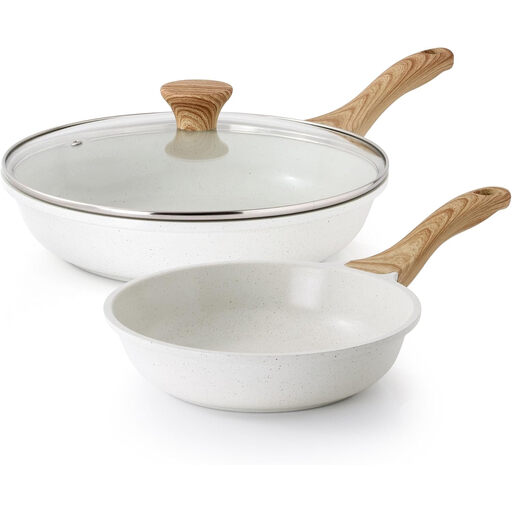
Why it's a great choice : This pair of frying pans is designed for those who prioritise healthy, stick-free cooking. The ceramic coating allows you to cook with minimal fat, which is ideal for omelettes, sautéed vegetables, and fish.
It directly addresses the trap of vague health claims by specifying that its coating is made without the intentional addition of PFAS, PTFE, PFOA, lead, or cadmium.
Its high magnetic conductivity stainless steel base ensures universal compatibility (including induction) and rapid, even heating.
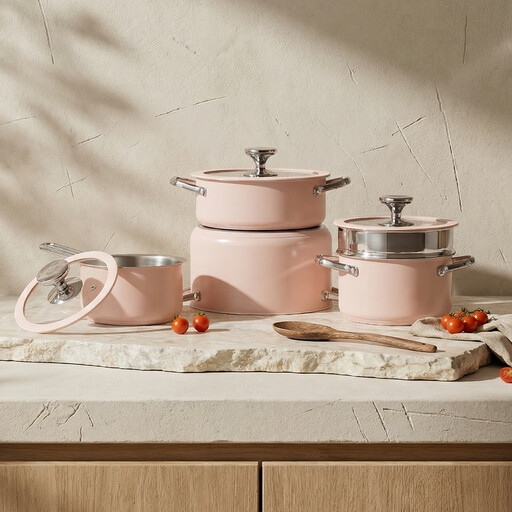
Why it's a great choice : For those who refuse to choose between aesthetics and performance. This set offers the same benefits as its beige counterpart but with a colourful finish that adds a pop of personality to the kitchen.
It sidesteps the "subpar induction compatibility" trap thanks to its robust 304 stainless steel construction, which ensures a sound base for all hobs and rock-solid durability.
Its 304 stainless steel internal structure maintains its integrity up to 870 °C, guaranteeing resistance to warping even in cases of accidental overheating.
Explore our full selection of products that meet our quality criteria and current safety standards.
The longevity of a non-stick coating, even a quality ceramic one, depends heavily on its care. On average, with careful use and cleaning (no dishwasher, no metal utensils, no overheating while empty), a good pan can retain its properties for 2 to 5 years. Stainless steel, on the other hand, can last a lifetime.
The magnet test is foolproof. If a magnet (a fridge magnet will do) sticks firmly to the outer bottom of your pot or pan, it is induction-compatible. If it doesn't stick, or sticks very weakly, it will not work.
Absolutely. Food-grade stainless steel (like types 304 or 18/10) is considered one of the safest and most inert materials for cooking. It is non-porous, does not react with foods (even acidic ones), does not leach any substances, and is remarkably resistant to rust and corrosion.