
Same-day & Next-day Delivery

Quality Guaranteed

Unlock Your Welcome Offers: FREE Delivery | Up to 80% OFF | Free 30-day JoyPlus trial
Download the APP
Buying bottled water can quickly become a headache. Between the chore of carrying heavy packs and the maze of labels on the shelf, it's easy to just grab the first bottle you see. However, not all waters are created equal, and some, despite slick marketing, may not be right for your needs.
Our editorial team is here to help you see things more clearly. Let's forget the slogans and focus on the facts: here are the most common pitfalls and the objective criteria for choosing the ideal bottled mineral water for your home or office, and getting it delivered effortlessly.
The Myth of "Absolute Purity": Many brands promote an image of immaculate purity. Yet, behind this marketing term lie very different realities. A water can be "pure" because it's free of pollutants, but its mineral composition varies enormously. A water very rich in minerals won't be suitable for everyone (be careful with infants!), while a very low-mineral water may not meet the needs of athletes or people with deficiencies.
The Hidden Sodium in Sparkling Waters: Do you enjoy some fizz with your meals? Be wary: many sparkling waters, even those that seem healthiest, have a high sodium (salt) content. For daily consumption or as part of a low-salt diet, this detail is anything but trivial.
The Wrong Format for Your Needs: Buying a large pack of 1.5L bottles seems economical, but is it really practical for daily use? If you live alone or drink little, an opened bottle will lose its freshness (and its bubbles, for sparkling water) long before it's finished. Conversely, smaller formats, while convenient on the go, generate more plastic waste and cost more per litre.
To make an informed choice, you just need to know where to look. Here are the three key indicators to check on every label.
This indicator, expressed in milligrams per litre (mg/L), measures the total amount of minerals (calcium, magnesium, sodium, etc.) remaining after the water is heated to 180°C and evaporated. It's the most reliable criterion for knowing the mineral "load" of a water.
Sodium is an essential mineral, but in excess, it's harmful to your health. When you want to buy water online, especially sparkling water, take a look at the "Sodium" or "Na+" line.
Home water delivery frees you from the chore of transport and allows you to opt for larger, often more economical formats.
Here are a few options that cater to different user profiles, taking into account the criteria we've just discussed.
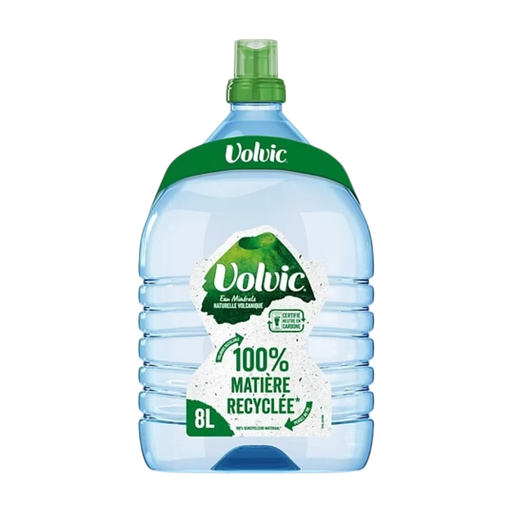
Editor's Take: This fountain format is the ideal solution for regular family consumption. No more multiplying plastic bottles! It's easy to store, and its tap is as practical for children as it is for adults. Volvic water, with its low mineral content, is suitable for everyone.
It solves the problem of an unsuitable format by offering a practical home solution that preserves the water's quality for much longer than a large open bottle.
The container is made from 100% recycled PET (excluding the tap and film), a welcome gesture for limiting your environmental impact.
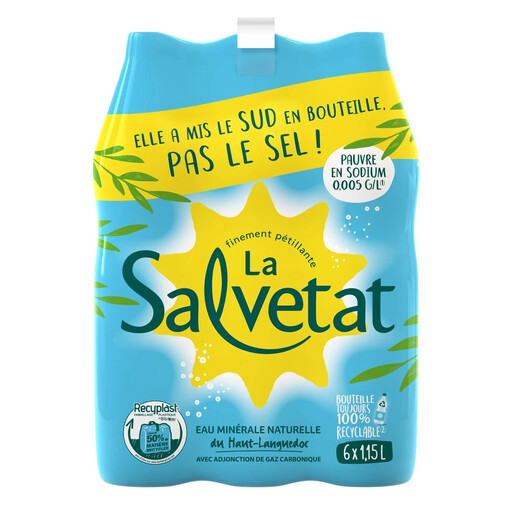
Editor's Take: For those who can't do without daily sparkling water but are watching their salt intake, Salvetat is a go-to choice.
It bypasses the high-sodium trap. With only 5 mg of sodium per litre, it's one of the least salty sparkling waters on the market, perfect for low-sodium diets.
Its effervescence is 100% natural, acquired during its underground journey. The result: fine bubbles that are particularly pleasant on the palate.
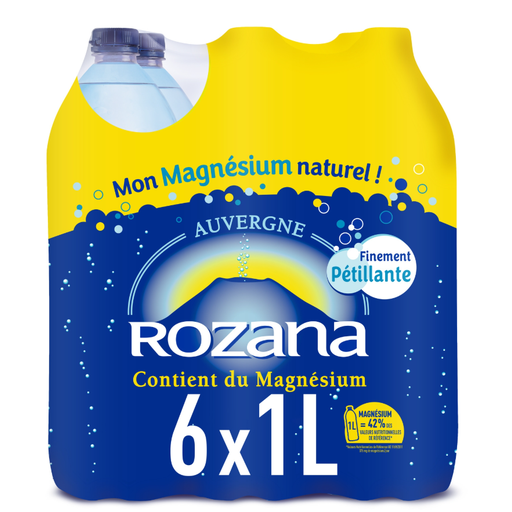
Editor's Take: Rozana stands out for its unique composition. It's a highly relevant option for people looking to increase their magnesium intake naturally, simply by hydrating.
It goes beyond the simple marketing claim of "purity" by offering a clear, functional benefit that can be verified on the label. No false promises, just a solution for a specific health need.
Its 160 mg/L magnesium content is one of the highest on the French market. A true health benefit.
We have compiled a complete selection of products that meet our selection criteria and current regulations.
The main difference lies in the stability of their composition. A natural mineral water has a composition of minerals and trace elements that is stable and guaranteed over time. In contrast, a spring water is naturally potable, but its composition can vary. For specific needs (low-sodium diet, calcium intake, etc.), it's better to turn to a natural mineral water, whose composition is known and reliable.
For still water, it is advisable to consume it within 48 hours of opening and to keep it in the refrigerator to preserve its taste and prevent bacterial growth. For sparkling water, the challenge is to keep the bubbles! It's best to consume it within 24 hours, making sure to close the cap tightly.
The first advantage is obvious: it's the end of the chore of carrying heavy, bulky packs. This is a considerable saving of time and energy, especially appreciated by families, offices, or people with reduced mobility. Home water delivery also allows you to better manage your stock so you never run out, and to access a much wider choice of brands and formats than in-store.