
Livraison le jour même ou le lendemain

Qualité garantie

Débloquez vos offres de bienvenue: Livraison GRATUITE | Jusqu'à -80 % | 30 jours d'essai gratuits à JoyPlus
Téléchargez l'application
Smartphones, computers, small appliances, power tools... our devices are multiplying, and with them, the headache of plugging everything in. Finding the right outlet at the right time can be a real challenge. However, hastily choosing a power strip or extension cord isn't just frustrating—it's potentially dangerous. As a product expert for the Joybuy editorial team, I'm here to help you see things more clearly, avoid the most common traps, and make a safe and smart choice.
Before we even start comparing models, let's review the three classic mistakes that can cost you dearly, both in money and safety. Knowing them is the first step to avoiding them.
You don't need to be an engineer to make the right choice. You just need to understand a few key technical points that guarantee a high-performance, durable, and, above all, perfectly safe product.
The maximum power your equipment can handle is the number one criterion. In Europe, a standard home outlet is rated for 16 Amperes (A), for a maximum power of 3680 Watts (W). In the US, it's typically 15 Amps and 1800 Watts. This is information you should always check, especially if you're looking for an extension cord or a power strip for power-hungry devices (space heater, oven, etc.). Also, pay attention to the cable gauge: a wire that's too thin (e.g., 16 AWG instead of 14 AWG) on a long cable reel can lead to overheating and a fire hazard.
Decipher the safety acronyms. The CE mark attests to compliance with European directives, but national standards like NF (French Standard) or UL (Underwriters Laboratories) go further: they are true seals of quality and safety, validated by stricter tests conducted by an independent body. For your valuable electronics (computer, TV, gaming console), a surge protector power strip is not a luxury. It acts as a shield by absorbing voltage spikes (from storms, brownouts) that could damage them. Finally, for outdoor use or in a damp room, a high Ingress Protection (IP) rating, like on a waterproof floor socket, is non-negotiable.
Nearly all our devices now charge via USB. A USB power strip has therefore become an essential. Pay attention to the details:
There's a solution for every need. To help you navigate the options, we've selected three products that meet specific needs while adhering to our criteria for safety and practicality.
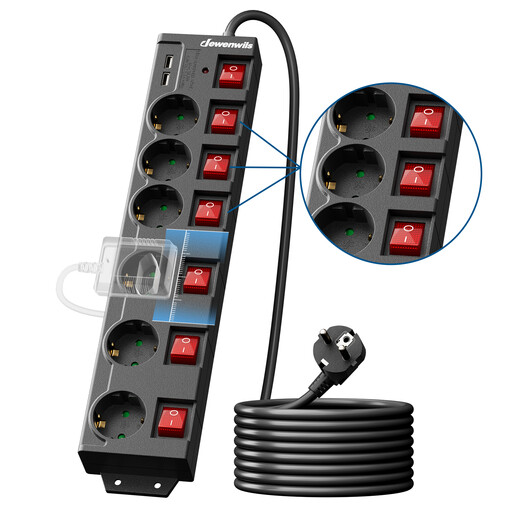
Why we chose it: Perfect for outfitting a home office from top to bottom. Its 5-meter cable offers maximum flexibility for arranging your workspace. The individual switches are a game-changer: they allow you to cut power to standby devices to lower your electricity bill and reduce your carbon footprint.
It checks all the boxes for safety (overload and surge protection) and practicality (individual switches). Most importantly, the generous spacing and 45° orientation of the outlets put an end to the puzzle of bulky chargers blocking each other.
6 x 16A outlets, 2 USB ports, surge protection, individual switches, and an extra-long 5-meter cable.
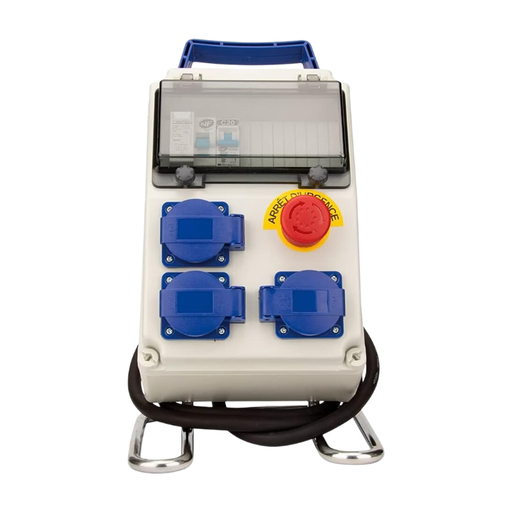
Why we chose it: On a construction site, safety is not an option. This power box is built for extreme conditions: its IP54 certification guarantees resistance to dust and water splashes, while the 30mA residual current device (RCD) and emergency stop protect both the worker and their equipment.
It eliminates the deadly risk of using domestic-grade equipment on a worksite. Far more than a simple extension cord, this construction site box is a complete, professional-grade unit, certified and compliant with the strictest safety standards (EN 60439).
IP54 protection, included 30mA RCD and 20A circuit breaker, 3 waterproof sockets, metal stand, and carrying handle.
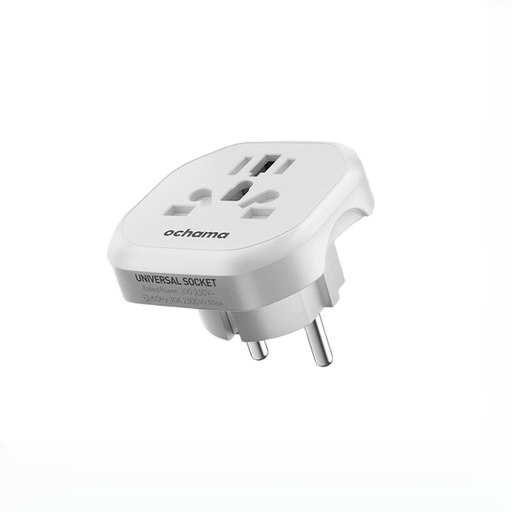
Why we chose it: The essential accessory for globe-trotters. Ultra-compact, it's compatible with outlets in over 150 countries. Its robust design with fire-retardant materials and child safety features make it a reliable and reassuring travel companion.
It tackles the adapter/converter confusion head-on. The product explicitly states that it is a plug adapter and not a voltage transformer. This is a critical reminder: always check that your devices are marked "100-240V" before plugging them in.
Compatibility in over 150 countries, compact and shock-resistant design, integrated child safety.
Power strips, extension cords, compact adapters... We've analysed dozens of products to select only those that combine safety and practicality, compliant with the highest standards.
1. What's the difference between a basic power strip and a surge protector? A standard power strip only multiplies the number of available outlets. A surge protector power strip goes further: it integrates an electronic component (a varistor) that detects and absorbs sudden voltage surges on the network. It's a true shield that protects your valuable devices (computer, TV, internet router) from the sometimes irreversible damage caused by a thunderstorm or power fluctuation.
2. Can you plug multiple power strips into each other? Absolutely not! This is an extremely dangerous practice known as "daisy-chaining." Plugging power strips in a series creates a risk of overloading the original wall outlet. The combined power draw of all the devices can easily exceed the authorised limit (e.g., 1800W in the US), leading to cable overheating and a fire hazard. Opt for a power strip with more ports or an extension cord of the correct length instead.
3. How do I choose a travel adapter for the United States or the United Kingdom? The first thing to do before you travel: check the label on your chargers (phone, laptop, etc.). If it says "INPUT: 100-240V", a simple travel adapter is all you need. If your device only accepts "230V" (or "120V"), you will need a voltage converter, which is a much heavier and more expensive device. For the United Kingdom, choose a Type G adapter (3 rectangular prongs); for the United States, a Type A or B (2 or 3 flat prongs).