
Livraison le jour même ou le lendemain

Qualité garantie

Débloquez vos offres de bienvenue: Livraison GRATUITE | Jusqu'à -80 % | 30 jours d'essai gratuits à JoyPlus
Téléchargez l'application
A household disinfectant isn’t chosen solely for its fragrance or its « 99,9 % » claim. The formulas and usage precautions can vary enormously between hand sanitiser, a surface disinfectant, a bathroom cleaner and a product designed for use on skin. Choosing the wrong type could make your purchase pointless, damage a surface or irritate your skin.
Here are the criteria to check before you order, along with a selection of products suited to different uses.
A product can remove grease, limescale or dust without having a documented disinfectant action. Conversely, a disinfectant doesn’t always replace cleaning beforehand. On a very dirty surface, residue can prevent the product from coming into proper contact with micro-organisms.
Before use, check that the label clearly distinguishes between cleaning, disinfection and, where applicable, deodorising.
Contact time is how long a surface needs to remain wet or covered with the product. It varies depending on the formula and the action claimed. Wiping away a disinfectant spray immediately could therefore significantly reduce its effectiveness.
Always follow the manufacturer’s instructions rather than the slogans printed on the front of the packaging.
Hand sanitiser is designed for hands, while a floor disinfectant or bathroom disinfectant is formulated for surfaces. A product intended for skin shouldn’t be applied to a table, and disinfectant wipes for surfaces should never be used to clean your hands.
This distinction is particularly important in households with children, pets or people with sensitive skin.
Start by identifying the area you need to treat:
The « bleach-free » claim may appeal if you want to avoid chlorine, but it doesn’t guarantee that the product is suitable for every surface. Chlorine-based formulas, meanwhile, require particular care and must never be mixed with acidic or ammonia-based products.
European references on the label provide more specific information than marketing claims alone. The most common include:
A product described as bactericidal, fungicidal and virucidal must only be used under the stated conditions: dosage, temperature, contact time and surface type. Also check the product use category, such as TP1 for human hygiene or TP2 for surfaces.
Depending on your needs, check whether the product contains alcohol, chlorine, hydrogen peroxide or quaternary ammonium compounds. If you’re sensitive to fragrances, consider a lightly scented formula and ventilate the room during use.
The format is also worth considering:
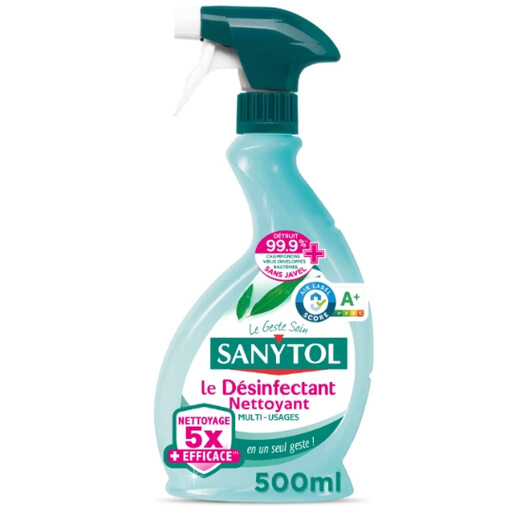
Why it suits this type of user : This ready-to-use spray is ideal for households that want one product for regularly treating handles, sinks, worktops and toilet bowls. The product details specify a bleach-free formula and a 5-minute contact time for general use.
The label clearly distinguishes use on surfaces from use on skin. It also specifies that surfaces in contact with food, toys or animals must be rinsed with drinking water.
500 ml format, eucalyptus fragrance and an active ingredient listed as 0,2 % didecyldimethylammonium chloride.
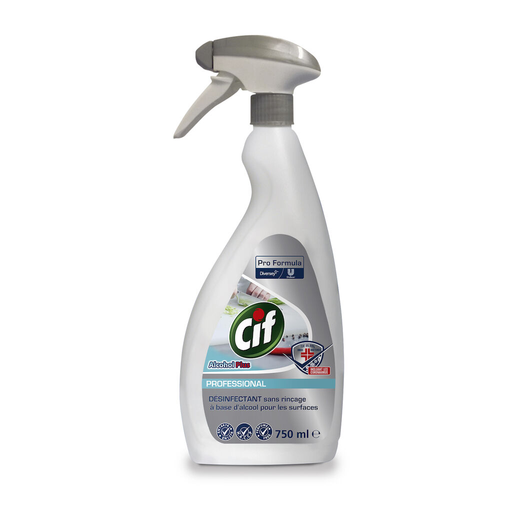
Why it suits this type of user : This ready-to-use spray is for people looking for a product dedicated to small surfaces, particularly in a kitchen or professional setting.
The product details specify a formula containing 80 % denatured ethanol, no-rinse use, and bactericidal, fungicidal and virucidal action according to the standards listed.
750 ml bottle, suitable for surfaces in indirect contact with food, and dries without rinsing according to the label.

Why it suits this type of user : The 5 l container is ideal for large areas, families and cleaning or catering professionals who regularly use a floor disinfectant.
The product details specify the dilution, contact time and rinsing required for surfaces in contact with food. That means there’s no need to guess the dosage.
Bleach-free formula, professional-size 5 l container and claims in line with the EN 13697, EN 1650 and EN 14476 references listed in the product details.
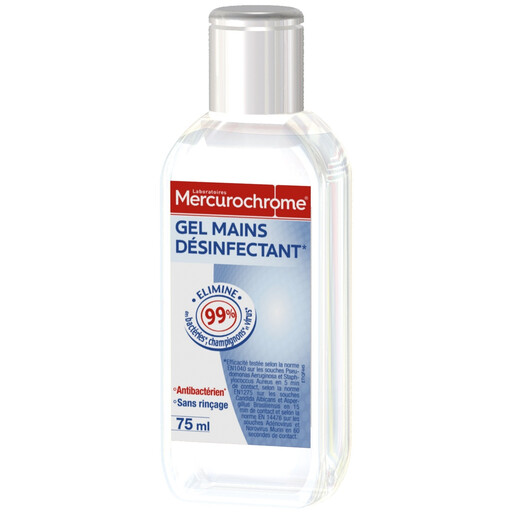
Why it suits this type of user : Its compact size is ideal for travel, public transport or situations where washing your hands with soap and water isn’t possible.
It’s clearly labelled as a hand product, not for surfaces or wounds. The instructions say to apply it to dry hands and rub until completely dry.
75 ml bottle, no-rinse gel and an ethanol content listed as 61 % in the product details.
We’ve put together a comprehensive, regularly updated selection of products that meet these demanding criteria and comply with European safety regulations.
No. Check the list of compatible materials on the label. Metal, untreated wood, natural stone, textiles and surfaces in contact with food may require specific precautions. Follow the rinsing instructions too.
It depends on the formula and storage conditions. Keep the bottle closed in a cool place out of direct sunlight, then check the date and batch number on the packaging. If the product’s smell, texture or colour seems unusual, stop using it.
They’re handy for small areas or when you’re out and about, but the cost per treated surface may be higher than with a spray or container. For frequent use, compare the volume, number of applications and contact time, rather than looking at the price alone.