
Livraison le jour même ou le lendemain

Qualité garantie

Débloquez vos offres de bienvenue: Livraison GRATUITE | Jusqu'à -80 % | 30 jours d'essai gratuits à JoyPlus
Téléchargez l'application
A splash of oil on your extractor hood, a hob marked by cooking, or a barbecue grate caked with residue – these don't all need the same product. Yet the household degreasing product aisle is packed with sprays, gels, powders, washing-up liquids and appliance tablets.
The risk is twofold: buying a formula that's too harsh for a delicate surface, or conversely, too gentle to tackle baked-on grease. Here are the criteria to check before choosing a kitchen degreaser, an oven cleaner or a multi-surface product.
A powerful degreaser may contain alkaline agents, solvents or chlorine. It will be effective on certain cooked-on greases, but not necessarily suitable for aluminium, painted surfaces, seals or ceramic hobs.
A formula labelled "multi-purpose" therefore deserves a careful read of the label. Check which surfaces are compatible, but also those explicitly excluded.
Any surface that comes into contact with food – worktop, sink or cooking grate – should generally be rinsed with drinking water after application. The absence of a rinse is not a universal advantage: it mainly applies to certain floor cleaners, provided the recommended dilution is followed.
An eco-friendly degreaser may rely on naturally derived ingredients, recyclable packaging or an environmental label. This does not guarantee its compatibility with all surfaces, nor that no precautions are needed. L'Arbre Vert, for example, claims EU Ecolabel certification and a formula free from phosphonates, colourants and MIT isothiazolinones, but still recommends testing on an inconspicuous area first.
A gel clings longer to vertical surfaces, while a spray makes targeted application easier. A powder like bicarbonate of soda or soda crystals requires a bit of preparation, but can prove handy for some intensive cleaning jobs.
Read the information about surfactants, alkaline agents, solvents, bleaching agents and fragrances. A corrosive or irritant product requires wearing gloves and, in some cases, eye protection.
Never mix a degreaser with bleach, an acid product or another cleaner. Some combinations can release dangerous gases. Ventilate the room and keep products out of reach of children.
A 500 to 750 ml bottle is suitable for targeted use. A one-litre container or a concentrated formula will be more practical for families who regularly clean floors, appliances and kitchen surfaces. For a dishwasher, choose a product designed for internal machine maintenance rather than a degreaser intended for surfaces.
Tablets and capsules simplify dosing, but must be stored in a dry place. Degreasing washing-up liquid is suitable for hand-washing plates, pans and utensils, while a dishwasher cleaner is used on an empty cycle.
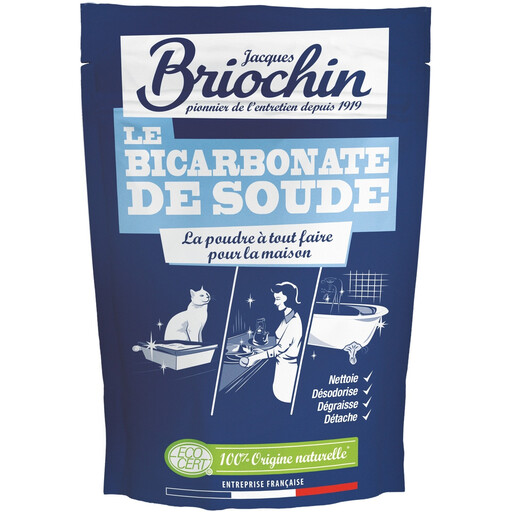
Why this choice suits this profile: Its powder format lets you prepare a paste or solution as needed, without cluttering a small home with multiple bottles.
It stops you reaching for a highly alkaline spray for a light soiling. Testing on a small area is still recommended on delicate materials.
A fine bicarbonate-based powder, usable for cleaning, deodorising and degreasing after mixing with water.
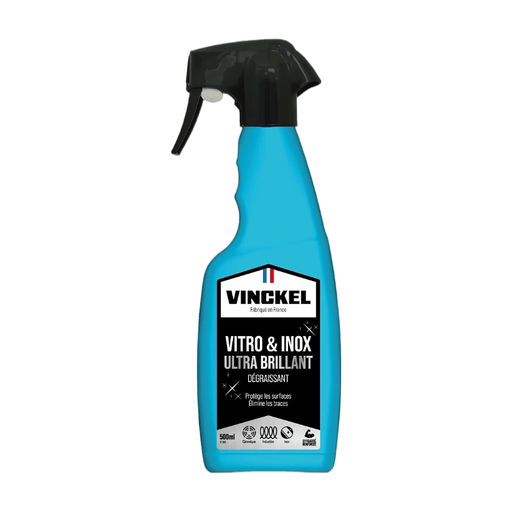
Why this choice suits this profile: It targets kitchens fitted with stainless steel, glass surfaces, ceramic or induction hobs, where a streak-free finish matters as much as degreasing.
Its purpose is clearly defined, which limits the risk of using an oven cleaner or a chlorinated product on a sensitive surface.
A 500 ml format, application with a soft cloth and a finish designed for stainless steel, ceramic hobs and induction hobs.
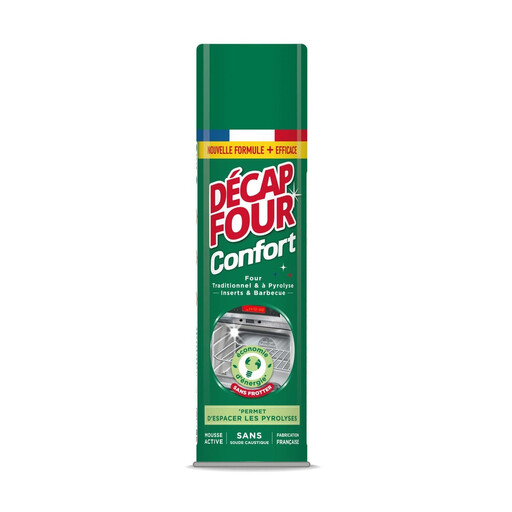
Why this choice suits this profile: Its aerosol format and stated dwell time meet the needs of occasional cleaning of ovens, grills, planchas or barbecues.
The product page specifies incompatible surfaces, including aluminium, copper, painted surfaces and certain oven interiors.
A formula stated to be free from caustic soda, application from approximately 20 cm and a dwell time that varies depending on the surface temperature.
For dishwasher maintenance, a dedicated product like SUN Classic Dishwasher Machine Cleaner is used in an empty machine, with one sachet and a short or eco cycle. For hand-washing dishes, a liquid like PAIC Excel 24h Ultra Degreasing Dishwashing Liquid or RAINETT Eco Washing-Up Liquid is suitable for this purpose, but must not be poured into the dishwasher.
Choose an oven cleaner specifically compatible with your appliance and follow the stated dwell time. Products like DECAP'FOUR or Wpro specify which surfaces are allowed and which are not. Remove the racks, ventilate the room, wear gloves and rinse thoroughly.
Only if the manufacturer states its compatibility with the material in question. After application, rinse any surface intended for food contact with drinking water. Test on an inconspicuous area for painted, laminate or delicate surfaces.
The shelf life depends on the formula and the instructions on the packaging. Store the bottle closed, in a cool place away from sunlight. Powders must be kept dry, while aerosols must not be exposed to a temperature higher than that stated on the label.