Anyone who puts fibre first
If fibre content guides your choice, start with the grams listed per 100 g. However, muesli and bran cereal are different categories, so also check the recipe you want to eat.


To choose muesli for breakfast at your hotel, compare the fibre per 100 g, then check the sugars, ingredients and allergens. Under EU Regulation (EC) No 1924/2006, the claim ‘high fibre’ requires at least 6 g of fibre per 100 g or 3 g per 100 kcal. A bran cereal may also suit you if fibre is your priority, but it isn’t muesli. At the buffet, only choose an option if you can check the information relevant to your allergy before serving yourself.
If fibre content guides your choice, start with the grams listed per 100 g. However, muesli and bran cereal are different categories, so also check the recipe you want to eat.
If you’re looking for wholegrains with fruit or nuts, check the ingredients list, fibre and ‘of which sugars’ figures separately. The claim ‘no added sugars’ doesn’t replace this comparison.
At the buffet, identify the product and check its ingredient and allergen information before serving yourself. This is especially important for recipes containing cereals with gluten or nuts.
| Criteria | What to check | Who is this for? |
|---|---|---|
| Fibre content | Compare the fibre per 100 g. For the ‘high fibre’ claim, EU Regulation (EC) No 1924/2006 sets the threshold at 6 g per 100 g or 3 g per 100 kcal. | For my hotel breakfast, I want to be able to compare the fibre content shown on the label first. Around 46% of consumers would put fibre content at the top of their list. |
| Recipe and sugars | Check the ingredients and the ‘of which sugars’ figure per 100 g, even if the pack says ‘no added sugars’. | I’d rather stick with a muesli recipe that suits me than choose solely by the highest fibre figure. For around 36% of consumers, ingredients and sugars would come first. |
| Allergens and tolerance | Check the allergens for the specific product before serving yourself. If you’re increasing your fibre intake, also take the amount you eat into account. | At the buffet, I first need to know whether I can eat the recipe, or avoid a sudden change to my usual routine. These precautions would be a priority for around 18% of consumers. |
Auchan’s product page for Jordans Organic Muesli with Fruit and Nuts says ‘no added sugars’, but also lists 18.9 g of sugars per 100 g. These two statements don’t mean the same thing.
Read the ‘of which sugars’ figure and compare like-for-like amounts, preferably per 100 g.
The Bjorg and Jordans recipes described by Auchan include cereals containing gluten; the Jordans recipe also contains hazelnuts. France’s Directorate-General for Competition, Consumer Affairs and Fraud Control says that allergens must be highlighted on the labels of prepacked foods.
Read the packaging of the product on offer. If the cereal is in an unlabelled dispenser, ask staff for allergen information before serving yourself.
Manger Bouger points out that too much fibre can cause bloating or intestinal pain. So, take extra care if the recipe is very different from your usual breakfast.
Increase the amount you eat gradually and take your usual tolerance into account.
A Carrefour product page lists Jordans Organic Muesli with Fruit and Nuts as unavailable, while Auchan has a product page for it. These pages don’t tell you what your hotel has on offer.
If a particular product matters to you, check with the hotel or bring a product whose label you can read.
Auchan’s product page for Bjorg Organic Fibre and Wheat Bran Muesli with Figs and Prunes lists 15 g of fibre per 100 g. This figure applies to that specific product, not to all Bjorg mueslis.
According to Auchan’s product page, Jordans Organic Muesli with Fruit and Nuts contains 65% wholegrains and 8.5 g of fibre per 100 g. These figures apply to this muesli, not to other Jordans cereals.
Carrefour’s product page for All-Bran Fibre Plus lists 27% fibre. It’s a wheat bran cereal to consider if you’re happy to choose something other than muesli.
As a retailer, Carrefour has cereal product pages that can help you check specific products, including Jordans and Kellogg's.
This selection includes one Bjorg muesli and two cluster cereals. If you want to stick to muesli, distinguish it from the other two recipes before comparing their labels for a hotel breakfast.
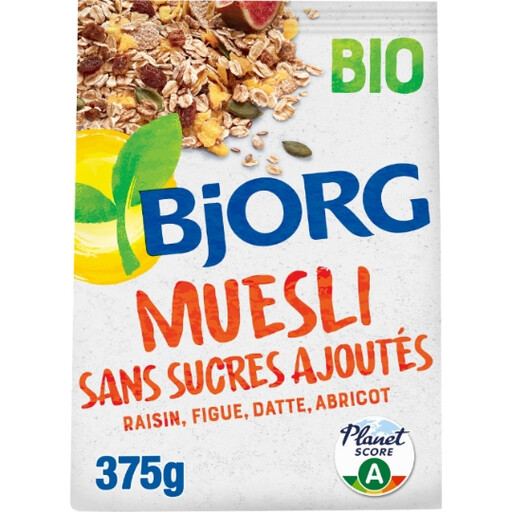 Image unavailable
This muesli is a good option if you’re looking for muesli for breakfast at your hotel. Check the fibre and sugars per 100 g on the label of the product you receive. If you need to avoid an ingredient, also check the allergens and any ‘may contain’ warnings.
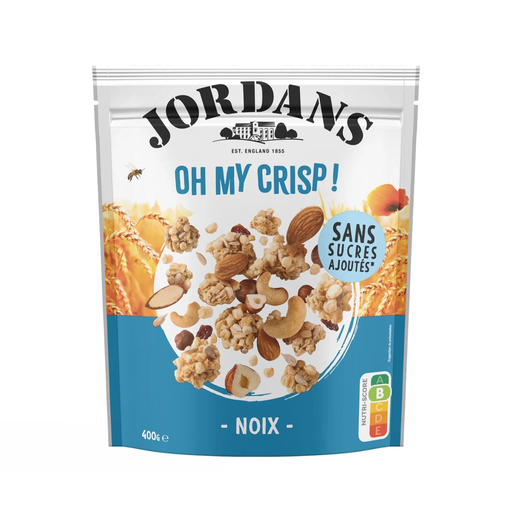 Image unavailable
Consider this nut cereal if you’re happy to choose something other than muesli for breakfast. Check the fibre, sugars and ingredients on its own label: the figures for Jordans Organic Muesli with Fruit and Nuts don’t apply to this product.
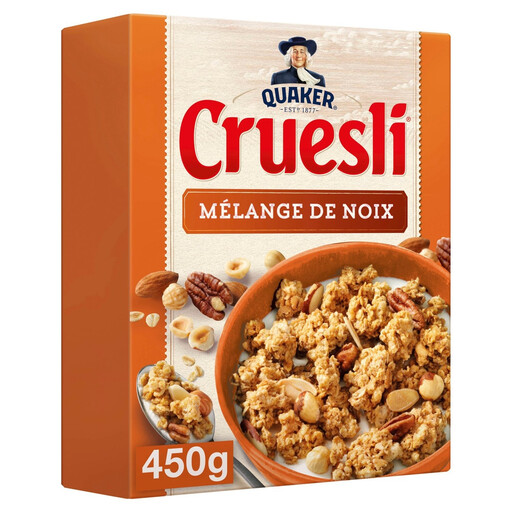 Image unavailable
These nut clusters are another breakfast cereal option, but they aren’t strictly muesli. If you’re comparing recipes in store or before a stay, check the sugars per 100 g and the ingredients list on the specific pack, particularly for allergens.
Under EU Regulation (EC) No 1924/2006, this claim requires at least 6 g of fibre per 100 g or 3 g per 100 kcal. To compare two packs that show figures per 100 g, check the ‘fibre’ line in their nutritional information rather than relying only on their suggested portion sizes.
No. This claim alone doesn’t tell you the total amount of sugars. Auchan’s product page for Jordans Organic Muesli with Fruit and Nuts says ‘no added sugars’ and lists 18.9 g of sugars per 100 g. Check both details for the product you’re considering.
Read the label if the muesli is prepacked: France’s Directorate-General for Competition, Consumer Affairs and Fraud Control says allergenic ingredients must be highlighted. If you can’t identify the recipe in a dispenser, ask staff for allergen information before serving yourself. Don’t assume the cereal is free from an allergen based on how it looks.
It’s best to bear your usual habits in mind when choosing your portion. Manger Bouger says too much fibre can cause bloating or intestinal pain. If you’re switching recipes, increase the amount you eat gradually.