For breakfast at the hotel, choose wholegrain oats if you’d like to put together your own bowl, flakes if you prefer a ready-to-serve cereal, or muesli if you’re looking for a recipe with fruit and nuts. In every case, check the ingredients, the proportion of wholegrains if stated, the nutritional values per 100 g and the allergens. At the buffet, this information should still be available even if the cereal has been taken out of its packaging.
Who are these formats for?
For building your own bowl
Wholegrain oats are a good choice if you want to decide what to add to your cereal base. If you’re looking for oats with no added sugar, check that this is stated on the product you choose, as with Quaker Oats presented by Quaker France.
For ready-to-serve flakes
If the texture of the flakes matters to you, compare the recipes rather than just how they’re presented. Nestlé Céréales and Kellogg’s product information gives different proportions of wholewheat for FITNESS Original Nature and Special K Nature. Fibre and sugar values are listed on the same per-100 g basis.
For checking allergens before serving yourself
If you need to avoid an ingredient, make sure you can access the label or ask for information about cereal served out of its packaging. It’s particularly worth checking the ingredients in a muesli with toppings before filling your bowl.
What should you check first?
Start by choosing a format that suits the way you like to have breakfast, then compare recipes using their labels.
Wholegrain oats
Choose these: if you want a base you can customise at the buffet.
Bear in mind: what goes into your bowl depends on the toppings you add. Also check the allergen information for the product being served.
Wholewheat flakes
Choose these: if you prefer a cereal that’s ready to pour, with a flake texture.
Compare: the fact that a cereal contains wholewheat doesn’t tell you what proportion it contains or how much sugar is in it.
Muesli with toppings
Choose this: if you’re looking for a recipe combining cereals, dried fruit, nuts or seeds.
Check: ingredients vary from product to product, particularly nuts and sugar.
| What to consider |
What to check |
Who is it for? |
| Wholegrains and fibre |
Look for the wholegrain cereal in the ingredients, its proportion if stated, and the fibre per 100 g. |
If wholegrains are my main priority, I want to know how much of the recipe they actually make up. Around 37% of consumers prioritise this composition and fibre. |
| Sugar and ingredients |
Check the sugar, fibre and fat per 100 g to compare recipes on a like-for-like basis. |
The word “wholegrain” doesn’t tell me whether the recipe suits my preference for sugar content. This is the main priority for around 27% of consumers. |
| Allergens |
Check the allergen information for the product being served. If it’s out of its packaging, ask for the information before serving yourself. |
At the buffet, I need to identify ingredients I should avoid before choosing my bowl. Access to this information comes first for around 18% of consumers. |
| Serving format |
Choose between oats to customise, flakes ready to pour and a recipe that’s already topped. Check the storage instructions after opening. |
If I want a quick breakfast to serve, the format and any extras needed affect my choice. Around 18% of consumers put convenience first. |
Two buffet mistakes to avoid
-
Assuming “wholegrain” means “low in sugar”
Wholegrain recipes don’t all contain the same amount of sugar. Nestlé Céréales lists 8.8 g per 100 g for FITNESS Original Nature, compared with 15 g per 100 g for Special K Nature according to Kellogg’s, and 19 g per 100 g for Spécial Muesli according to Jordans.
Compare the nutritional information per 100 g and check the proportion of wholegrains if it’s shown on the packaging.
-
Choosing muesli with toppings without checking the ingredients
A recipe may combine cereals containing gluten with several types of nuts. Jordans lists wheat, cashews, almonds and hazelnuts among the ingredients in Spécial Muesli.
Check the allergen information for the product on offer. If the cereal is being served out of its packaging and the information isn’t visible, ask a member of staff.
Brands to compare, product by product
Nestlé Céréales
FITNESS Original Nature is an example of ready-to-serve flakes with a stated proportion of wholewheat.
- Nestlé Céréales lists 61.3% wholewheat, 10.3 g of fibre and 8.8 g of sugar per 100 g.
- These details apply to FITNESS Original Nature, not all cereals from the brand. The recipe also contains rice and sugar.
Kellogg's
Special K Nature combines rice, wholewheat and barley in a flake recipe.
- Kellogg’s lists 37% wholewheat, 6 g of fibre and 15 g of sugar per 100 g for this product.
- The recipe contains cereals with gluten. Its nutritional values don’t apply to other Kellogg’s products.
Quaker
Quaker Oats can be used as an oat base, with toppings chosen from those on offer.
- Quaker France describes this product as made from wholegrain oats, with no added sugar.
- This description doesn’t apply to the brand’s recipes with toppings. Check the label and allergen information for the product being served.
Jordans
Spécial Muesli is for those looking for a recipe that combines cereals, dried fruit, nuts and seeds.
- Jordans lists 67% wholegrain cereals, 33% fruit, nuts and seeds, and 8.5 g of fibre per 100 g.
- The same product contains 19 g of sugar per 100 g and several types of nuts.
Carrefour
The Carrefour range lets you compare different categories, including plain oats and wholegrain flakes.
- The product information for each item lets you distinguish its recipe and format.
- Check the ingredients and nutritional values for the specific product rather than assuming they apply to the whole range.
E.Leclerc
The E.Leclerc range includes Grainea oats and a Bio Village product described as an organic wholegrain cereal.
- These products offer useful comparisons if you’re looking for oats rather than a recipe that’s already topped.
- Check the ingredients and nutritional information for each product.
Oats and topped cereals on Joybuy
This selection includes oats to customise at breakfast and two crunchy cereals with nuts. Compare their ingredients and allergen information before choosing a product for the buffet.
 Image unavailable
BJORG organic oats 500 g
Oats to serve as a base that everyone can customise at the buffet. Check the nutritional information and allergen details on the packaging before serving.
View on Joybuy
 Image unavailable
Quaker Oats 500 g
An oat base to customise or prepare according to how breakfast is served. Quaker France describes Quaker Oats as wholegrain oats. Check the pack for allergen information.
View on Joybuy
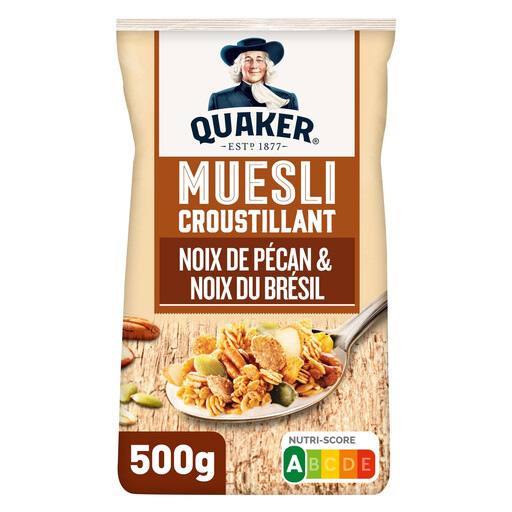 Image unavailable
Quaker Crispy Muesli Pecan & Brazil Nuts 500 g
A crunchy muesli for anyone who prefers a recipe with toppings to plain oats. Its name indicates that it contains pecans and Brazil nuts. Check the full allergen list before serving.
View on Joybuy
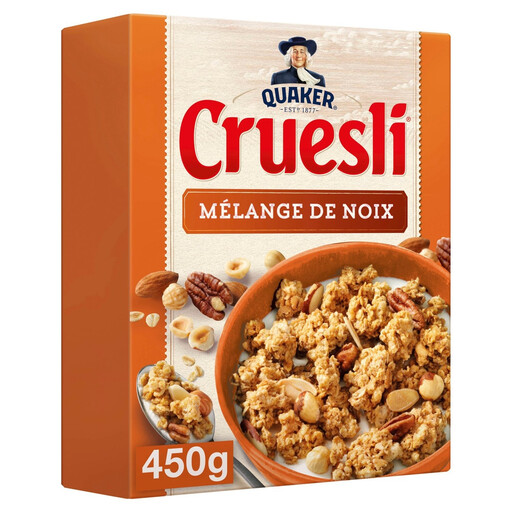 Image unavailable
Quaker Cruesli Mixed Nuts 450 g
Crunchy cereal clusters for serving without adding separate toppings. The product is labelled Mixed Nuts; check the packaging to see which nuts and other allergens it contains.
View on Joybuy
 Image unavailable
Lucien Georgelin oats 500 g
Oats for preparing or topping up a breakfast bowl. If the proportion of wholegrain oats or the allergen information will affect your choice, check these details on the packaging for this product.
View on Joybuy
Frequently asked questions
How can I tell how much of a cereal is wholegrain?
Look for a cereal explicitly described as wholegrain in the ingredients list, then check its proportion if this is stated. Nestlé Céréales lists 61.3% wholewheat for FITNESS Original Nature, while Jordans lists 67% wholegrain cereals for Spécial Muesli. These figures apply only to those recipes.
Does a wholegrain cereal always contain less sugar?
No. The presence of wholegrains alone doesn’t tell you how much sugar a recipe contains. Per 100 g, Nestlé Céréales lists 8.8 g of sugar for FITNESS Original Nature, Kellogg’s lists 15 g for Special K Nature, and Jordans lists 19 g for Spécial Muesli. Compare the labels on the same basis.
How can I check the allergens in cereal served at a buffet?
For a pre-packed box or bag, read the allergens highlighted in the ingredients list. If the cereal is served out of its packaging and the information isn’t visible, ask before serving yourself. In France, the decree of 17 April 2015 sets out requirements for allergen information on non-prepacked food. Don’t assume a recipe is suitable for your dietary needs just because its name includes words such as “oats” or “muesli”.


