What should you check before buying?
For hotel breakfast service, first choose a format that suits the number of portions you need and the equipment at your serving station. Then check the recipe and the product-specific instructions.
Dehydrated sachet
Worth considering: for preparing one portion to order; the Royco sachets listed by Carrefour France and Auchan France each make 20 cl of soup.
Bear in mind: you’ll need to prepare each portion separately and use water at the temperature specified in the recipe.
Liquid soup in a carton
Worth considering: when your service can use a container holding several portions, such as the 1 L format listed by Carrefour France.
Bear in mind: you’ll need a plan for storing the product after opening if demand is low or unpredictable.
Metal tin
Worth considering: if the tin you choose has a quantity and instructions suited to the service you have planned.
Check: its own preparation and storage instructions; don’t apply those for a carton or sachet.
| Criteria |
What to check |
Relevant consumer needs |
| Single portions |
How much soup each sachet makes, and the instructions for water and preparation time. |
When someone orders just one cup, I want to make the right amount without opening a large container; around 27% of consumers prioritise this need. |
| Volume and leftovers |
Container size, number of portions and storage instructions after opening. |
For regular service, I want a container that suits the number of guests expected without creating lots of leftovers; around 27% of consumers rank this need first. |
| Ingredients and allergens |
Ingredient list, declared allergens and any ‘may contain’ statements for the exact product. |
Before offering a recipe to a guest with dietary restrictions, I need to be able to check its exact ingredients; around 20% of consumers prioritise this check. |
| Dates and storage |
Best-before date (DDM) or use-by date (DLC), followed by storage instructions before and after opening. |
If I manage a cupboard stock, I want to keep track of dates and avoid applying the same storage instructions to every pack; stock management is a priority for around 26% of consumers. |
Soups available on Joybuy
These products illustrate three possible ways to organise your service: a dehydrated single portion made to order, a dehydrated soup that needs to be cooked for several bowls, and a soup described as ready to eat. For each one, check that the packaging and instructions suit your breakfast service.
 Image unavailable
Royco dehydrated noodle soup with carrots and mushrooms, 3 × 20 cl
Worth considering for single-cup service: each of the three sachets makes 20 cl of soup. Before adding it to your service, check the pack for the amount of water and preparation time for this recipe, along with its ingredients and allergens.
View on Joybuy
 Image unavailable
Knorr Thai Noodle Soup with Mushrooms, 2 Assorted, 69 g, 0.70 L
Worth considering if your service station can prepare several bowls: this recipe requires 700 ml of cold water followed by five minutes of simmering, rather than simply being reconstituted in a cup. Check the allergens for this product and follow the storage instructions on its packaging.
View on Joybuy
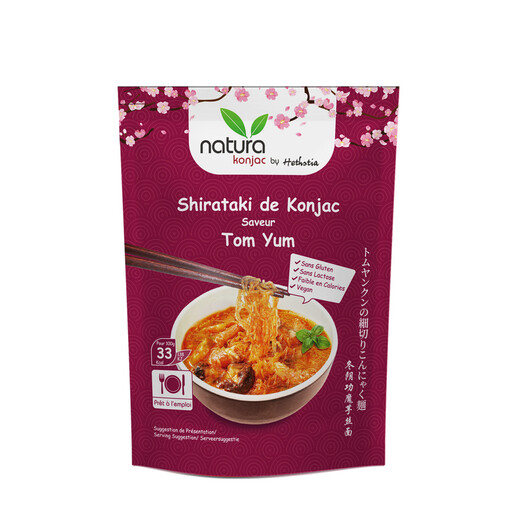 Image unavailable
Natura Konjac Soup, Tom Yum flavour, 190 g
This soup is described as ready to eat. Before planning to serve it, check the packaging, portion size and instructions for storage after opening. The description mentions soya and a choking risk from konjac for children and people who have difficulty swallowing; the chilli may also cause irritation.
View on Joybuy
Frequently asked questions
Is dehydrated soup the same as tinned soup?
No. Dehydrated soup in a sachet needs to be reconstituted according to its instructions, while a tin refers here to metal packaging. Liquid soup in a carton is yet another format; don’t apply one product’s preparation or storage instructions to another.
What should you check when advising guests about allergens?
Check the ingredients and declared allergens for the exact recipe rather than relying on the product name alone. The DGCCRF states that, in France, allergenic ingredients must be emphasised on the labels of prepacked foods; the Carrefour France listing for Royco Chicken, Vermicelli and Carrot soup specifically mentions wheat, barley, milk and celery.
Do best-before and use-by dates require the same stock checks?
No. According to Anses, a use-by date must be followed, while a best-before date is not the same kind of strict deadline. Tins are among the products that generally carry a best-before date; however, check the date and condition of every product, as well as its storage requirements.
How should you store soup after opening?
Follow the instructions on the packaging of the soup you’ve chosen, as they vary between recipes and packaging formats. In general, Anses recommends putting opened perishable foods straight back in the fridge and not leaving them at room temperature for long.


