For a buffet where recipe and presentation matter, consider plaited or all-butter brioches. If slicing slows down service, choose one that’s already sliced. A brioche with a sugar content that suits your selection can add variety, provided you compare the values per 100 g and check the allergens, packaging and storage instructions for every product you serve.
Who is this choice for?
Buffet managers looking for a distinctive recipe
You want to serve a plaited brioche or a recipe that highlights butter, eggs or sourdough. Check these details on the specific product you order: they vary from one product to another, including among the brioches offered by Brioche Pasquier, Carrefour and Auchan.
Hotel teams serving breakfast at pace
You need portions that are easy to lay out and replenish. Pre-sliced brioche saves you having to cut it at the buffet, but check the number of slices per packet and the storage instructions before deciding how much to order.
Buyers who pay close attention to ingredients
You want to compare ingredients, nutritional values and the information on the packaging. In particular, check the sugar content per 100 g and the allergen list for each brioche, rather than assuming that information for one product applies to an entire range.
What should you look for in a breakfast buffet brioche?
Start with the need that will determine your choice, then check the packaging and product information for the brioche you’ll actually be serving.
| Criteria |
What to check |
Relevant to |
| Recipe and presentation |
Highlighted ingredients, plaited or individual format, and product weight. |
If I want to serve a brioche with a distinctive recipe at the buffet, I need to know what claims such as ‘all-butter’ or ‘plaited’ actually mean. Around 31% of consumers rank this as their main criterion. |
| Service and portions |
Whether it’s pre-sliced, the number of portions per packet and the packaging. |
When the buffet needs replenishing without slicing on site, ready-portioned servings matter more to me. Ease of service is the priority for around 38% of consumers. |
| Ingredients and sugar |
Sugar values per 100 g, the ingredients list and the scope of claims on the packaging. |
If I want to offer a brioche that differs from the usual recipe, I need to be able to compare its ingredients on a like-for-like basis. This is the main criterion for around 23% of consumers. |
| Allergen information |
Allergens in the exact product and access to this information once it’s on the buffet. |
When brioches are served out of their packaging, I want to be able to tell customers which product is being served. Around 8% of consumers make how this information is organised their top priority; it still needs to be provided for every product. |
What mistakes should you avoid?
-
Assuming ‘premium’ describes a specific recipe
A plaited brioche, an all-butter brioche and a family-sized loaf don’t necessarily have the same ingredients or packaging. These descriptions alone don’t tell you how the product will be served.
Compare the ingredients list, allergens, weight and storage instructions for each product you’re considering.
-
Discarding the packaging without keeping allergen information
Once the brioche is served out of its packaging, customers must still be able to find out about the relevant allergens. The French Ministry of the Economy explains food labelling rules; the French decree of 17 April 2015 covers, among other things, allergen information for non-prepacked food.
Keep the information for the product being served accessible to your team, and update it if the product or recipe changes.
-
Reading ‘less sugar’ as ‘sugar-free’
The sugar values published by Harrys and Brioche Pasquier for the products reviewed are 9.3 g and 8.8 g per 100 g, respectively. A comparative claim doesn’t replace checking the nutritional value and the basis for comparison.
Compare the nutritional information per 100 g, and check the ingredients and allergens of the product you order.
-
Choosing a large pack without planning how you’ll serve it
The weight of a brioche or the number of packets doesn’t, by itself, tell you how many portions you’ll serve. Preparing too much can also leave you with opened portions after breakfast.
Start with the number of slices or portions listed for the product, then adjust your orders based on actual consumption and the storage instructions.
Brands and retailers to consider
These examples can help you compare specific products; a brand or retailer name alone doesn’t describe all the products it sells.
Brioche Pasquier
The range includes plaited and sliced brioches for breakfast.
- According to Brioche Pasquier, its Brioche Tressée Tranchée is hand-plaited, made in France and supplied pre-sliced.
- This product contains wheat, eggs and dairy ingredients, among other things. For any other recipe in the range, check its own ingredients list.
Harrys
Harrys FoodService offers a sliced brioche intended, among other uses, for professional breakfast service.
- The FoodService product described by Harrys comes in a tray of 7 x 500 g packets, with 16 + 2 slices per packet: a format worth comparing with the number of portions you need.
- According to Harrys, the ‘no additives’ claim for this product comes with a clarification that it may contain ingredients with a similar function. Also check the allergens for the product delivered.
Carrefour
Carrefour stocks all-butter brioche rolls, which may be suitable for serving as individual portions.
- The product information for these brioche rolls states that they contain 12.5% butter and fresh eggs.
- The product lists wheat, butter and eggs, among other ingredients, and may contain traces of almonds, sulphites and soya. Check the information for the product you order.
E.Leclerc
E.Leclerc stocks a 500 g all-butter Vendée brioche with the Label Rouge quality mark, under the Nos Régions ont du Talent range.
- The product name and weight make it easy to identify when comparing formats.
- Before adding it to your buffet, ask for the ingredients, allergens and supply conditions for the specific product you order.
Auchan
Auchan’s range includes brioches in various formats, including an 800 g all-butter La Boulangère plaited brioche.
- The product information for this La Boulangère brioche states that it contains 8.5% butter and sourdough, among other things.
- This product contains wheat, eggs and dairy ingredients, among other things. The product information says to store it in its sealed packaging, in a dry place at room temperature.
An all-butter brioche on Joybuy
This selection features an all-butter brioche to consider when the recipe is the buffet’s top priority. Check how it can be portioned before planning your service.
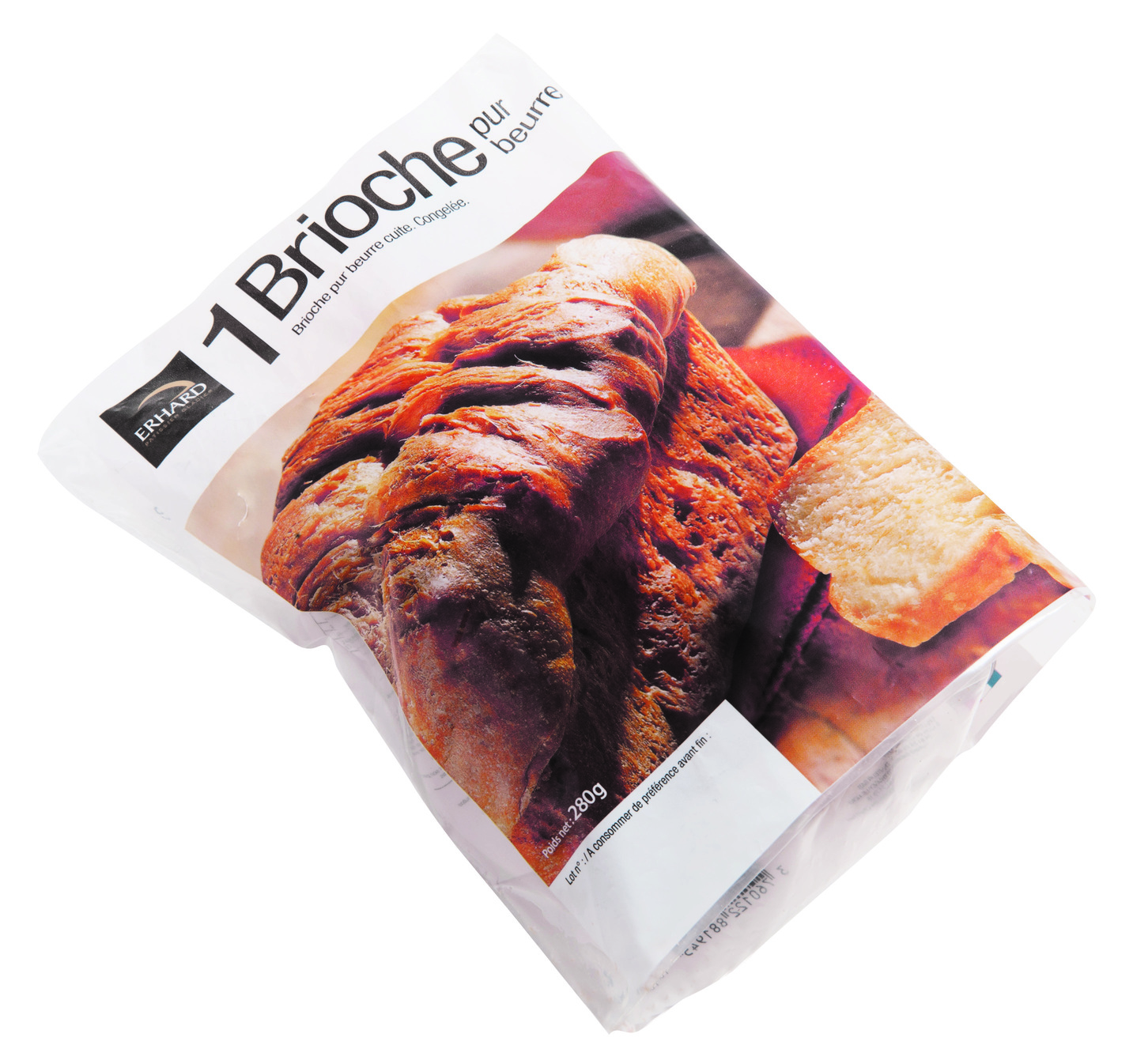 Image unavailable
ERHARD All-butter brioche 280 g
For a buffet that favours all-butter brioche, this ERHARD product comes as a 280 g loaf.
Before serving, check the packaging for allergens and storage instructions, and whether the loaf is pre-sliced, so you can plan the portions.
View on Joybuy
Frequently asked questions
Is a lower-sugar brioche automatically suitable for all customers?
No. Compare the sugar content per 100 g and the basis for any comparative claim; also check the ingredients and allergens for the product being served. A different sugar content alone doesn’t mean a product is suitable for everyone.
Which allergens should you check before serving brioche?
Check the information for the exact product. The brioches described by Brioche Pasquier, Carrefour and Auchan include wheat, eggs and dairy ingredients, among other things. Some product information also mentions possible traces of other allergens. Don’t use the list for one product to provide information about another.
Do allergen details need to be available when brioche is served out of its packaging?
Yes. For brioche served in France, relevant allergen information must remain accessible to customers even when the product is presented out of its packaging. The Ministry of the Economy explains the food information rules, and the French decree of 17 April 2015 covers non-prepacked food, among other things. Keep the information for every product on the buffet.
How much brioche should you order for the buffet?
Use the number of portions in the chosen pack and the consumption you’ve observed during service as a guide. For example, Harrys FoodService states that its product reviewed comes in 500 g packets with 16 + 2 slices each. Compare this format with your customer numbers and the storage instructions before deciding how much to replenish.


