If fat content is your top priority
You want a figure you can check per 100 g of powder, rather than relying on how light it seems or on the figures for an already-prepared cup.


If your priority is to keep fat content down, start by comparing powders on the same basis: per 100 g. Then check their sugar content, as a ‘reduced sugar’ claim doesn’t necessarily address your first priority. When choosing your morning hot chocolate, also consider how much powder and milk you’ll use, as the figures for a prepared cup don’t describe the powder on its own.
You want a figure you can check per 100 g of powder, rather than relying on how light it seems or on the figures for an already-prepared cup.
You want to compare both lines in the nutrition table: a lower-fat powder may still be high in sugar, and the reverse is worth checking too.
You’re happy to choose the cocoa, any sugar and the milk separately, so you can tailor your morning cup.
First compare the figures per 100 g for powders of the same type, then check the ingredients and the portion you plan to make. Regulation (EC) No 1924/2006 sets a maximum of 3 g of fat per 100 g of solid food for a ‘low fat’ claim. This benchmark alone doesn’t tell you what’s in a prepared cup.
| Criterion | What to check | Who it matters to |
|---|---|---|
| Fat | The ‘fat’ figure per 100 g of powder, followed by the milk you plan to use. | For my morning break, I want to compare powders using a clear fat-content figure, without confusing the powder with the prepared drink. Around 42% of consumers would put this need first. |
| Sugars | Sugars per 100 g and, if there’s a ‘reduced sugar’ claim, what it’s being compared with. | I don’t want to choose a powder just because it’s low in fat if its sugar content doesn’t suit me. Around 42% of consumers would put keeping sugar in check first. |
| Taste and preparation | The ingredients list and the amount of powder used per cup. | For a quick cup, I need to choose between a powder that’s already sweetened and unsweetened cocoa that I can sweeten myself. Around 16% of consumers would prioritise this flexibility when making their drink. |
These claims refer to different things. Carrefour France’s product listing for Nesquik reduced in sugar gives a fat content of 5.4 g per 100 g of powder.
Before choosing, check the ‘fat’, ‘of which saturates’ and ‘sugars’ figures separately per 100 g.
A per-cup figure may include milk and a specific amount of powder, as set out in the preparation instructions. Chocolat Poulain, for example, gives figures for its 1848 recipe made with 15 g of powder and 200 ml of milk.
Compare powders per 100 g first, then check what your usual serving works out to with your chosen milk.
In France, the DGCCRF says that the relevant prepacked foods must carry a nutrition declaration; the Ministry of the Economy clarifies that displaying the Nutri-Score is voluntary.
Use the nutrition table and ingredients list, whether or not the logo is shown.
Article 1613 ter of the General Tax Code, published on Légifrance, applies to drinks and liquid preparations intended for human consumption. It says nothing about the nutritional composition of a dry powder.
To compare powders, check their ingredients, figures per 100 g and recommended serving size.
The figures below relate to specific recipes, not every product from each brand. Check the variant name and the basis for the figures before comparing two packs.
Instant cocoa powders, including a standard recipe and a reduced-sugar version.
The range includes Grand Arôme Moins de Sucres and 1848, two recipes to consider separately.
A cocoa powder whose recipe includes ingredients such as cereal, banana and honey.
The organic chocolate powder described by Carrefour France is a sweetened recipe, distinct from its cocoa powder products.
This selection features a granulated powder for making hot chocolate. If you’re looking to keep fat content down during your morning break, compare its nutrition information with that of other powders and take the milk you use into account.
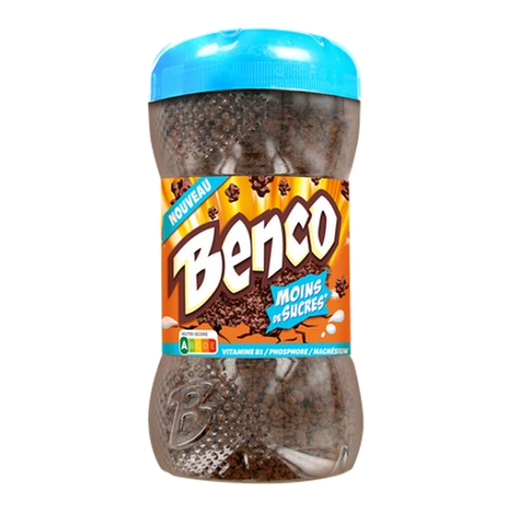 Image unavailable
This granulated powder is worth considering if you’re making hot chocolate in the morning and want to check its fat and sugar content. Check both figures per 100 g on the pack, then compare them in light of how much powder and milk you’ll use.
For a powder classed as a solid food, Regulation (EC) No 1924/2006 allows this claim only when the fat content is no more than 3 g per 100 g. Check the figure for the powder alone; the fat content of your cup also depends on the milk and how much powder you use.
No. Sugar reduction and fat content are two separate criteria. Carrefour France gives a fat content of 5.4 g per 100 g for Nesquik reduced in sugar. Check each line of the nutrition table separately.
A per-cup figure may include milk and a specific amount of powder. For example, Chocolat Poulain gives figures for 1848 prepared with 15 g of powder and 200 ml of milk. Compare powders per 100 g first, then work out the figures for your own drink.
No. The Ministry of the Economy says the Nutri-Score is voluntary, while the DGCCRF notes that relevant prepacked foods must carry a nutrition declaration. You can therefore compare the figures per 100 g even without the logo.
No. It doesn’t tell you about the fat or sugar content of a powder. Article 1613 ter of the General Tax Code, published on Légifrance, describes a levy on drinks and liquid preparations intended for human consumption. To choose a dry powder, check its ingredients and nutrition table instead.