For a fussy child, start by comparing the sugars in the powder and the amount used per cup. Don’t assume that a ‘reduced sugar’ claim means your child will like the taste. If you’re looking to limit the fat in their drink, remember to take the added milk into account too. If your child has an allergy or you’re taking the drink to school, check the ingredients and any ‘may contain’ warnings on the exact product before choosing.
Which families is this for?
Parents looking to reduce sugar without disrupting familiar habits
If your child prefers a familiar flavour, compare the sugar content and the amount of powder used before trying a different recipe. Nesquik and Banania’s reduced-sugar claims are based on different comparison products.
Families keeping an eye on the fat in their cup
The figures for the powder alone don’t tell you everything about the drink you’ll serve. Consider the milk you use too: Banania’s preparation examples are based on semi-skimmed milk.
Families who need to check for allergens
Before sharing the drink or taking it to school, read the label on the exact variant you’ve bought, including the ingredients and any ‘may contain’ warnings. Information about milk, soya and cereals varies between recipes.
What should you compare?
When choosing a chocolate drink powder, start with the factor that really matters for the cup you’ll serve your child: allergens to check, sugar, a flavour they’ll accept or the fat in the finished drink.
| Factor |
What to check |
Who is it for? |
| Sugars |
Compare the sugars per 100 g of powder, then check how much you use per cup. For a ‘reduced sugar’ claim, also look at what it’s being compared with. |
If I want to reduce sugar without giving up the hot chocolate my child likes, the amount I actually pour matters just as much as the recipe’s name. Around 27% of consumers put reducing sugar first. |
| Allergens |
Read the ingredients and ‘may contain’ warnings on the exact variant, particularly for milk, soya and cereals. |
Before taking the drink to school or sharing it, I need to be able to check the allergens listed on the packaging. This is the top priority for around 27% of consumers. |
| Accepted flavour |
Compare the recipes, including whether they contain cereals and the cocoa content where stated; start with the recommended serving. |
If my child doesn’t like a stronger cocoa flavour, they may find it difficult to switch recipes, even if the nutritional information appeals to me. Around 26% of consumers put taste first. |
| Fat |
Check the fat in the powder and in the drink made with the milk you plan to use. |
I’m looking to limit the fat in the cup I serve, not just in the dry powder. Around 20% of consumers prioritise the finished drink. |
Mistakes to avoid
-
Taking ‘reduced sugar’ to mean ‘sugar-free’
Carrefour France’s product listing for Nesquik Less Sugar says it contains 35% less sugar per mug than the average children’s cocoa drink. Banania says its Less Sugar recipe contains 36% less sugar than the family chocolate powders on the market. These claims use different comparison products.
To compare the recipes themselves, check the sugar content per 100 g of each powder and how much you add to a cup.
-
Judging the fat content from the powder alone
Banania’s serving examples include 200 ml of semi-skimmed milk. The figures for the drink will change if you use a different milk.
Compare the powder and the liquid used to prepare it together, measuring the amount of powder each time.
-
Overlooking ‘may contain’ warnings
Recipes don’t all list the same allergens: Banania Original warns that it may contain traces of milk and soya, while Carrefour Classic' warns that it may contain traces of milk.
If your child has an allergy, check the packaging of the variant you’ve bought. If you’re unsure what to do about traces, ask your child’s healthcare professional and check the school’s guidance.
-
Relying on the Nutri-Score alone
According to Santé publique France, displaying the Nutri-Score is voluntary. It doesn’t replace checking the sugars, fat and allergens.
If it’s shown on the packaging, use it as an extra guide, then check the nutritional information and ingredients for the recipe you’re considering.
Brands to compare
Nesquik
The Less Sugar variant gives you a way to compare a familiar-tasting recipe with the powder you usually use.
- Carrefour France’s product listing says it contains 35% less sugar per mug than the average children’s cocoa drink.
- This comparison doesn’t cover every competing recipe; the product listing for this variant also mentions soya.
Poulain
Grand Arôme Less Sugar is worth considering if your child likes a pronounced cocoa flavour.
- Carrefour France’s product listing says this variant contains at least 47% cocoa.
- It warns that the product may contain milk and soya. A ‘reduced sugar’ claim doesn’t replace comparing nutritional values and serving sizes.
Banania
Original and Less Sugar offer two different recipes to compare when the flavour of the drink is part of your decision.
- Banania says its Less Sugar recipe contains 36% less sugar than the family chocolate powders on the market.
- Recipes containing cereals call for a careful check of the ingredients and ‘may contain’ warnings. The claimed reduction doesn’t tell you whether your child will like the taste.
Carrefour
Classic' and Organic products let you compare ingredients and nutritional information across different recipes.
- Their product listings let you check the ingredients and allergen information for each variant separately.
- The word ‘organic’ doesn’t tell you by itself how much sugar a product contains or whether it’s free from allergens. The Classic' listing warns that it may contain traces of milk.
A chocolate powder to consider
You can compare the sugar and fat in this Poulain product per 100 g of powder. To work out what will be in your child’s cup, also consider the amount you prepare and the milk you add.
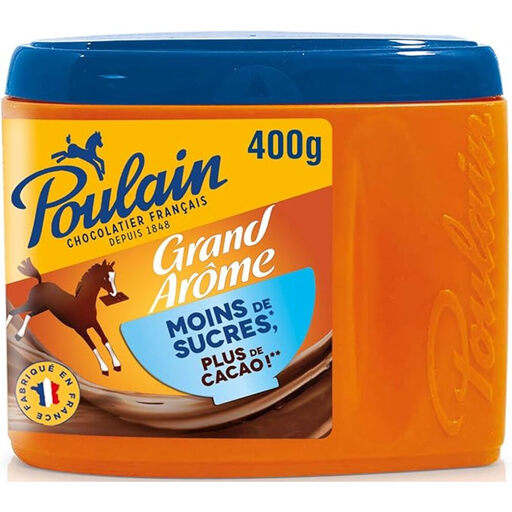 Image unavailable
Poulain Cacao Grand Arôme, 400 g
Worth considering if you’d like to compare a powder with a pronounced cocoa flavour against the recipe your child already likes. The flavour alone can’t tell you whether they’ll prefer it.
The Joybuy product listing gives 52 g of sugars and 5.4 g of fat per 100 g of powder. These figures don’t describe a cup made with milk. If you need to manage allergens, check the ingredients and any ‘may contain’ warnings on the packaging for this product.
View on Joybuy
Frequently asked questions
Is the Nutri-Score compulsory on chocolate powder in France?
No. According to Santé publique France, displaying it is voluntary. If it appears on the packaging, also read the nutritional information, ingredients and allergen details for the exact recipe you’re considering.
How can I take the fat content into account without changing the powder?
Compare the fat in the powder with that in the drink made using the milk you actually use. Banania’s serving examples, which include 200 ml of semi-skimmed milk, don’t describe a cup made with a different milk. Changing the milk can affect the flavour too.
What should I check before taking hot chocolate to school?
Read the ingredients and any ‘may contain’ warnings on the variant you’ve bought, then check the school’s guidance. The DGCCRF states that allergenic ingredients must be highlighted on the labels of prepacked foods. This information shouldn’t be mistaken for a guarantee that the product contains no traces.
Will a ‘reduced sugar’ powder necessarily suit a fussy child?
No. The claimed reduction can’t tell you whether your child will like the flavour. Compare the amount you use, the sugar content of the exact recipe and its ingredients. Don’t add more powder to make up for a taste that seems different.


