Shoppers keeping an eye on fat content
You want to compare the fat content of several powders on a like-for-like basis, per 100 g, then look separately at the sugars and the milk used to make your drink.


If fat content is your top priority, compare the values per 100 g of powder before choosing a “less sugar” option. Carrefour’s listing for Benco Less Sugar gives 2.7 g of fat per 100 g, compared with 5.4 g on Auchan’s listings for Nesquik Less Sugar and Poulain Grand Arôme Less Sugar. Also check the sugars, ingredients and label on the tin you buy. The nutritional content of your drink will depend on how much powder and milk you use.
You want to compare the fat content of several powders on a like-for-like basis, per 100 g, then look separately at the sugars and the milk used to make your drink.
You’re looking for a “less sugar” recipe, but don’t want to rely on that claim alone: the sugar content per 100 g and the ingredients matter too.
You want to be able to find the format, ingredients, allergens, best-before date and nutritional information on the tin you choose.
Start with what matters most to you, then compare the other details on the label of the exact product you’re considering.
| Criteria | What to check | Who it’s for |
|---|---|---|
| Fat | The “fat” value per 100 g of powder; don’t compare it with the value for a prepared drink. | If my main aim is to limit the fat in the powder, I need to compare tins on the same basis. Around 44% of shoppers would make this their top priority. |
| Sugars | The “of which sugars” value per 100 g and, if a reduction is claimed, what it is being compared with. | A “less sugar” claim appeals to me, but I want to know the amount shown on the tin. This would be the top priority for around 33% of shoppers. |
| Reading the label | The format, ingredients list, highlighted allergens and best-before date. | For my first food shop, I want to identify the right recipe and read its information without confusing it with another variant. This would come first for around 23% of shoppers. |
These claims refer to different nutritional values. Auchan’s and Poulain’s listings both give 5.4 g of fat per 100 g for their “less sugar” products, compared with 2.7 g on Carrefour’s listing for Benco Less Sugar.
Choose the criterion that matters most to you, then check “fat” and “of which sugars” separately, per 100 g.
According to Santé publique France, displaying the Nutri-Score is voluntary. Even when it appears on a tin, it doesn’t replace checking the nutritional values and ingredients.
Use it as an additional guide, then check the fat, sugars and allergens for the product you’ve chosen.
The amount of powder and the milk used will change the values for the finished drink. For example, Auchan’s listing for Nesquik Less Sugar gives values for a drink made with 200 ml of semi-skimmed milk.
To compare powders, use the values per 100 g of powder, then look at how you’ll prepare your drink.
Benco offers a 400 g tin of granulated chocolate drink powder in a “Less Sugar” recipe.
The range includes a 350 g pack of “Less Sugar” powder.
Poulain describes Grand Arôme Less Sugar as a recipe containing 47% cocoa.
This 400 g chocolate drink powder is another option to assess by checking its label, without confusing it with a “less sugar” variant.
This Benco powder is worth considering if fat content per 100 g is your top priority. Be sure to check the sugar content and the values on the tin for the variant you buy.
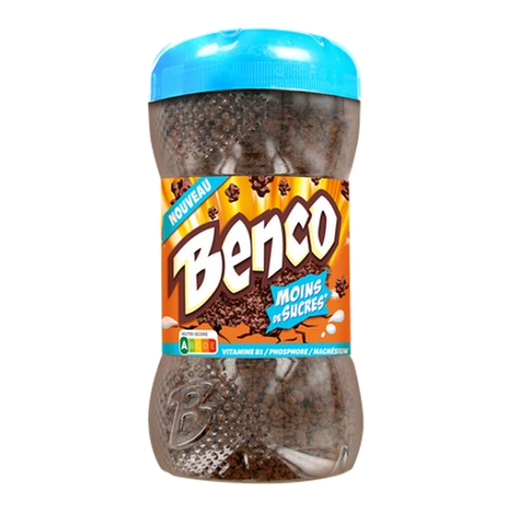 Image unavailable
Worth considering if you’re comparing the fat content of powders per 100 g first.
Joybuy’s listing gives 2.5 g of fat and 50 g of sugars per 100 g. Carrefour’s listing for Benco Less Sugar 400 g gives 2.7 g of fat per 100 g, so check the value on the tin you receive.
No. According to Santé publique France, displaying the Nutri-Score is voluntary. Nutritional declarations are covered by separate labelling rules, so read the nutritional information and ingredients list even when a Nutri-Score is shown.
No. You shouldn’t assume that dry powder is automatically covered. Article 1613 ter of the French General Tax Code applies to drinks and liquid drink preparations that meet the conditions set out in the legislation. The classification of a particular product needs to be checked before drawing a conclusion.
First compare the fat per 100 g of powder, then check the amount of powder and the milk specified for your drink. Values for prepared drinks can only be compared directly if they’ve been made in the same way.
Read the ingredients list for the exact product and check the allergens highlighted on it, in line with DGCCRF labelling guidance. Auchan’s listing for Nesquik Less Sugar mentions oats and soya lecithin, among other ingredients. Don’t assume that another variant has the same recipe.