Travellers with access to a Dolce Gusto machine
You can use a capsule in a lounge, accommodation or arrival venue with a suitable machine. Check that you’ll have access to one before relying on this drink as part of your meal.


For an airport meal, only bring hot chocolate capsules if you know where you can use a Dolce Gusto-compatible machine: pouring hot water over these capsules is not enough to prepare them. Then choose based on the pack size, sugars per serving and allergens listed for the exact product. If you’re taking the capsules in your cabin baggage, check the rules that apply to your journey.
You can use a capsule in a lounge, accommodation or arrival venue with a suitable machine. Check that you’ll have access to one before relying on this drink as part of your meal.
Recipes and serving sizes vary between products. Check the ingredients, allergens and nutritional information for your chosen product to find out what the drink contains.
If you’re taking the capsules with you, check the rules for your airline and route. For departures from France, the French Civil Aviation Authority notes that airlines may impose additional restrictions. Its general guidance does not cover the destination’s health and customs rules.
Start by considering where you’ll prepare the drink. If you can’t access a compatible machine, choosing between capsule recipes won’t solve the problem of what to have at the airport.
| Criterion | What to check | Who it matters to |
|---|---|---|
| Machine compatibility | Check that the machine you can access uses the Dolce Gusto system, and make sure you have enough capsules for your needs. | If I’m planning to make my drink when I arrive, my capsules need to work with the machine there. Around 42% of consumers rank compatibility as their top priority. |
| Planning your journey | Find out where you can prepare the drink, and check the rules for your airline, connections and destination. | Before packing the capsules, I want to know whether I can take them with me and use them. This is the main priority for around 33% of consumers. |
| Ingredients and labelling | Check the allergens and sugars per prepared serving, taking note of the stated serving volume. | When choosing a recipe, I first need to know what’s in it and how much sugar is in my drink. This is the top priority for around 25% of consumers. |
The NESQUIK, BANANIA and GIMOKA products featured here are designed for a Dolce Gusto-compatible machine, not for direct preparation in a cup.
Check where you’ll prepare your drink. If you only have access to hot water, choose a product labelled as instant or buy a drink prepared on the spot instead.
Without a machine, you risk carrying the capsules with you but being unable to use them during your journey.
The French Directorate General for Competition Policy, Consumer Affairs and Fraud Control states that Nutri-Score labelling is voluntary in France. Whether it appears on the pack or not, you should still read the label.
Compare the nutritional information for the prepared serving, and check the ingredients and allergens.
The general guidance from the French Civil Aviation Authority for departures from France does not mean the capsules are permitted by every airline, on every connection or at every destination.
Check the rules for each stage of your journey before putting the capsules in your cabin baggage.
The BANANIA recipe contains milk and barley malt extract containing gluten. NESQUIK contains milk and may contain soya. The product information for classic GIMOKA hot chocolate lists milk.
Check the information on the packaging of the product you buy before consuming it.
The NESQUIK range for NESCAFÉ Dolce Gusto includes a box of 16 capsules. Auchan states that each capsule makes a 150 ml drink for this product.
BANANIA offers a box of 12 capsules compatible with Nescafé Dolce Gusto, featuring a recipe that combines cocoa, cereals, banana and honey.
The Joybuy listing for GIMOKA hot chocolate shows a box of 16 capsules with a total weight of 224 g, compatible with Dolce Gusto machines.
These hot chocolate capsules are for travellers who have access to a Dolce Gusto-compatible machine where they’ll be preparing their drink. GIMOKA white chocolate is a separate variety from classic GIMOKA hot chocolate, so check the recipe you’re interested in before buying.
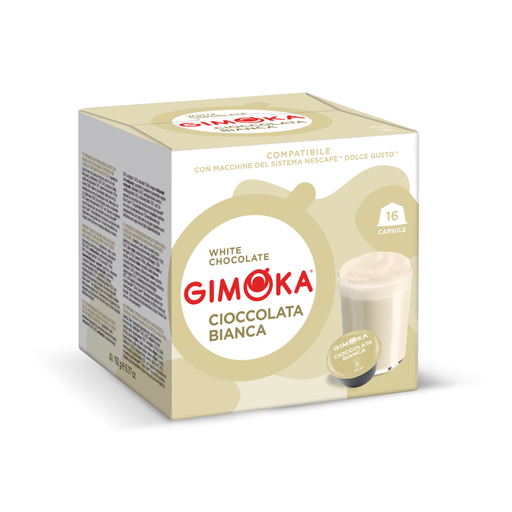 Image unavailable
Consider this if you’re looking for a white chocolate option and have access to a Dolce Gusto-compatible machine. Check the volume made per capsule, as well as the ingredients and allergens listed on the packaging.
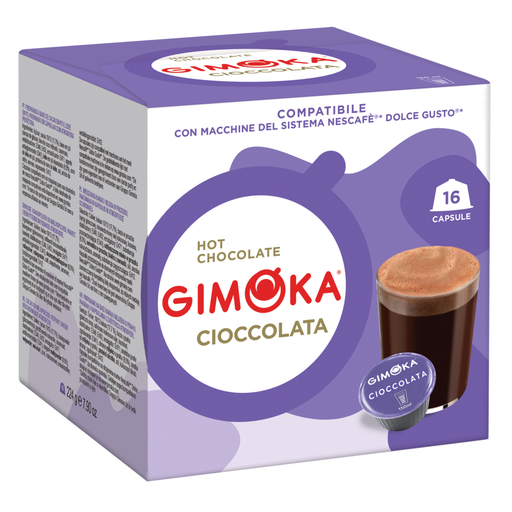 Image unavailable
For making hot chocolate with a Dolce Gusto-compatible machine. The Joybuy seller listing states that it contains 17.7% cocoa and 8.3 g of sugars per serving, and includes milk. Check the volume of the prepared drink on the packaging.
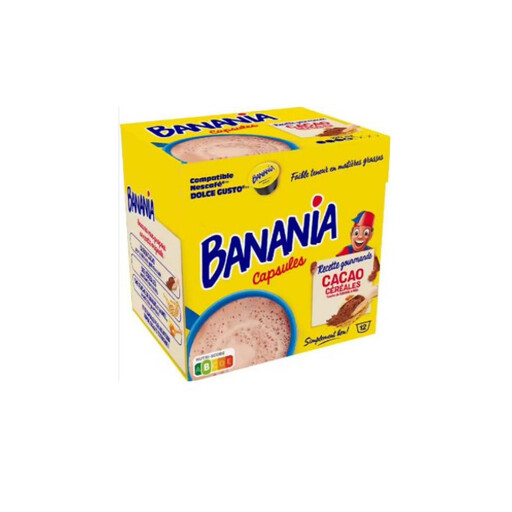 Image unavailable
For travellers with access to a Nescafé Dolce Gusto-compatible machine who want to try the BANANIA recipe. The brand lists 9.6 g of sugars per 120 ml serving; the recipe contains milk and barley malt containing gluten.
No. The NESQUIK and BANANIA capsules described here need to be used in a Dolce Gusto-compatible machine. A kettle or hot water dispenser is not a substitute for this machine.
No, displaying it is voluntary in France, as stated by the French Directorate General for Competition Policy, Consumer Affairs and Fraud Control. Whether or not a Nutri-Score appears, check the ingredients, allergens and nutritional information for the product you choose.
No. To find out the sugar content, read the product’s nutritional information, including the grams of sugars per prepared serving. The guidance from the French Official Bulletin of Public Finances – Tax does not establish that capsules sold as a powdered preparation are subject to this levy.
Check the label for the exact product. The BANANIA and NESQUIK recipes described here contain milk; BANANIA contains barley malt with gluten, and NESQUIK may contain soya. The Joybuy listing for classic GIMOKA hot chocolate also states that it contains milk.