
Livraison le jour même ou le lendemain

Qualité garantie

Débloquez vos offres de bienvenue: Livraison GRATUITE | Jusqu'à -80 % | 30 jours d'essai gratuits à JoyPlus
Téléchargez l'application
Are you looking for a hot air brush for smoothing hair to tame your style before heading to work, banish frizz, or save time in the morning? Not all models are designed for the same purpose. A smoothing brush is used on dry hair, whereas a hot air styling brush combines drying and styling in one go. A straightening brush, on the other hand, focuses on a quick pass through already detangled sections.
The most common pitfall? Buying an appliance that claims to be versatile but doesn't suit your hair type or your routine. Here are the points to check before you place your order.
A standard hot brush doesn't necessarily replace a hairdryer. Some models, like the Wavytalk thermal brush, are designed for use on dry hair and don't blow hot air. Conversely, a hot air styling brush like the RAF uses an airflow to dry and style at the same time.
A rotating hot brush or an appliance with a round attachment can also add volume or create waves. However, the technique is different from that of a straightening brush. Before ordering, ask yourself what you're really after: quick smoothing at home, a drying appliance, curls, or more volume.
A temperature that can reach 230 °C isn't automatically suitable for all hair types. Fine, bleached, or damaged hair generally needs a gentler heat. Thick or curly hair, on the other hand, may require a higher setting to be tamed effectively.
It's better to choose an appliance with several clearly marked temperature levels. That way, you can adjust the heat to your hair instead of always running it at full power.
An appliance ordered online may arrive with a plug that's incompatible with UK sockets. The mention 'dual voltage' means the appliance can handle different voltages, but it doesn't guarantee the type of plug supplied. So this point deserves careful checking in the product description.
A 360° swivel cord makes movements more comfortable, while a built-in battery can be handy when you're on the go. In any case, look for automatic shut-off, an insulated handle, and bristles designed to minimise direct contact with the scalp.
PTC systems quickly reach the selected temperature and maintain a relatively stable heat. However, this information alone isn't enough to judge the appliance's performance: also look at the number of levels available and the gap between each setting.
Depending on the product's design, ceramic or a ceramic coating can help distribute heat more evenly. In any case, work on small sections, glide the appliance without lingering in one spot, and use a heat protectant suited to your hair.
An ionic smoothing brush contains a negative ion generator. This feature is generally presented as a way to help reduce static and frizz. It's a technical characteristic, not a guarantee of identical results on all hair types.
A steam hair brush releases moisture during styling. The K·SKIN KD880 model has a reservoir or spray system designed to introduce water during use. Only use the liquid recommended in the instructions and follow all safety guidelines relating to electricity and heat.
A wide head covers more hair with each pass, which can be useful for thick hair. Closely spaced bristles sometimes make it easier to grip sections, but you need to be careful about the distance from your scalp.
For thick, curly hair, prioritise multiple temperature levels, good grip on sections, and an appliance that's easy to handle. For fine hair, a low setting, gentle use, and a lightweight design will often be more important.
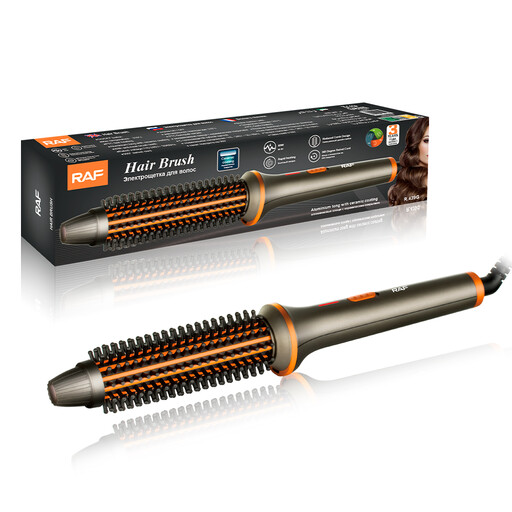
Why this choice suits this profile: Its 2-in-1 design makes it easy to discover heated styling at home, whether you want to smooth your hair or give it a gentle shape.
The product description specifies PTC heating, a ceramic coating, and use on small sections – concrete information that's far more useful than a simple promise of instant styling.
A 60 W power output, PTC heating, and a compact 32 cm design.
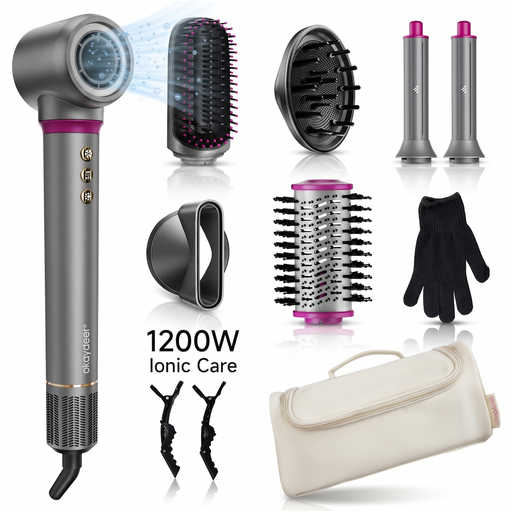
Why this choice suits this profile: This multi-styler is for those who want to combine drying, smoothing, diffusing, volume, and curls in a single appliance.
The included accessories are detailed: smoothing and volumising brushes, diffuser, concentrator, and curling attachments. This means you can check that the set really matches your needs.
Seven advertised functions, a 1,200 W motor, two speeds, and three temperature levels.
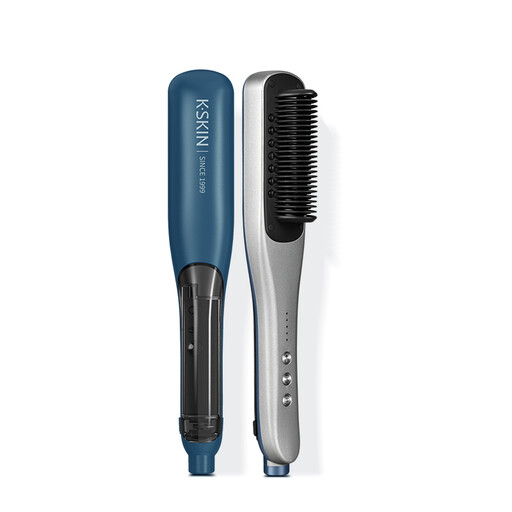
Why this choice suits this profile: Its design combines a heated comb with water spray. An interesting combination for hair prone to frizz and for regular styling sessions.
The product description documents the 25 teeth, PTC heating, and spray system – so you know exactly which features you're buying.
A size of 36.3 × 9.8 × 6 cm, advertised even heating, and a built-in steam function.
We've put together a comprehensive, real-time updated list of products that meet these strict selection criteria and European safety regulations.
Not always. Most standard hot brushes are designed for dry hair. A hot air styling brush, however, can be used on towel-dried hair, provided the manual allows it. Always check the manufacturer's instructions before first use.
It depends on the length and thickness of your hair, as well as how well you've prepared it. Detangled hair divided into sections generally allows for a more even pass. Some manufacturers claim styling in just a few minutes – take this as a rough guide rather than a promise that applies to everyone.
The consumption depends on the appliance's power and how long you use it. In practice, a 60 W model used for 10 minutes consumes around 0.01 kWh. A 1,200 W appliance used for the same duration consumes around 0.20 kWh. The calculation is simple: power in kilowatts × time in hours. For the exact cost, check the rate charged by your electricity supplier.