
Livraison le jour même ou le lendemain

Qualité garantie

Débloquez vos offres de bienvenue: Livraison GRATUITE | Jusqu'à -80 % | 30 jours d'essai gratuits à JoyPlus
Téléchargez l'application
A hot air brush can replace several devices for drying, detangling, straightening or adding volume. However, the differences between a basic drying brush, a hair dryer brush and a multi-styler are far from negligible. High power does not necessarily guarantee comfortable handling, while an abundance of attachments can quickly make your routine more complicated.
To avoid buying a device that does not meet your needs, here are the key criteria to consider before choosing, followed by a selection of models suited to different user profiles in France.
Power, expressed in watts, indicates electricity consumption and motor capacity. However, it is not enough to predict drying speed. Airflow, brush shape and the distance between your hair and the heated surface also play a role.
A 750–900 W hot air brush may be suitable for fine hair or styling touch-ups. For thick, long or very wet hair, a 1,000–1,200 W model offers more power to work with. Nevertheless, choose a device with several settings so you do not have to use the highest temperature every time.
Terms such as “ionic”, “ceramic”, “intelligent heat control” or “Coanda effect” describe technical features, not a guaranteed result for everyone.
An ionic hot air brush is generally marketed as a way to reduce static electricity. A ceramic coating, meanwhile, may help distribute heat more evenly across the styling surface. These technologies can make use more comfortable, but they do not replace essential precautions: towel-dried hair, continuous movement and moderate temperatures.
A 5-in-1 or 7-in-1 device may appear particularly versatile, but its attachments still need to match your routine. A straightening brush does not serve the same purpose as a diffuser for curly hair. Automatic curling attachments can also require a short learning curve.
Before ordering, check the weight, storage options, attachment system and cord length. A slightly less powerful device that is easier to handle will often be more pleasant to use every day.
For versatile use, choose a model with at least two speeds and two temperature settings. Three speed-temperature combinations make it possible to adapt drying to hair density and the desired result.
The cool-air setting is useful for finishing the style and cooling the strands. It is not a treatment in itself, but it is a practical setting for final touches.
Not all heated brushes are designed to be used directly on wet hair. A hot air brush for wet and dry hair should clearly mention both modes in its manual or product description.
On damp hair, first remove excess water with a towel and avoid starting with dripping-wet strands. On dry hair, a smoothing mode or heated comb may be enough to refresh your style between washes.
A wide brush makes blow-drying and creating volume easier on long hair. Long nylon bristles can help work through dense hair, while shorter bristles are better suited to surface smoothing.
A ceramic coating is worth considering if you are looking for more even heat distribution. Also check for an accessible filter, a swivel cord and a handle that is light enough to hold comfortably. For a device sold in France, the CE marking, manufacturer information, French-language instructions and safety guidance should all be available.
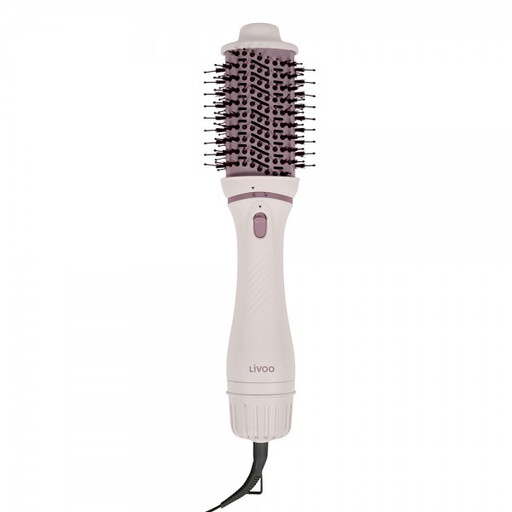
Why this model suits this profile: a simple solution that combines drying and styling in one device, particularly well suited to everyday routines.
The brush is removable, so the device can also be used as a conventional hair dryer rather than being limited to a single styling format.
1,200 W of power, ceramic coating, three speed-temperature combinations, cool-air mode and a 1.75 m swivel cord.
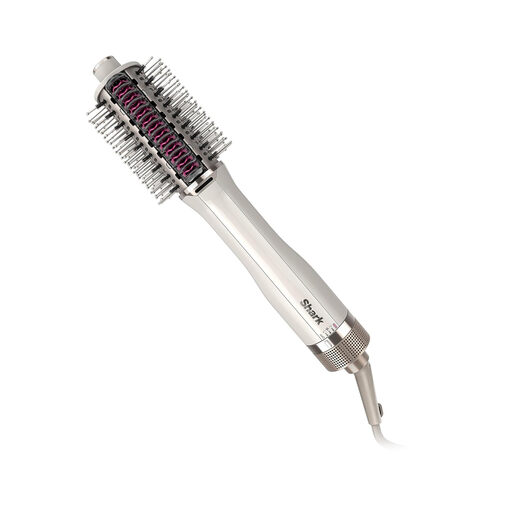
Why this model suits this profile: it is designed for people who want to move from drying to straightening with the same device.
The damp-hair and dry-hair modes are separate, making the intended use clearer than a generic “all hair types” claim.
900 W motor, three temperature settings, three speeds and a straightening comb with ceramic-coated elements.
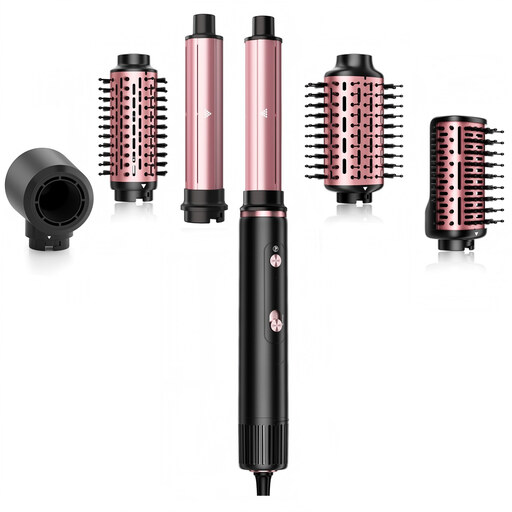
Why this model suits this profile: its design is aimed at people who want to switch between drying, straightening, volumising and curling without having to use multiple devices.
The settings are clearly detailed: three temperatures and three airflow levels, rather than a one-size-fits-all operating mode.
Five advertised functions, a brushless motor rated at 110,000 rpm, a 360° swivel cord and stated overheat protection.
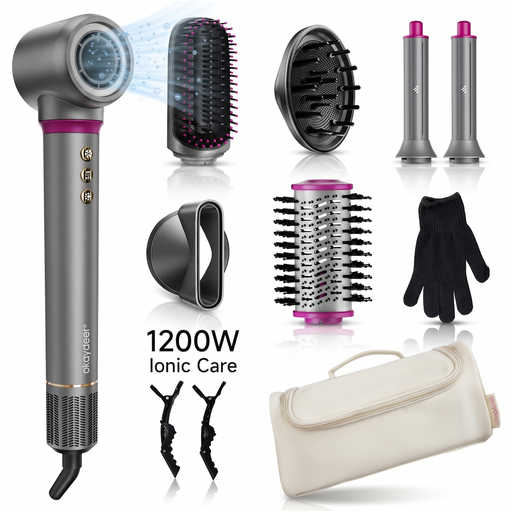
Why this model suits this profile: it is aimed at users who want to experiment with several styles at home, including drying, volumising and curling.
The quick-release and attachment-locking systems are specified, helping prevent attachments from being fitted incorrectly.
Seven advertised attachments, including a diffuser, a volumising brush, a straightening brush and two curling attachments; two speeds and three temperatures.
We have put together an up-to-date selection of products so you can compare their features, attachments and intended uses before making your choice.
Only if the manufacturer explicitly provides a damp-hair mode. Otherwise, dry your hair first until it is towel-dried or nearly dry. Always consult the manual for the model in question.
It depends on its power rating and how long it is used. For the same usage time, a 1,200 W model will consume more electricity than a 750 W model. To estimate the cost, multiply the power in kilowatts by the number of hours of use, then by the rate specified in your electricity contract.
It depends on build quality, frequency of use and maintenance. Make sure the air intakes do not become blocked, clean the filter regularly and avoid wrapping the cord tightly around the handle. The warranty period and contact details of the responsible party established in the European Union are also among the points to check before buying.