Parents who want to take it one step at a time
You’re making fougasse for children who aren’t keen on the taste of wholemeal flour, and would rather try a semi-wholemeal flour before making bigger changes to your usual recipe.


For your first homemade fougasse, especially if the children aren’t used to the taste of wholemeal flour, a semi-wholemeal T80 or T110 flour is a gentler starting point than switching straight to dough made entirely with T150. If you’d like to adjust the wholemeal content yourself, gradually mix T150 with white flour and try a batch before the evening. A ready-to-heat fougasse can be a handy backup, but it gives you less control over the flour and toppings.
You’re making fougasse for children who aren’t keen on the taste of wholemeal flour, and would rather try a semi-wholemeal flour before making bigger changes to your usual recipe.
You’re happy to try a batch and choose how much white and wholemeal flour to use, rather than switching straight to dough made entirely with T150.
You need to check the grains, listed allergens and toppings in the fougasse to suit your guests, even if you opt for a ready-to-heat product.
First, decide whether you’d prefer a semi-wholemeal flour, a blend you measure out yourself or a ready-to-heat fougasse. Each option involves a different amount of preparation and gives you a different level of control over the ingredients.
Worth considering : if you’d like to start with a semi-wholemeal flour without blending two types yourself.
Bear in mind : its seller describes T80 as having a neutral flavour, but the result in your fougasse will also depend on the recipe.
Worth considering : if you want to adjust the amount of wholemeal flour yourself as you try different batches.
Bear in mind : T150 is a wholemeal flour on its own. You’ll need to make your own blend and try the recipe before serving it to guests.
Worth considering : as a backup if you can’t make the dough from scratch.
Bear in mind : its ingredients and toppings are fixed, so check they’re suitable for your guests.
| What matters | What to check | Who is it for? |
|---|---|---|
| Familiar flavour and texture | Consider T80 or T110, and try the recipe before making fougasse for everyone. | If the children are unsure about rustic-tasting bread, you may want to start with dough that feels familiar. Around 40% of consumers put this acceptance first. |
| Wholemeal content | Compare the flour types. If you use T150, decide how much to add to your white flour base after trying a batch. | You’d like to increase the wholemeal content without switching straight to dough made entirely with T150. Around 40% of consumers prefer this compromise. |
| Planning and ingredients | Check that your chosen product is available, and check the ingredients and allergens on the packet or ready-to-serve fougasse. | When you’re sharing a meal with several guests, you want to be able to buy the ingredients you’ve planned for and check what will be served. Around 20% of consumers prioritise this kind of planning. |
If the children are used to fougasse made with white flour, making this change means you won’t know in advance whether they’ll like the flavour and texture.
Try T80 or T110 first, or gradually add T150 to a white flour base. Make a small batch before the meal rather than changing the whole recipe on the day.
These labels don’t replace the ingredients list. The wheat flour products mentioned contain wheat, and some labels also warn of possible traces.
Read the ingredients and allergen information on the packet you’ll actually use, and check any toppings you add to the fougasse separately.
A particular flour may not always be available at your chosen shop. This could make it harder to prepare your fougasse for a specific date.
Check that the product is available at your shop before settling on the recipe, and have another flour of the same type in mind if needed.
A topped, ready-to-heat fougasse may contain ingredients other than those you’d planned to use in your dough and toppings.
If you’re using it as a backup, check its ingredients and allergens rather than assuming it’s suitable for all your guests.
Auchan’s listings include Auchan Bio T110 semi-wholemeal wheat flour and Paysans d’Ici T80 flour for home baking.
Bio Village’s product is an organic T110 semi-wholemeal wheat flour, sold in a 1 kg pack.
The Francine product listed by Carrefour is a T150 wholemeal wheat flour, which you could use as part of a homemade blend.
Lidl offers Belbake organic wholemeal spelt flour, suitable for bread and baking, among other things.
The product listed by Aldi is an organic wheat flour in a 1 kg pack.
This Joybuy selection is for making your own blend: the T150 flour shown can be combined with white flour, using proportions you can try out for your fougasse.
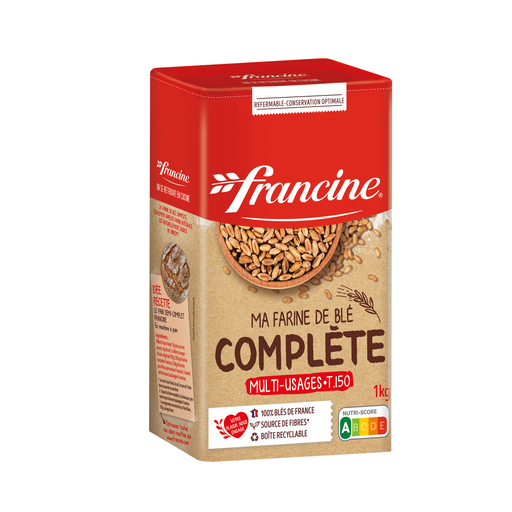 Image unavailable
Worth considering if you’d like to adjust the wholemeal content in fougasse made with a white flour base. This is a 1 kg pack of T150 wholemeal wheat flour, not a ready-made blend. Try the recipe first and check the allergen information on the packet before serving it to your guests.
If the children aren’t used to wholemeal flour, it’s best to start by trying a semi-wholemeal T80 or T110, without assuming how it will turn out in your recipe. If you choose T150, you can first mix some with white flour and try the fougasse before the evening.
The wheat flour products featured contain wheat, so don’t treat them as gluten-free. Check the label of the exact product, including the ingredients and any possible traces, before making fougasse for a guest who needs to avoid gluten.
Read the ingredients and listed allergens, and check the information about the toppings, whether they’re shop-bought or added at home. To compare the nutritional values of pre-packed flours, use the same basis, such as the information per 100 g. The DGCCRF also reminds consumers that allergenic ingredients must be clearly highlighted.
It can be a backup if its ingredients are suitable for your guests, but you won’t be able to choose the flour blend yourself. The Carrefour Traiteur product described contains wheat, milk and bacon bits, among other ingredients. Its product listing recommends reheating for 2 to 3 minutes at 170 °C.