
Livraison le jour même ou le lendemain

Qualité garantie

Débloquez vos offres de bienvenue: Livraison GRATUITE | Jusqu'à -80 % | 30 jours d'essai gratuits à JoyPlus
Téléchargez l'application
A cluttered hallway, shoes piling up, or a recycling bin that’s too small can quickly make daily life more complicated. Attractive photos and promises of large capacity aren’t enough to choose equipment that’s truly suited to a UK home.
To find the home storage and waste sorting solutions that work for you, it’s best to look beyond the product description. Actual dimensions, internal layout, usable capacity and ease of cleaning are the criteria that will make a real difference day to day. Here are the pitfalls to avoid, the points to compare, and a selection designed for different needs.
A kitchen bin with two compartments and a total capacity of 60 L might seem particularly spacious. But you need to distinguish the total volume from the capacity of each individual bin. Two compartments of 30 L don’t meet the same need as three bins of 20 L: the first setup is best for two waste streams, while the second allows for more precise sorting.
In a household that cooks often, a 60 L recycling bin can reduce how frequently you need to empty it. Before ordering, however, measure the intended space, taking into account the depth and the height needed when the lid is open.
A shoe cabinet with a bench can be very practical in a narrow hallway. But its dimensions must still leave enough room to walk past, open a door and move around the furniture. The same logic applies to a bin placed against a wall: its lid must be able to open without hitting the wall.
The classic mistake is only comparing the width. Also note the depth, the total height and the space you need to keep clear in front of the furniture or bin.
A fabric wardrobe protects clothes from dust, but how practical it is depends on the rigidity of its frame and the weight each shelf can support. For flat-pack furniture, numbered parts and an illustrated instruction manual make assembly much less tedious.
For a bin, removable inner buckets, handles and an easy-to-clean surface will be far more useful day to day than a purely decorative finish.
Before ordering, measure the installation area precisely with a tape measure. In a hallway, a shallow shoe storage unit will often be more suitable than a bulky cabinet. In a bedroom, a fabric wardrobe that’s tall enough makes better use of vertical space.
In the kitchen, check:
Stainless steel works well in areas exposed to splashes and frequent handling. A fingerprint-resistant stainless steel bin will stay looking clean more easily with a soft cloth and a non-abrasive cleaner. Metal scourers and harsh cleaning products, on the other hand, risk scratching the surface.
For furniture, particle board is fine for everyday domestic use, provided it’s placed on a stable surface. Frames made from metal tubes and plastic connectors are generally easy to dismantle – a useful advantage in a rented home or when moving rooms.
A pedal bin with soft-close lid means you don’t have to touch the lid and reduces slamming. Separate bins make both sorting and cleaning simpler. The ability to keep the lid open can also be handy while you’re preparing meals.
For storage, go for adjustable shelves if you need to store items of different sizes. This flexibility is especially useful for boots, trainers, boxes or folded laundry, without wasting space.
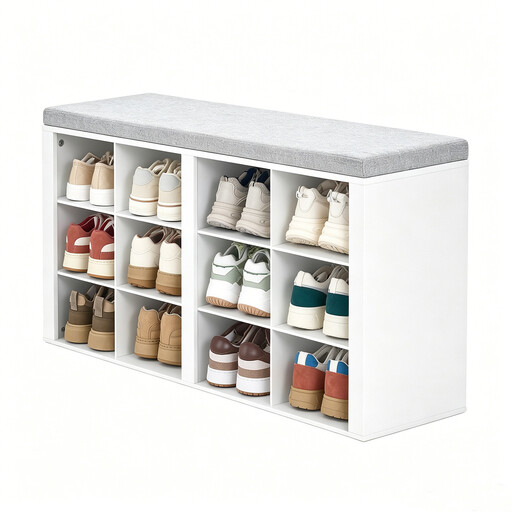
Why this choice suits this profile: This piece combines a seat and hallway shoe storage in a compact 30.5 × 104.5 × 49.5 cm format. It’s ideal for households that want to tidy their hallway without adding lots of separate furniture.
The adjustable shelves let you adapt the space for shoes of different heights. The cushion cover is removable for easy cleaning.
Twelve compartments, a stated weight capacity of 150 kg and an illustrated manual with clearly labelled parts.
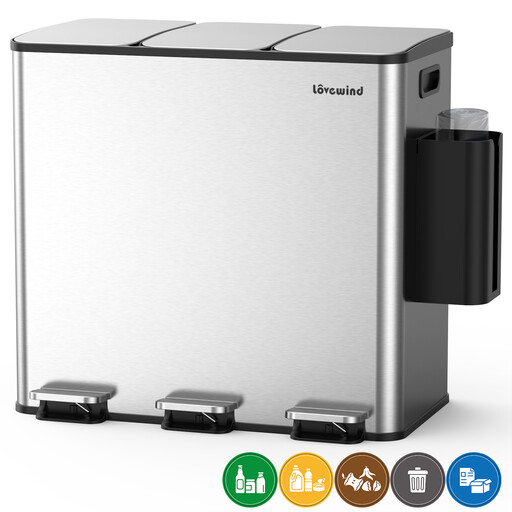
Why this choice suits this profile: This three-compartment bin is designed for open-plan kitchens where aesthetics and well-organised sorting matter as much as capacity.
The three separate bins make the capacity immediately clear. Soft-close lids and magnetic labels make everyday use easy.
Stainless steel described as fingerprint-resistant, three 20 L compartments and a storage box for bin bags.
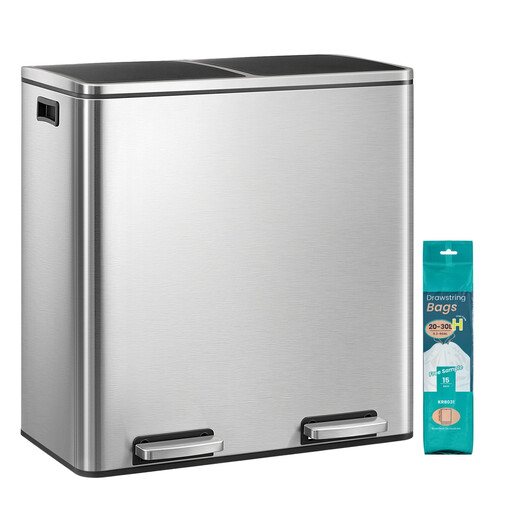
Why this choice suits this profile: The two 30 L bins are ideal for a family or a home where you mainly separate recyclable packaging from general waste.
The removable inner buckets let you take out the bags without moving the whole bin. The soft-close mechanism reduces repeated noise.
Total capacity of 60 L, separate pedals, two PP buckets with handles and fifteen bin bags included.
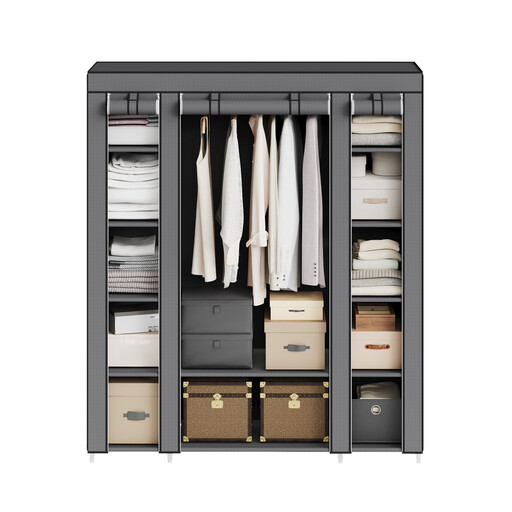
Why this choice suits this profile: This fabric wardrobe makes use of a 175 cm height and offers twelve compartments for clothes, shoes, accessories and linen.
The cover protects the contents from dust, while the compartments separate different categories instead of everything being piled into one impossible-to-sort heap.
Dimensions of 45 × 150 × 175 cm, stated weight capacity of 5 kg per shelf and 15 kg for the hanging rail.
We’ve selected a full range, updated in real time, of products that meet these demanding criteria as well as European safety standards.
For a couple, two compartments of 20 to 30 L may be enough, depending on your cooking habits and how often your waste is collected. A family will often be better off choosing a total capacity of 60 L, checking the available space and the volume of each bin. Recycling rules can vary from one council to another, so check your local authority’s guidelines before assigning a waste type to each compartment.
Start by measuring the available area, then make sure the floor is perfectly stable and level. Place the heaviest items in the lower sections and stick to the maximum weight stated for each shelf or hanging rail. For a fabric wardrobe, avoid very damp rooms and leave a small gap around the frame to allow air to circulate.
Empty the bins before they get too full, clean the inner buckets regularly and wipe the outside with a soft cloth. Don’t use steel wool on stainless steel and never force the lid by hand. Keep the pedal mechanism dry and place the bin on a stable surface, out of reach of young children.