
Livraison le jour même ou le lendemain

Qualité garantie

Débloquez vos offres de bienvenue: Livraison GRATUITE | Jusqu'à -80 % | 30 jours d'essai gratuits à JoyPlus
Téléchargez l'application
A cluttered hallway, an impossible-to-organise wardrobe or a garage overrun with boxes can quickly waste your time and space. Home storage solutions help you restore order, provided you choose a format that suits the room, the volume you need to store and how often you'll use it.
However, some marketing claims are worth checking before you place an order.
A box or shelf may look spacious in a photo, yet its walls, doors or structure can significantly reduce the available space. For a shoe cabinet, measure the actual usable length, width and height for each pair.
Stackable shoe boxes and space-saving storage modules need to remain accessible and perfectly stable. A column that's too tall, placed on an uneven floor or near a walkway, can quickly become impractical or even dangerous. For a metal garage shelf, also check the wall fixing and the maximum load per shelf.
Transparent plastic makes it easy to see the contents and is simple to clean, but it isn't suitable for every situation. In a garage, a steel frame with rigid shelves will be better suited for storing tools. For a jewellery organiser, a lined interior will protect accessories from scratches better than a simple compartmented box.
Start by measuring the available space: the width of the hallway, the depth of the wardrobe, the ceiling height or the spot you've planned in your dressing room. Also remember to leave enough clearance to open a front door or remove a shelf.
For transparent storage boxes, check the dimensions of each compartment rather than just the number of boxes supplied. High-top shoes, bulky trainers or ankle boots may need more height than a pair of flat shoes.
A maximum load should be treated with caution: it usually refers to a static load, evenly distributed across the surface. For storage shelving, place the heaviest items on the lower levels and never exceed the limit stated by the manufacturer.
If a model comes with an anti-tip kit, fix it to the wall carefully following the instructions. This precaution is especially important in a garage, utility room or pantry that children can access.
Polypropylene, very common in storage boxes, is lightweight and easy to clean. Transparent doors let you find your belongings quickly, but you still need to ensure ventilation when shoes are stored straight after being worn.
For jewellery, choose separate trays, a soft lining and a lid that helps keep dust out. If accessories will be stored for a long time, keep the jewellery box with trays away from humidity and direct light.
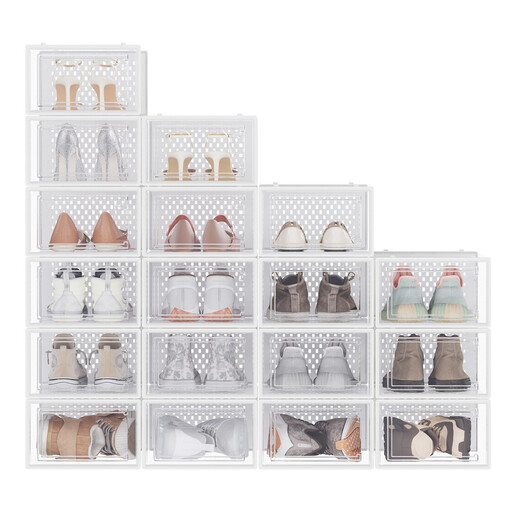
Why this choice suits this profile: This pack is ideal for anyone who wants to organise a shoe collection without immediately installing a bulky piece of furniture in the hallway or dressing room.
The dimensions of each box are clearly stated, and the transparent front means you don't have to open them all to find a pair. Still, take the time to measure your shoes before buying.
Pack of 18 boxes, stackable design, transparent doors and ventilation openings. Dimensions of each box: 33.3 x 23.1 x 14.3 cm.
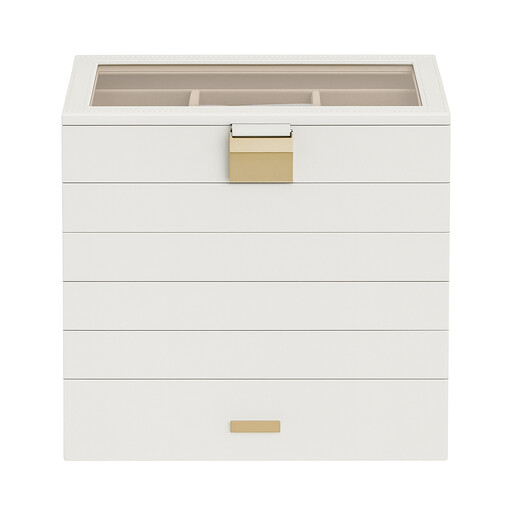
Why this choice suits this profile: This format is ideal for those who want to display and separate their jewellery, glasses or watches on a dressing table, in a drawer or in a wardrobe.
The six trays let you separate different categories, and the glass lid gives you an immediate overview. Check the dimensions of 17 x 28 x 25.3 cm before finding it a home.
Six stackable tiers, velvet lining, transparent lid and MDF and PU construction. The manufacturer recommends keeping the box away from humidity and direct light.
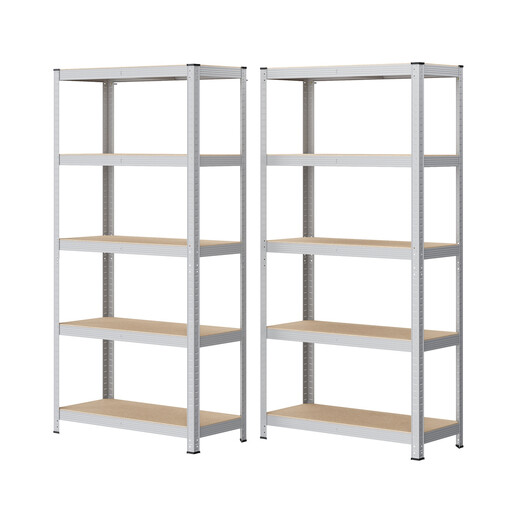
Why this choice suits this profile: This solution is designed for the garage, workshop or storage area, where tools, seasonal equipment and boxes need a robust structure.
The stated load reaches 175 kg per shelf and 875 kg total, under static load. For safe use, wall fixing using the anti-tip kits remains essential.
Two five-tier units, adjustable shelves, steel frame with coating and dimensions of 40 x 90 x 180 cm per unit.
We've put together a comprehensive selection, updated in real time, of products that meet these strict criteria as well as European safety regulations.
Measure the available depth, then choose vertical modules or front-opening boxes. Stacking lets you make use of the height, but stability must remain a priority, especially in a walkway.
The lifespan depends on the material, the weight stored, how often they're handled and exposure to humidity or sunlight. Clean the surfaces with a mild product, avoid overloading the boxes and replace any cracked or warped items.
They generally don't need any power supply. The main expenses are for installation, fixing accessories and routine maintenance. Always respect the stated maximum load and the manufacturer's assembly instructions.