
Livraison le jour même ou le lendemain

Qualité garantie

Débloquez vos offres de bienvenue: Livraison GRATUITE | Jusqu'à -80 % | 30 jours d'essai gratuits à JoyPlus
Téléchargez l'application
A cluttered home doesn’t necessarily need extra furniture. More often than not, the problem comes down to the wrong size, an unsuitable material, or an accessory that isn’t practical for everyday use. Home storage solutions should therefore be chosen based on the space you have available, the items you need to store, and how often you use them.
Before you give in to the temptation of vacuum storage bags, foldable boxes or baskets, here are the most common mistakes to avoid.
A large volume doesn’t guarantee a product will fit in your wardrobe. Once full, an XXL bag can become difficult to move, while a box that’s too deep might not fit on a shelf.
Always check the external dimensions, not just the capacity in litres. In a dressing room, measure the width, depth and height that are actually available.
Vacuum bags are particularly well suited to duvets, coats, pillows and seasonal textiles. However, they are less practical for clothes you wear regularly: you have to open the bag, take out what you need, then compress it again.
For everyday clothing, a drawer organiser, a foldable box or an easily accessible basket will usually be more suitable.
A fabric basket that can’t withstand moisture has no place in a poorly ventilated utility room. Similarly, a cover that’s too short risks leaving coats or dresses poking out.
Check the material, the cleaning instructions and any usage restrictions. A cardboard structure, for example, must be kept away from prolonged damp and cannot be machine washed.
For a narrow shelf, it’s best to go for a compact model. A box measuring 42 × 36 × 16.5 cm can work in a wardrobe or under a bed. A basket measuring 56 × 36 × 16.5 cm is better suited to bulky laundry, toys or accessories.
To make the most of your space, allow a few extra centimetres. That way, you can remove the container without having to move everything around it.
Oxford fabric combined with a cardboard structure helps the storage item keep its shape, while still allowing you to fold it away when not in use. Bamboo gives small storage items a natural finish, but it should be cleaned with a dry or barely damp cloth, and never submerged.
Compression bags made from nylon and polyethylene, or PE/PET, must be kept away from sharp objects. After compression, check that the seal, valve and cap are properly positioned.
A vacuum bag that works with a vacuum cleaner fitted with a hose is not used in the same way as a roll-up bag. The former is better suited to seasonal storage at home. The latter is very handy in a cabin suitcase, a rucksack or when travelling, as it requires neither a pump nor a vacuum cleaner.
For hanging clothes, choose a cover that matches their length: 60 × 100 cm for jackets and short dresses, or 60 × 137 cm for coats, trousers and long dresses.
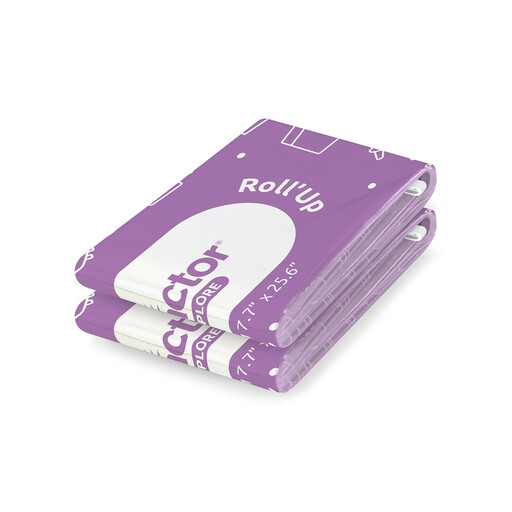
Why this choice suits this profile: This pack of two size M bags is perfect for trying out compression or storing clothes without investing in an extra pump or vacuum cleaner.
The bag compresses simply by rolling it, with no equipment needed. Its size of 45 × 85 cm also reduces the risk of choosing a container that’s too bulky.
A pack of 2 bags, a size suitable for suitcases and travel bags, 55-micron PE/PET material and reusable as stated on the product page.
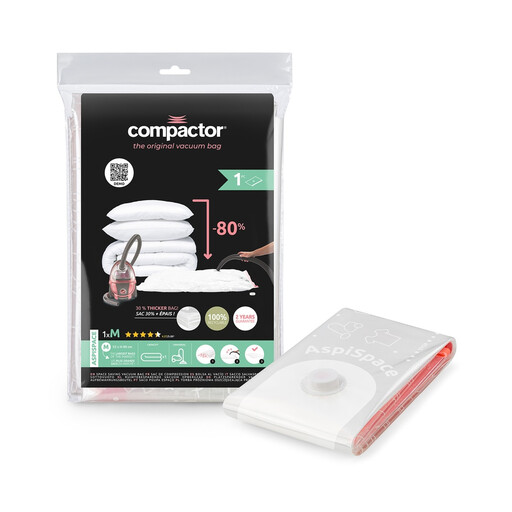
Why this choice suits this profile: This model is for those who want to easily see the contents, benefit from a secure seal and have a bag designed to be reused.
The material, stated to be 30% thicker than standard models, and the zip closure are based on concrete features rather than a vague promise.
A size M of 90 × 55 cm, a stated capacity of 70 l, a valve compatible with a vacuum cleaner and a 2-year warranty as stated by the manufacturer.
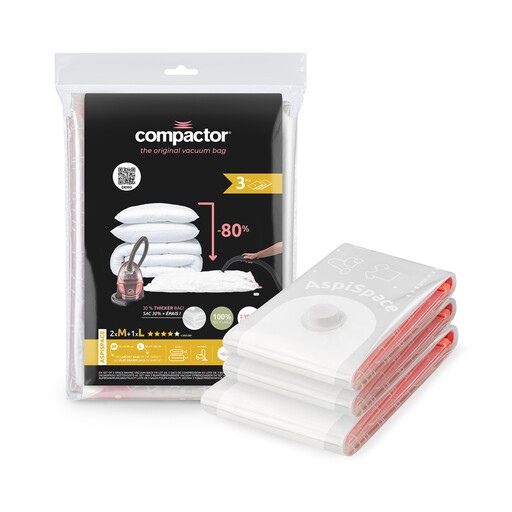
Why this choice suits this profile: Households that alternate between linen, duvets and seasonal clothes benefit from three complementary sizes to sort items without mixing everything together.
The two sizes prevent overloading a single bag. The transparency also lets you quickly identify the contents without opening each storage item.
A pack comprising 2 size M bags and 1 size L bag, stated recyclable PE/PET material, a valve compatible with a standard vacuum cleaner and an airtight seal.
We’ve put together a comprehensive, real-time updated list of products that meet these demanding selection criteria while complying with European safety regulations.
Start by separating clothes you wear regularly from seasonal items. Use a drawer organiser for underwear and accessories, covers for hanging clothes, and vacuum bags for duvets or coats you rarely use. Remember to label opaque containers so you can find your belongings without having to open them all.
They are mainly suitable for soft, bulky textiles. Avoid filling them to the brim and keep them away from sharp objects. Before long-term compression, check the care label on your clothes. Then store the bags in a dry place, away from direct heat sources.
The cost mainly depends on whether you have a compatible vacuum cleaner and whether the bag can be reused. Roll-up models work without any equipment, while valve models need a vacuum cleaner with a hose or a suitable pump. After each use, also check the condition of the seal to avoid having to replace the bag prematurely.