
Livraison le jour même ou le lendemain

Qualité garantie

Débloquez vos offres de bienvenue: Livraison GRATUITE | Jusqu'à -80 % | 30 jours d'essai gratuits à JoyPlus
Téléchargez l'application
Vacuum storage bags can significantly reduce the volume of clothes, duvets and blankets before you store them in a wardrobe, under a bed or in a moving box. But not all models are created equal. A leaky seal, a bag that’s too small or an incompatible pump can quickly turn a good idea into a wasted purchase.
Before you compare the options, here are the main pitfalls to avoid.
Product listings sometimes promise a volume reduction of “up to 75% or 80%”. In practice, the result depends on the fabric, its thickness, how it’s folded and how effectively the air is removed. A very fluffy duvet compresses more than an item of clothing that’s already compact.
It’s best to check the bag’s dimensions, the type of valve and its actual capacity rather than relying on a promotional figure.
A large bag is ideal for duvets and blankets, but isn’t very practical for storing seasonal clothes. Smaller vacuum bags let you separate outfits, household linen or travel essentials. A range of sizes also makes it easier to organise belongings in spaces of different dimensions.
A valve that’s incompatible with your vacuum cleaner or a poorly secured seal can let air back in. If you’ll be using the bags regularly, check for a sliding zip, an anti-leak valve and, if needed, a pump included in the pack. Vacuum storage bags with a pump are especially convenient if you don’t want to use your household vacuum cleaner.
Compression bags are generally made from PA and PE, two materials that create a flexible, airtight cover. For seasonal use, look for a design described as tear-resistant. However, avoid putting sharp objects, hangers or unprotected shoes inside.
Transparency is also a real everyday advantage: you can see what’s inside at a glance, without having to open each bag.
Choose dimensions to suit the textiles you want to store. As a guide:
To save space in your wardrobe, it’s better to divide the contents between several bags rather than overfill a single one.
Make sure the seal is fully closed before you start removing the air. Once the bag is compressed, check that it stays flat for a few minutes. To help it last longer, wipe the outside with a slightly damp cloth, leave it to dry completely, then store it away from heat and sharp objects.
Vacuum bags for bedding can help limit exposure to dust and moisture, but they’re no substitute for clean textiles and thorough drying. Never store a duvet while it’s still damp.
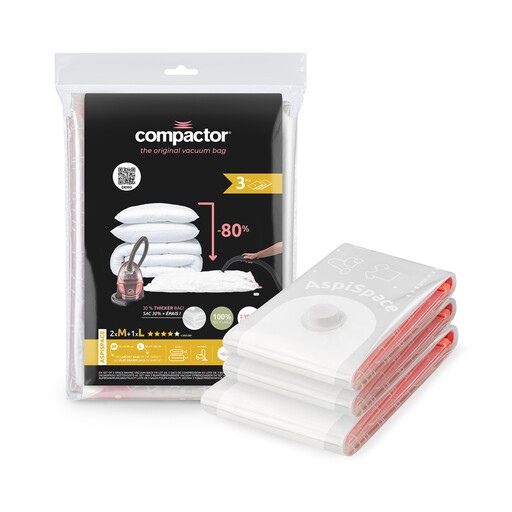
Why it’s a good fit for this type of user: this pack lets you get started with several sizes without investing in a bulky assortment. It works with a vacuum cleaner fitted with a hose.
The two sizes reduce the risk of using a bag that’s too large or too small for its contents. The zip and valve are designed for vacuum sealing with a compatible vacuum cleaner.
Pack of 2 size M bags and 1 size L bag, made from nylon and polyethylene, and designed for repeated use.
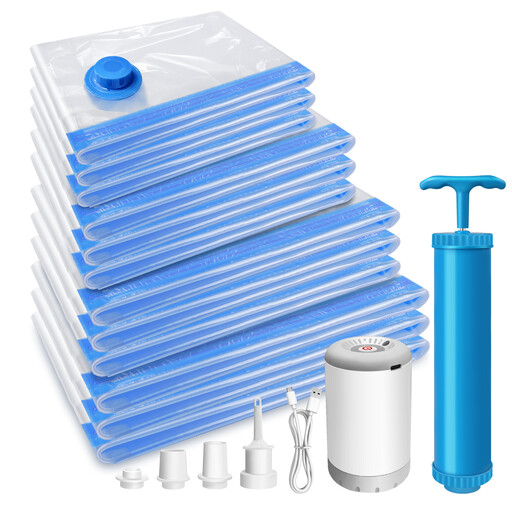
Why it’s a good fit for this type of user: this set is ideal if you want a complete solution for your wardrobe, bedding, travel or a house move.
The electric pump, with a hand pump also included, means you don’t have to rely on a household vacuum cleaner. Four sizes let you choose the right bag for each type of textile.
12 bags ranging from 60 × 40 to 70 × 100 cm, a Li-Ion pump, a hand pump, a valve advertised as having triple-seal protection and PA+PE material.
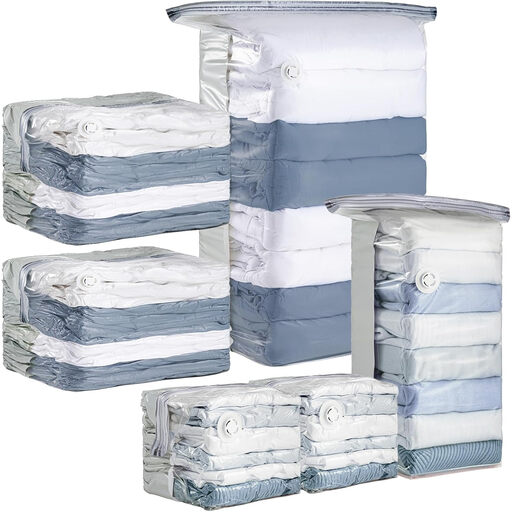
Why they’re a good fit for this type of user: their cube-shaped design suits families, house moves and anyone storing several duvets or blankets.
The wider base makes the bags easier to fill and close using the slider. Their self-supporting shape makes them easier to handle than a very large, flexible storage bag.
Set of 6 cube-shaped bags, double-zip closure, valve compatible with a standard vacuum cleaner and advertised capacity for several bedding items.
We’ve put together a comprehensive list, updated in real time, of products that meet these strict selection criteria and comply with European safety regulations.
Reusable vacuum storage bags aren’t designed for food unless the manufacturer explicitly says otherwise. Keep them out of children’s reach too, as several models carry a warning about the risk of suffocation.
It depends on the fabric, its condition when stored and how airtight the bag is. For both clothes and bedding, open the bags regularly to air out the contents. While you’re at it, check for any signs of damp or unusual odours.
No. Some models have a universal valve, while others need a specific pump or the one supplied in the pack. Before buying, check the diameter and type of connector, especially if you use a stick vacuum cleaner.
An airtight seal can help limit exposure to dust and moisture in the air. However, it won’t dry out a textile that was damp to begin with, and it’s no substitute for storage in a dry room. For lasting protection against moisture and dust, check the condition of the bag after each use.