
Livraison le jour même ou le lendemain

Qualité garantie

Débloquez vos offres de bienvenue: Livraison GRATUITE | Jusqu'à -80 % | 30 jours d'essai gratuits à JoyPlus
Téléchargez l'application
A well-organised home is not determined solely by the number of pieces of furniture available. To choose the right home storage organiser, you must first consider the space that can actually be used, the weight of the items and how often you need them. A box that is too deep quickly becomes awkward to handle, while a poorly sized basket may prevent a cupboard or drawer from closing properly.
To help you avoid purchases that end up forgotten at the back of a cupboard, here are the main pitfalls to avoid, the criteria to check and the solutions best suited to each use.
A storage box may appear spacious on paper, but reinforcement bars, handles or thick walls can significantly reduce its internal capacity. Before ordering, measure the width, depth and height of the intended space. Also leave a little clearance so you can easily grip and remove the container.
In a drawer or kitchen cabinet, remember to account for internal obstacles such as hinges, runners, pipes or skirting boards. A pull-out basket should be able to slide out fully without catching on the door or the back of the cabinet.
A stackable box is not necessarily designed to support a substantial load. Its stability depends in particular on the strength of the base, the shape of the lid and how the weight is distributed. Heavy items should be placed in the containers at the bottom, and boxes should never be overloaded.
For plastic models, look for tangible features such as a non-slip base, reinforcing ribs or a lid that closes securely. These details are far more informative than a simple promise of “large capacity”.
Closed storage protects effectively against dust, but it is less convenient for items used several times a day. Conversely, an open organiser lets you reach what you need quickly, at the cost of more frequent cleaning.
In a bathroom, avoid materials that do not tolerate prolonged exposure to moisture. For a desk or dressing table, a bamboo organiser adds a warm, natural touch, provided you wipe it with a slightly damp cloth and never leave it soaking.
Start by measuring the available space, then group items by category:
A space-saving storage solution often makes better use of vertical space than floor area. Stackable lidded boxes fit easily in a cupboard, garage or on a balcony, while pull-out bins are particularly practical in base cabinets.
Polypropylene is easy to clean and suitable for a wide range of household uses. Bamboo appeals with its natural appearance, but should be kept away from persistent moisture and sources of heat. Enameled steel can be suitable for a pull-out basket, provided you respect the stated load limit and regularly check that it remains securely fixed.
Do not choose a material based on appearance alone. Check the care instructions, manufacturer warnings and stated maximum load.
A drawer with too many compartments can quickly run out of space for bulky utensils. A pull-out basket should glide smoothly and remain stable when loaded. With a stacked box, the handles should allow you to move it without excessive force.
If young children live in the home, keep small parts out of their reach. Also respect the load limits and warnings relating to flames, heat or prolonged exposure to sunlight.
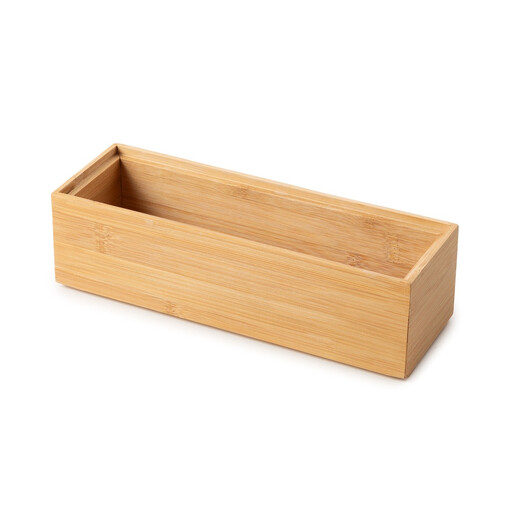
Why this model suits this profile: its compact format is ideal for a desk, dressing table or shelf, bringing small items together without requiring installation.
Its stated dimensions of 22.5 × 7.5 × 6.5 cm make it easy to check how much space it will occupy before purchase. No assembly is required.
Bamboo construction, a natural finish and quick cleaning with a dry or slightly damp cloth.
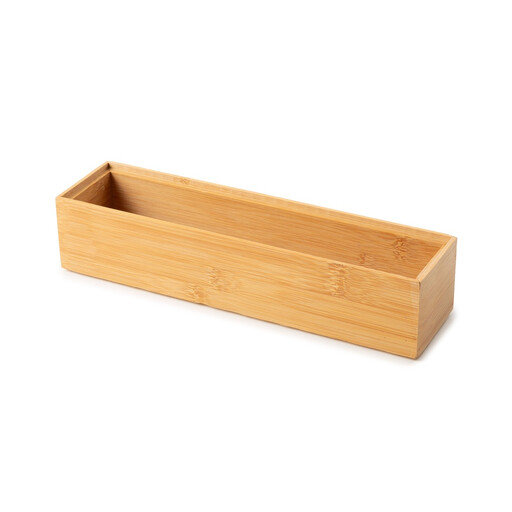
Why this model suits this profile: its generous length makes it easy to organise accessories on a worktop, shelf or dressing table.
The 30 × 7.5 × 6.35 cm format is clearly specified. It is more practical than several small containers if you want to keep your items together.
No assembly required, with a bamboo finish that can be cleaned using very little water.
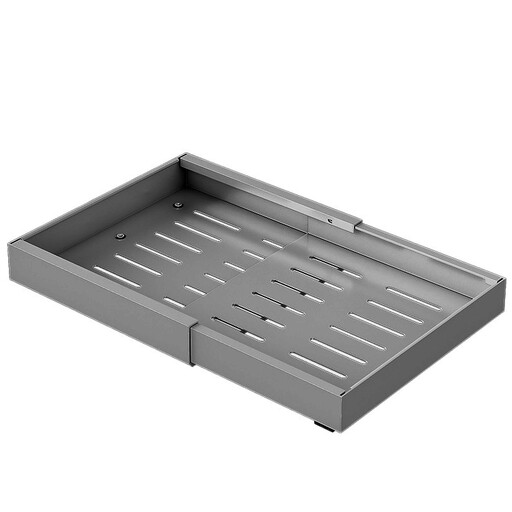
Why this model suits this profile: its no-drill installation is ideal for renters who want to optimise a kitchen cabinet without modifying it.
Its length adjusts from 42 to 68 cm. Nevertheless, measure the cabinet and check the stability of the runners before loading it.
An enamelled carbon-steel structure, smooth sliding action and a stated maximum load of 33 pounds, or approximately 15 kg.

Why this model suits this profile: its generous dimensions are suitable for seasonal clothing, baby items, supplies or belongings stored in a garage or on a balcony.
The clip-on lid and flat top make stacking easier. However, avoid heat, prolonged sunlight and excessive loads.
A stated size of 50.4 × 37.6 × 28.8 cm, integrated handles and 2.5 mm reinforced PP walls.
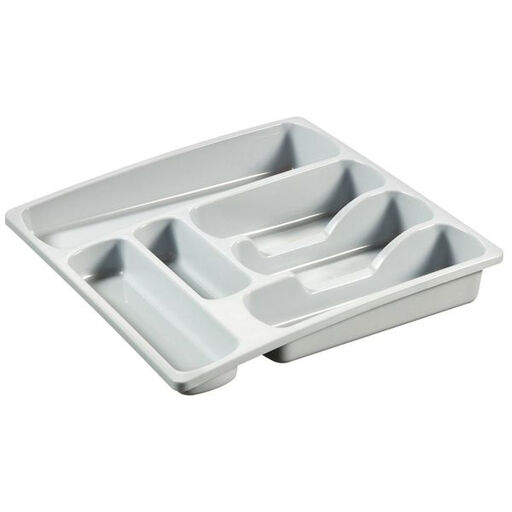
Why this model suits this profile: its fixed compartments make it easy to sort cutlery in a sufficiently wide kitchen drawer.
Compare its dimensions of 39 × 38 × 6.5 cm with those of the drawer. The stated maximum load is 2.5 kg, to be distributed evenly.
Easy-to-clean polypropylene, with no wall mounting or assembly required.
Explore a regularly updated selection of storage solutions for organising your drawers and kitchen cabinets, based on their dimensions and your habits.
Measure the usable width, depth and height inside the drawer, without taking the external handles into account. For a cutlery organiser, also check that the drawer can still close once the accessory is installed.
It may be suitable for temporary or moderate storage, but always consult the manufacturer’s warnings. Avoid prolonged exposure to sunlight, high temperatures and persistent moisture. For textiles and sensitive items, good ventilation remains preferable.
Respect the maximum load, distribute the weight evenly and avoid pulling sharply on pull-out baskets. Clean surfaces with the recommended products, dry bamboo promptly and regularly inspect the runners, lids and walls if the storage solution is used frequently.