
Livraison le jour même ou le lendemain

Qualité garantie

Débloquez vos offres de bienvenue: Livraison GRATUITE | Jusqu'à -80 % | 30 jours d'essai gratuits à JoyPlus
Téléchargez l'application
A home rowing machine lets you work on your cardio, strengthen your muscles and enjoy equipment that is relatively easy to store. However, some purchases end badly: a machine that is too noisy for a flat, a rail that is too short for taller users or resistance that lacks progression after a few weeks.
Before comparing prices, it is therefore better to look at the design, usage limits and features that offer genuine benefits. Here are the criteria to consider when choosing a foldable, quiet or connected rowing machine without being swayed by marketing claims alone.
A magnetic rowing machine is generally mechanically quieter than a model with air or water resistance. That does not mean it is inaudible, however: the seat moving along the rail, the footrests and vibrations can all be heard, particularly on a hard floor.
In a flat, examine the type of resistance, the stability of the frame and whether it has wheels or feet. A protective mat can also reduce the transmission of vibrations to the floor and your neighbours.
An adjustable-resistance rowing machine may advertise 10, 14 or 16 levels. This figure alone is not enough to judge how smoothly the effort progresses. You should also consider the mechanism used:
The value given in kilograms or newtons should be viewed as technical data specific to the system, not as a direct measure of the difficulty felt by every user.
A machine may be compact when folded but become much more cumbersome when fully extended. Users measuring around 1.85 m or more should check the usable rail length and the available leg extension.
The maximum user weight is also an essential safety consideration. It must never be exceeded. If the machine will be used by several people, allow a reasonable margin above the heaviest user’s weight and install the rowing machine on a flat, stable surface.
For regular use, choose a system that provides a smooth transition between the different levels. A magnetic rowing machine is often suitable for home workouts when low noise is a priority. An air-resistance model is better suited to demanding training sessions, but you will need to accept noisier operation.
The seat should move smoothly without jolts and offer sufficient width. Adjustable footrests with straps improve stability, while a reinforced rail can be useful for taller users or frequent sessions.
Measure the available space when the rowing machine is fully open, then allow room for vertical or horizontal storage. In particular, check:
Even when foldable, a rowing machine remains bulky equipment. Compare the stated dimensions with those of the room where you plan to install it, leaving enough space around the seat and handles.
A connected rowing machine can display time, distance, stroke rate, calories burned or power. Bluetooth connectivity can sometimes synchronise this data with an app. Before placing your order, check whether the app is free, whether certain features are reserved for subscribers and whether your smartphone or tablet is compatible.
An app cannot compensate for poorly designed resistance. For straightforward use, a clear LCD display may be more than sufficient. Those who enjoy guided workouts can opt for a model equipped with an app and a tablet holder.
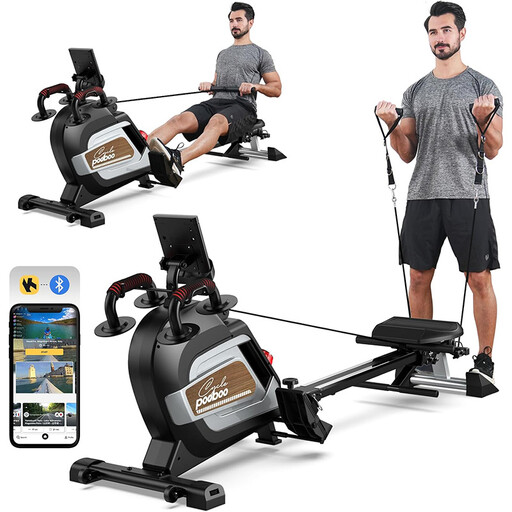
Why this choice suits this profile : Its 14 magnetic resistance levels, LCD display and tablet holder make it easy to get started gradually without having to manage numerous settings.
Magnetic resistance reduces mechanical noise, while the foldable frame addresses a common constraint in French homes.
14 adjustable levels, advertised 360 lb capacity, LCD display, tablet holder and foldable design.
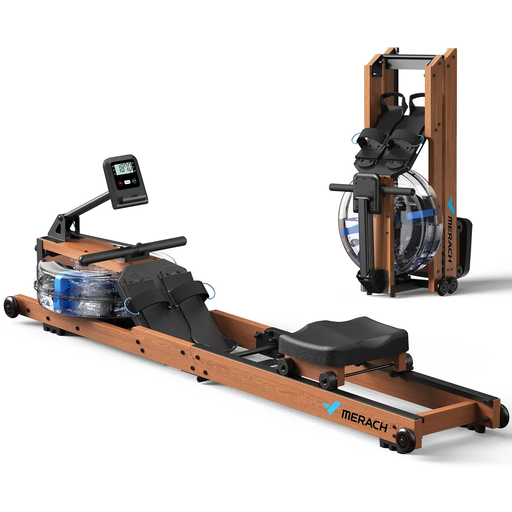
Why this choice suits this profile : Its wooden frame, water tank and compatibility with the MERACH app will appeal to those looking for equipment that is as stylish as it is immersive.
The water tank requires regular maintenance and checks. This is a consideration to plan for, unlike magnetic systems, which do not require filling.
180° folding, transport wheels, Bluetooth connectivity and an advertised capacity of up to 181 kg.
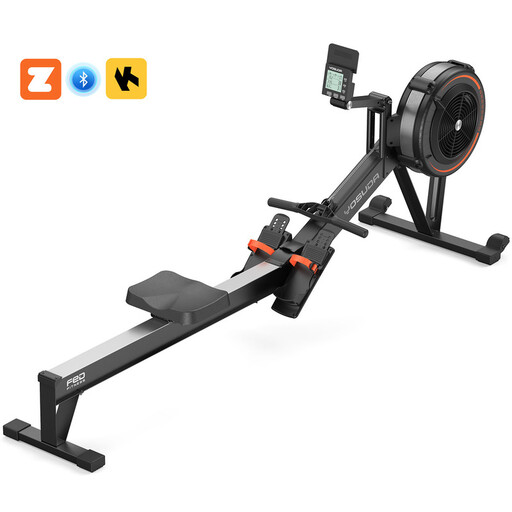
Why this choice suits this profile : Its long aluminium rail, dynamic air resistance and advertised 158 kg capacity make it suitable for frequent sessions and users looking for a wide range of motion.
The extended rail reduces the risk of a restricted range of motion. Air resistance adapts to your stroke rate, but it will be more audible than a magnetic rowing machine.
10 air-resistance levels, backlit display, Bluetooth, adjustable tablet holder and advertised vertical folding without disassembly.
After purchase, the running costs of a home rowing machine generally remain limited. Magnetic- or air-resistance models do not use water, although some displays run on batteries. A water-resistance model, on the other hand, requires you to monitor the tank, seals and water level.
To extend the machine’s lifespan, wipe the rail and frame after every session, check the screws regularly and inspect the seat wheels. Always observe the maximum user weight specified by the manufacturer. If you experience pain, dizziness or discomfort, stop exercising and seek medical advice before starting again.
We have compiled a complete, real-time updated list of products that fully meet these strict selection criteria and European safety regulations.
A magnetic rowing machine is often the most suitable choice when low noise and smooth movement are priorities. Nevertheless, check the machine’s dimensions when fully open, the noise made by the seat and its stability on your floor. A protective mat can complete the setup.
This depends on how often it is used, the weight it supports, maintenance and the quality of its components. Regularly checking the screws, rail, wheels and straps helps limit premature wear. Store the machine in a dry place and follow the assembly instructions.
No. An app can offer programmes, performance tracking or guided workouts, but it is not necessary to use the machine. If you choose a connected rowing machine, check Bluetooth compatibility, which features are genuinely available and whether any associated subscriptions apply.