
Livraison le jour même ou le lendemain

Qualité garantie

Débloquez vos offres de bienvenue: Livraison GRATUITE | Jusqu'à -80 % | 30 jours d'essai gratuits à JoyPlus
Téléchargez l'application
Who hasn't dreamed of a perfectly tidy and functional home? Yet, the quest for perfect home organisation is often fraught with pitfalls. Between impulse buys and poorly designed products, a once-promising investment can quickly turn into a nightmare, adding only frustration and clutter.
As a Product Specialist at Joybuy, I test and analyse hundreds of items. My role is to help you navigate the options. This article breaks down the common mistakes to avoid and gives you concrete criteria for choosing storage solutions that finally meet your needs.
Before you rush into buying the first storage accessory you see, learn to spot the design flaws that make so many products ineffective in the long run.
To ensure you make the right choice, focus on a few technical features that make all the difference.
The type of plastic is the primary indicator of durability. Polypropylene (PP) is often the best choice for its robustness, resistance to wear, and light weight. For a plastic storage box intended to hold heavy loads, check the wall thickness (2.5?mm is a good benchmark) and look for reinforcements like ribs or consolidated corners, which significantly increase sturdiness. For kitchen storage, insist on containers that are certified BPA-free and food-safe.
A good decluttering solution must leverage every square centimetre. Prioritise products designed to stack securely. Look for flat lids with raised edges or box bases with non-slip grooves. For wardrobe storage or shoe collections, a stackable shoe organiser with a transparent front door is a must-have: it allows you to see and grab a pair without having to unstack everything.
Before making any purchase, take out your tape measure and measure the available space (shelves, cupboards, under the bed). Opt for systems that offer different, compatible sizes. This will allow you to create a custom configuration, whether for a small cupboard or a large garage, and adapt your organisation over time.
Here are a few options that cater to distinct user profiles, taking into account our criteria for quality and functionality.
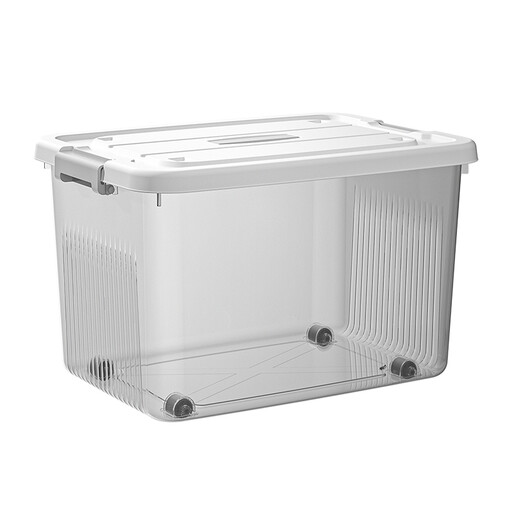
Why we chose it: Ideal for those who need a robust solution for seasonal storage, toys, archives, or garage items. Its transparency allows you to identify the contents at a glance.
Its structure, made of 2.5 mm thick polypropylene (PP), and its reinforcing ribs prevent cracks and warping. The flat lid and non-slip base ensure secure stacking, overcoming the pitfall of non-functional design.
A design engineered for load-bearing and durability, with ergonomic integrated handles that make transport easy, even when the box is packed to the brim.
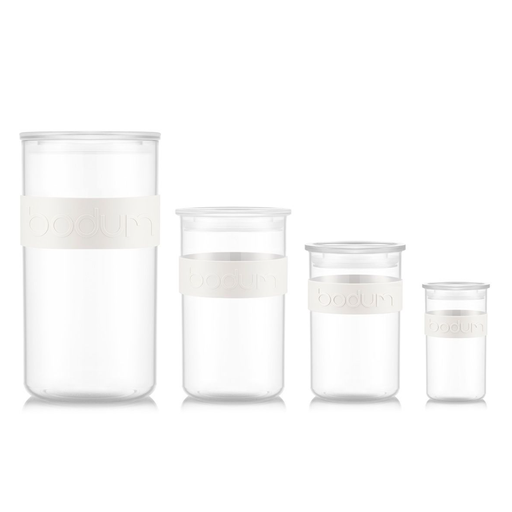
Why we chose it: Perfect for those who want a pristine pantry. This comprehensive set allows you to store pasta, cereal, flour, and other dry goods while preserving their freshness.
This set directly tackles the pitfall of unsuitability. Made from BPA-free plastic, its airtight seal protects food from air and moisture. The assortment of 4 different sizes puts an end to the "one-size-fits-all" approach.
A complete and aesthetically pleasing system that creates a cohesive and stackable kitchen storage solution, optimising space in your cupboards.
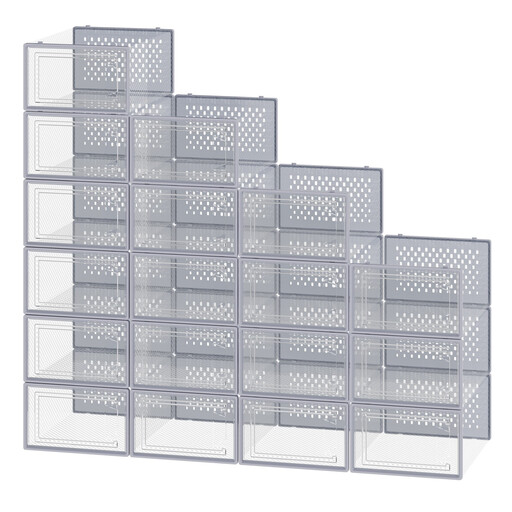
Why we chose it: Designed for sneaker and shoe fans who want to protect their collection while keeping it visible and accessible. No more collapsing piles of cardboard boxes!
The transparent front door solves the accessibility problem of classic boxes. Its stable, stackable design is the perfect answer to the lack of modularity, allowing you to create a true storage wall worthy of a showroom.
This stackable shoe organiser transforms a simple pile of shoes into a neat display, while ensuring proper ventilation to preserve their condition.
To explore further, discover our complete selection of products that meet our criteria for functionality and durability.
Start by measuring the destination space (height, width, depth of your shelf or cupboard). Then, estimate the volume of the items you need to store. Bulky items like duvets or winter coats require large boxes. For smaller items, opt for organisers with compartments or smaller boxes to avoid mixing everything up.
Yes, this is a risk, especially with prolonged exposure to the sun's UV rays. The quality of the plastic is crucial: a good polypropylene (PP) will be much more stable and resistant to yellowing than a low-end plastic. The best advice is to store your boxes away from direct light, whether in a cupboard, garage, or cellar.
That's a very bad idea. The interlocking systems, grooves, and lid dimensions are unique to each manufacturer to ensure perfect stability. Mixing incompatible boxes is a recipe for an unstable and dangerous stack—the exact opposite of successful space optimisation. For safe and effective stacking, stick to a single product range.