
Livraison le jour même ou le lendemain

Qualité garantie

Débloquez vos offres de bienvenue: Livraison GRATUITE | Jusqu'à -80 % | 30 jours d'essai gratuits à JoyPlus
Téléchargez l'application
With remote work becoming the norm, a desk is no longer just a piece of furniture: it's the heart of our professional workspace. But let's face it, finding the perfect home office desk can often be an uphill battle. It's easy to be tempted by a stylish photo, only to end up with a wobbly, impractical piece of furniture. To help you make the right choice, let's review the classic mistakes to avoid.
A poorly chosen desk can quickly become a daily nightmare. Here are the three most common mistakes that can sabotage your comfort and productivity.
To avoid these disappointments, here are the technical points you absolutely must check.
The durability and stability of your desk depend on its frame. A non-negotiable criterion: a sturdy steel frame. Paired with thick particleboard panels (usually 15 mm or more), it ensures the desk won't budge, even when loaded with multiple monitors and peripherals. Adjustable feet are also a real plus for compensating for minor floor irregularities. This type of construction is often the hallmark of an industrial design desk, blending aesthetics with strength.
Your desk should adapt to you, not the other way around. If you spend long hours sitting, the option of a sit-stand desk is seriously worth considering. An electric desk allows you to switch postures effortlessly with the simple press of a button. Models with a height memory function are an absolute comfort, allowing you to return to your favourite settings instantly. It's a direct investment in your daily well-being.
The available space is a decisive factor. For smaller rooms or unused corners, a corner desk (or L-shaped desk) is a clever solution. It maximises the work surface without encroaching on your living space. Also, consider modularity: reversible or removable shelves offer the flexibility you need to evolve your computer desk over time.
Our editorial team has analysed dozens of models to bring you a selection that meets strict quality and functionality criteria, no matter your profile. Here are a few options that caught our eye.
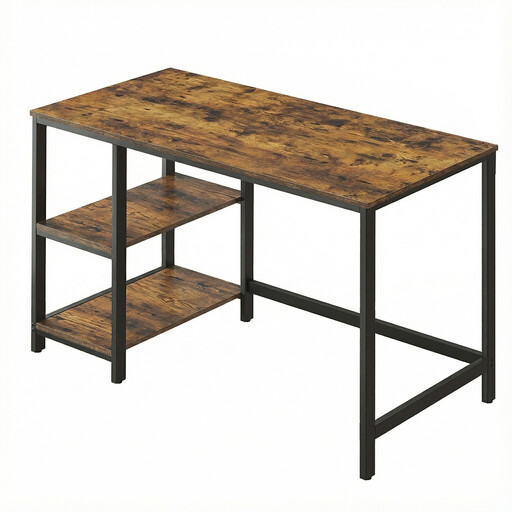
Who is it for? Perfect for students or anyone needing to set up an office on a budget. Its surface is large enough for a laptop and an external monitor, all in a compact format.
Its steel frame ensures rock-solid stability, while the adjustable feet compensate for uneven floors. Bonus: the 2 shelves are reversible (left/right) to fit your room's layout.
Its versatile industrial look and ultra-simple assembly make it a reliable choice to get started.
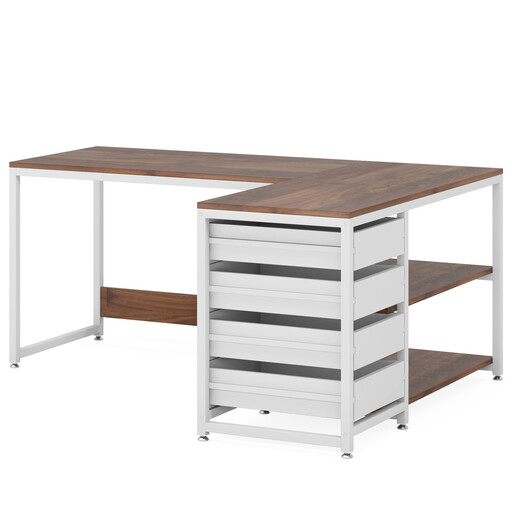
Who is it for? The perfect solution for utilising a neglected corner and maximising surface area. Ideal for those who juggle multiple tasks and need storage within arm's reach.
No more storage headaches: with 4 drawers and 2 shelves, everything has its place. Its L-shaped structure, reinforced by a metal frame, guarantees perfect stability along its entire length.
Its greatest strength: it's fully reversible. The storage unit can be assembled on the left or right, giving you complete freedom to arrange your space.
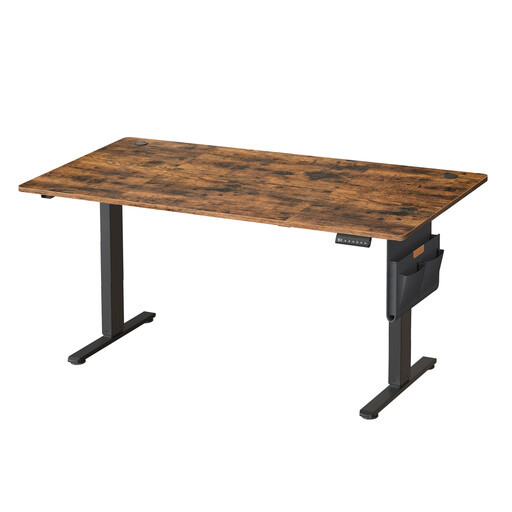
Who is it for? Essential for dedicated remote workers (6+ hours/day). Alternating between sitting and standing is a game-changer and protects your back in the long run.
It checks all the boxes for ergonomics. Its silent motor ensures smooth transitions, and its reinforced steel frame guarantees impeccable stability, even at maximum height. No more wobbly desks!
The ultimate convenience: 4 memory presets to switch from sitting to standing at the touch of a button. The small details that make a big difference: cable grommets and a storage pouch for a consistently tidy setup.
Explore our complete selection of desks that meet our quality charter and current safety standards.
It all depends on the build quality. A model with a steel frame and a thick desktop will last for years, whereas a desk made entirely of particleboard will quickly show signs of wear. When well-maintained, a quality desk is an investment that can last you more than a decade.
For intensive use, the answer is a resounding yes. The benefit of a sit-stand desk is the ability to vary your posture without thinking about it. It's the best way to combat the negative effects of a sedentary lifestyle and reduce fatigue and pain at the end of the day. The memory function is the detail that changes everything: it removes the last barrier to daily use.
First step: get out your tape measure. Measure the available floor space, and don't forget to leave enough room for your chair to move back. Next, take inventory of your setup: one or two monitors? A laptop as well? Documents? A lamp? A desktop width of 120 cm is a good minimum to be comfortable with one monitor. For a multi-monitor or more complex setup, aim for 160 cm or more to avoid feeling cramped.