
Livraison le jour même ou le lendemain

Qualité garantie

Débloquez vos offres de bienvenue: Livraison GRATUITE | Jusqu'à -80 % | 30 jours d'essai gratuits à JoyPlus
Téléchargez l'application
Setting up a home gym sounds simple enough… until a bulky, unstable or fiddly piece of equipment arrives. A home multi-gym station should let you vary your exercises without turning the room into an obstacle course. Before comparing prices, it’s worth spotting the classic mistakes and focusing on the features that really matter.
A high maximum load is certainly appealing, but it’s not enough to judge a station. You also need to look at the base width, the frame design, the fixing points and the floor surface. A power tower poorly installed on an uneven floor can shift during pull-ups or dips, even if its spec sheet boasts an impressive capacity.
The stated load usually refers to the manufacturer’s usage limit. It doesn’t guarantee comfort or stability in every configuration. So, always set the equipment on a flat, clear floor that’s strong enough to support it.
A multi-gym tower may take up little floor space while standing much taller than a wardrobe. Models with a height of 94 or 99 inches reach around 2.39 or 2.51 metres. Leave some clearance above the pull-up bar – you’ll avoid hitting the ceiling and be able to grip the bar properly.
Also think about the route from delivery to the installation room: hallways, doorways, stairs and corners all need to be wide enough. A unit delivered in several parts is often easier to get inside than a pre-assembled model, but you’ll need to set aside time and space for assembly.
A Roman chair, a dip station, a pull-up bar and an adjustable bench already let you perform a wide variety of exercises. However, every extra function adds more joints, adjustments and points to check. If you mainly do pull-ups and bodyweight training, a simple structure can be more than enough. For dumbbells and bench press, an adjustable weight bench is often a more sensible choice.
Go for a frame described as made from alloy steel or reinforced steel, with easily accessible bolted connections. The product sheet should state the maximum load and the conditions of use. If you train regularly, periodically check the bolts, visible welds, pins and adjustment areas.
International spec sheets still often list loads in pounds. As a rough guide, 440 lb is about 200 kg and 480 lb is about 218 kg. These conversions make comparison easier, but the limit you must follow is the one given in the product manual.
An adjustable-height pull-up bar can suit several users and make exercises with bent knees easier. For dips, check the handle width and the height of the supports. A poorly suited position can quickly make the station uncomfortable and reduce how often you use it.
For a bench, look for several lockable positions: flat, incline and, if needed, decline. The mechanism should be simple to operate, but most importantly, it must lock fully before you load the bench. A foldable model is handy in a flat, as long as you check the lock every time you change position.
Before choosing a home gym machine, note its assembled dimensions, the space you need to move around it and the clearance around the equipment. A suitable mat or non-slip surface can reduce slipping and protect the floor, but it will never replace a stable installation.
Maintenance is fairly basic: wipe the frame with a dry cloth, check the fixings regularly and inspect the moving parts. During sessions, keep children and pets away from the equipment.
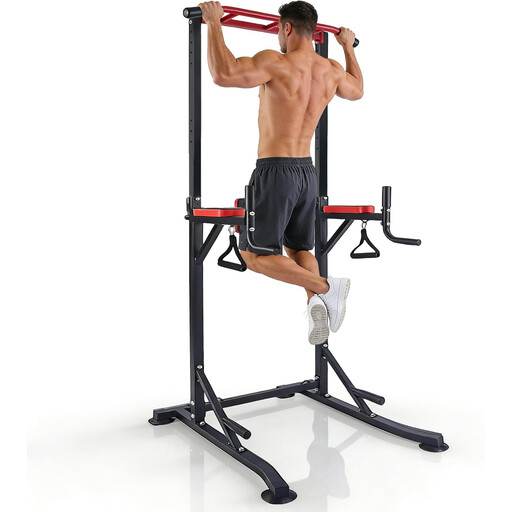
Why this choice suits this profile: this frame is ideal for a first setup dedicated to pull-ups and bodyweight training. The product listing also mentions two included resistance bands.
It stops you paying for a host of features you wouldn’t use if your priority is the pull-up bar and bodyweight exercises.
Multifunctional freestanding format and resistance accessories mentioned in the product name.
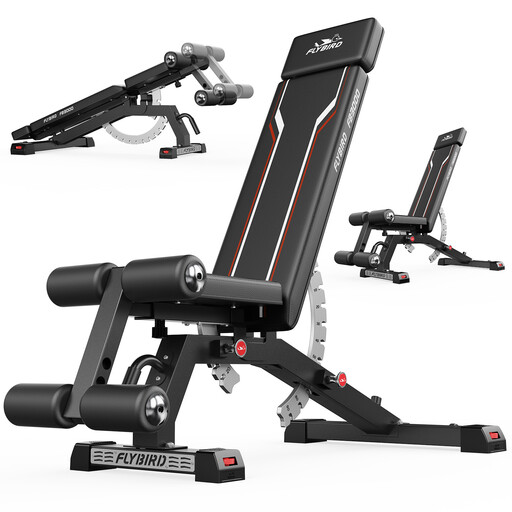
Why this choice suits this profile: its quick adjustments, multiple positions and foldable design are aimed at those who want to vary exercises with dumbbells or a barbell without taking over an entire room.
Its foldable format keeps the footprint small, while the adjustment mechanism saves you from fiddling between exercises.
Maximum load stated by the manufacturer as 544 kg, quick adjustment and assembly described as 80% pre-assembled.

Why this choice suits this profile: this station combines a pull-up bar, dip station and strengthening exercises in a frame described as alloy steel, designed for regular home workouts.
The adjustable height lets you adapt the station for different uses. However, installation on a flat floor and respecting the maximum load remain essential.
Stated dimensions of 106 × 106 × 239 cm and a maximum capacity indicated as 200 kg.

Why this choice suits this profile: combining a bench, a climbing-style grip pull-up bar and a dip station lets you group several exercises into a single piece of equipment.
It saves you from buying a pull-up tower and a bench separately. However, you must carefully check the available space and the various connections.
Integrated bench, adjustable height and a maximum load stated as 218 kg.
We’ve put together a full, real-time selection of products that meet these demanding criteria and European safety standards.
Allow for the floor area stated by the manufacturer, plus a clear zone around the handles and bar. Also check the ceiling height: a station over two metres tall needs a precise measurement, especially in a basement, mezzanine or attic room.
Not always. A pull-up station is mainly designed for pull-ups, dips and bodyweight exercises. An adjustable bench is better for presses, dumbbell work and incline positions. A model that combines a tower and bench can reduce the number of items you need, but it generally takes up more space.
A mechanical machine doesn’t use electricity. Your budget will mainly cover the purchase, a protective mat, any accessories and replacing worn parts. Regularly checking the fixings can also prevent repairs caused by poor installation or incorrect use.