
Livraison le jour même ou le lendemain

Qualité garantie

Débloquez vos offres de bienvenue: Livraison GRATUITE | Jusqu'à -80 % | 30 jours d'essai gratuits à JoyPlus
Téléchargez l'application
Styling your home isn’t just about picking a colour or a look. A vase that’s too light can tip over, a rug marketed as washable can turn out to be a hassle to maintain, and a narrow shelf can lose stability once it’s loaded up. To get your home interior decoration right, you need to strike the perfect balance between aesthetics, dimensions and everyday use.
Here are the main pitfalls to avoid, the criteria to check before you buy, and a selection of items suited to different lifestyles.
A photo can make a piece of furniture look as though it will fit easily into a large living room, when its actual dimensions are better suited to a hallway or a small study. Before you order, measure the available width, depth and height. Don’t forget to account for skirting boards, door swings and walkways.
For a tall piece of furniture, also check whether it can be fixed to the wall. A well-proportioned shelf that isn’t properly secured can topple over when loaded with books or nudged by a child or a pet.
Bohemian decoration, rustic, vintage or industrial styles often play with materials and finishes. A distressed look, however, doesn’t on its own tell you anything about the product’s durability. Examine the stated material, the weight, the maximum load and the care instructions.
An industrial storage unit made from particle board and steel can be perfectly fine for daily use, as long as you respect its static load capacity. For a bookcase, how you distribute the items matters just as much as their total weight.
In a home with a cat or a small dog, go for surfaces that are easy to wipe clean and fabrics described as scratch-resistant. Bear in mind, though, that this is a marketing claim, not a guarantee of indestructibility. As for vases, place them on a flat, stable surface, out of reach of pets.
For a rug, check whether it has a non-slip backing, its exact dimensions and the washing instructions. The term “washable” can mean machine-washable, hand-washable or simply spot-cleanable, depending on the model.
In a living room, leave enough space between the rug, the coffee table and the seating. An armchair measuring 66 × 69 × 76 cm can fit into a compact room, but you also need to consider the door swing and the space needed to walk around the furniture.
For a 6-tier bookcase shelf, compare the available width with the actual depth of the model. A depth of 30 cm works well for books and decorative objects, while a narrower format can be especially handy in a hallway or a corner.
Ceramic is great for decorative items, but it remains vulnerable to knocks. Product listings sometimes mention a matte finish, an irregular texture or an artisanal appearance. These details describe the visual effect and are not a certification of sturdiness.
For a bookcase, check the stated maximum static load. A model with a total capacity of 50 or 60 kg should be used by spreading the books across several shelves, without exceeding the stated limit.
A tall shelf must be secured with the anti-tip kit supplied, if the manufacturer provides one. Check that it is compatible with your wall and choose fixings suited to the wall type, especially in an older property.
For textiles, look at the composition, the pile height and the type of backing. Ceramic home accessories are generally best cleaned with a soft cloth and a mild soap rather than an abrasive sponge. In all cases, follow the manufacturer’s recommendations.
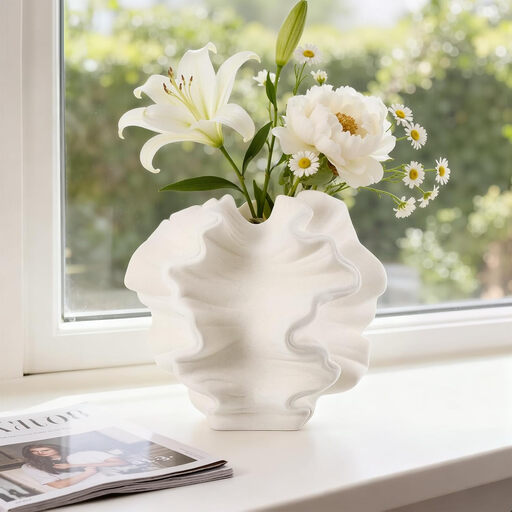
Why this choice suits this profile: This 17 cm decorative ceramic vase adds a bohemian or Scandinavian touch without requiring you to overhaul your entire décor. It can be placed on a coffee table, a console or a shelf.
Its stated height helps you plan where to put it. Place it on a flat surface and avoid areas where it might get knocked.
Matte beige ceramic, a wavy silhouette and the option to use it with dried branches or as a standalone decorative piece.
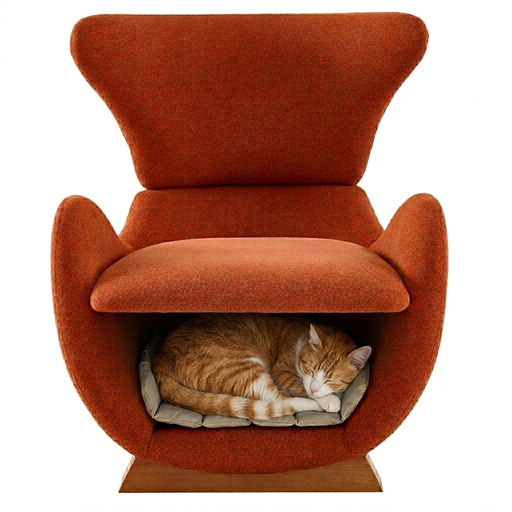
Why this choice suits this profile: With its brick-red colour, this armchair is aimed at those looking for a statement piece for their living room décor, while also offering a dedicated space for a cat or a small dog.
The space for your pet is built into the seat base, so you don’t need to add a separate basket in a small room. Do check its dimensions before ordering, though.
Frame stated as solid wood, high-density foam, fabric described as scratch-resistant and a stated maximum load of 150 kg.
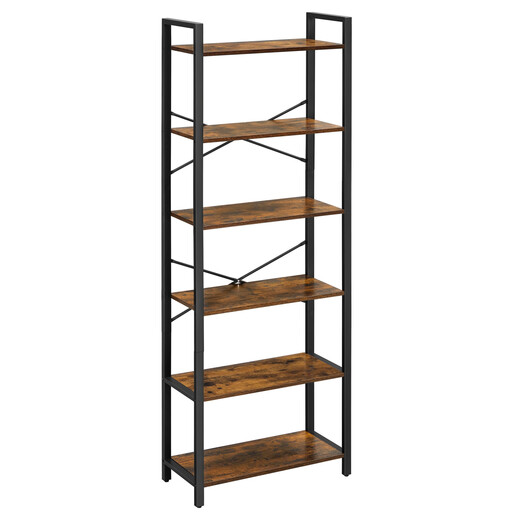
Why this choice suits this profile: With dimensions of 30 × 66 × 186 cm, this bookcase uses height to organise a study, living room or bedroom without taking up too much floor space.
The adjustable feet help compensate for uneven floors, while the X-brace and anti-tip kit improve stability. Wall fixing is still essential.
Six tiers, steel and particle board construction, with a stated total static load capacity of up to 60 kg.
We’ve put together a comprehensive, real-time updated list of products that meet these exacting criteria, while also taking European safety regulations into account.
Start with a neutral base, then add two or three different materials: ceramic, wood, natural fibres or printed textiles. A beige vase, a patterned rug or a few baskets are often enough to create a cohesive feel. Avoid piling objects onto surfaces so that the eye can move around the room comfortably.
First, measure the area you want to cover and check that the rug will fit under doors and furniture. Then look at the cleaning instructions, whether it has a non-slip backing and the product’s composition. For frequent use, a short-pile rug is generally easier to vacuum. Even when described as washable, the rug should be cared for according to the manufacturer’s guidelines.
A tall, shallow shelf gives you extra storage vertically. Compare its width with the available space, check its maximum load and plan to fix it to the wall. In a hallway, a narrow bookcase can hold books, boxes and home accessories without taking up too much room.